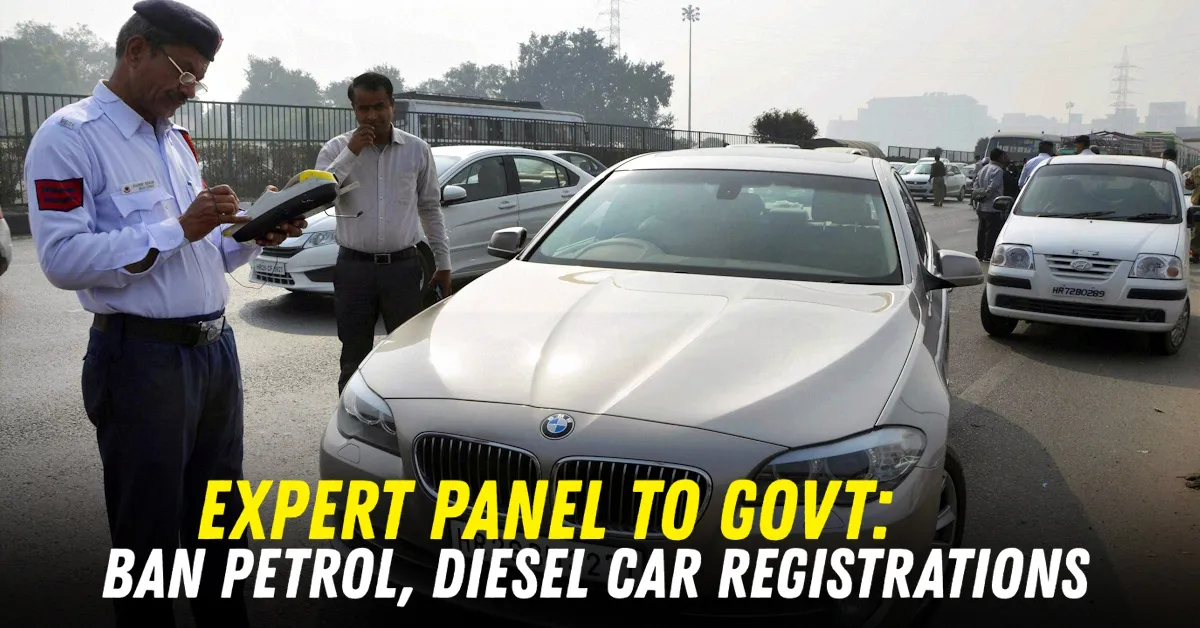
The pollution levels in the capital of our country, Delhi, have been increasing for a while now. And to make sure that they can be controlled in the coming years, recently, a 15-member expert committee constituted by the Commission for Air Quality Management (CAQM) has made a bold recommendation. It has stated that there is a need for a phased transition from petrol and diesel vehicles to zero-tailpipe-emission vehicles (electric cars, basically) across Delhi-NCR.

No New Car Registrations In 5 Years
The CAQM committee, in order to lower the emission levels in Delhi-NCR in the coming years, has recommended stopping the registration of new internal combustion engine (ICE) private four-wheelers in Delhi-NCR from January 1, 2031. It has also proposed that automakers selling private four-wheelers in the region will have to meet progressively higher targets for zero-tailpipe-emission vehicles.
These targets stand at 20 percent of new sales in 2027, 45 percent in 2028, 70 percent in 2029 and 100 percent in 2030. If implemented, this will push carmakers to offer only zero-tailpipe-emission private four-wheelers, which basically means electric cars, in the region by 2030.
The committee has proposed this long-term roadmap to reduce vehicular emissions. As per CAQM, vehicular emissions are among the major contributors to air pollution in the National Capital Region. However, these recommendations are yet to be approved and implemented by the authorities. So, whether the proposed ban will actually be enforced or not will be confirmed in the coming months.
Existing Petrol And Diesel Vehicles To Be Phased Out

Apart from restricting new registrations, the committee has also recommended a gradual phase-out of existing petrol and diesel vehicles. This phasing-out process will be based on their Bharat Stage (BS) emission standards. According to the proposed timeline, BS-I, BS-II and BS-III vehicles should exit Delhi-NCR immediately, while BS-IV vehicles should be phased out by 2030.
BS-VI two-wheelers would be phased out by 2035, and this would then be followed by BS-VI four-wheelers by 2040. The committee has recommended different timelines for older and newer vehicles because of their contribution to pollution. Now, although older vehicles would need to exit sooner, BS-VI vehicles would get more time to transition.
The recommendations also state that vehicles phased out from Delhi-NCR should not simply be transferred to other highly polluted cities. This has been stated because the authorities do not want to shift the problem instead of solving it.
Older Vehicles Contribute To A Major Share Of Pollution
According to the report, Delhi-NCR has around 2.21 crore active and fitness-approved vehicles. Of these, only 3.6 lakh are electric vehicles. This means EVs account for just 1.6 percent of the total fleet. The report also states that almost 57 percent of vehicles in the region comply with BS-IV emission standards or older norms.
The data provided by the Automotive Research Association of India (ARAI) has also highlighted the contribution of older vehicles to particulate matter emissions. BS-I to BS-III vehicles account for around 30 percent of the fleet but contribute nearly 74 percent of particulate matter emissions. BS-IV vehicles contribute an additional 19 percent.
Meanwhile, BS-VI vehicles make up over 41 percent of the fleet but contribute around 7 percent of particulate matter emissions. These figures explain why the committee wants to prioritise the removal of older vehicles while giving newer vehicles more time to transition.
As we are all aware, these vehicular emissions become particularly concerning during winter. This is because unfavourable weather conditions can trap pollutants close to the ground and worsen air quality across Delhi and neighbouring areas.
BS-IV Vehicles Could Face Winter Restrictions
The committee has also proposed additional restrictions on BS-IV vehicles during the winter pollution season. It has recommended a pilot measure under which BS-IV vehicles could be restricted or banned across Delhi-NCR between November 1 and January 31, and this could start in the winter of 2026-27.
It has also been reported that the proposal could be expanded to a full-scale restriction from the following year. Additionally, restrictions on BS-VI vehicles may be considered from 2035 if the average Air Quality Index (AQI) exceeds 200. It has to be highlighted that these measures are still recommendations and should not be confused with restrictions that have already come into force.
EV Charging And Scrappage Incentives Proposed

In order to encourage people to switch to electric vehicles, the committee has also recommended that the government introduce right-to-charge laws across Delhi-NCR. These would give EV owners a statutory right to install 3 kW, 7 kW or 11 kW AC chargers at their allocated parking spaces. These will include basement parking, subject to safety norms.
The proposed provision would apply to both homeowners and tenants. The report has also recommended additional scrappage incentives for owners of older vehicles who purchase a zero-tailpipe-emission replacement within six months. Incentives for scrapping BS-IV vehicles could remain available for three years. Meanwhile, those for BS-I, BS-II and BS-III vehicles could be available for one year.
Government Vehicles To Transition To Zero Emissions
The recommendations have also extended beyond private cars. The committee has proposed that central, state and city government offices and public-sector organisations should procure, hire or contract only zero-tailpipe-emission vehicles from April 1, 2027, wherever it is technically feasible.
It has also recommended transitioning construction vehicles and equipment to zero-tailpipe-emission alternatives from April 1, 2028. Municipal services, along with earth-moving, material-handling and mining equipment, would be expected to transition by April 1, 2030.

Additionally, tractors and agricultural machinery are also expected to follow the recommendations of the Agriculture and Stubble Burning Committee. And the transition should not take longer than April 1, 2030, as per the committee. The expert committee was constituted by CAQM in December 2025 and is headed by IIT Madras professor Ashok Jhunjhunwala.
It includes representatives from the Ministry of Road Transport and Highways, the Ministry of Heavy Industries, ARAI and NITI Aayog. The report was submitted to CAQM on August 18, 2026.