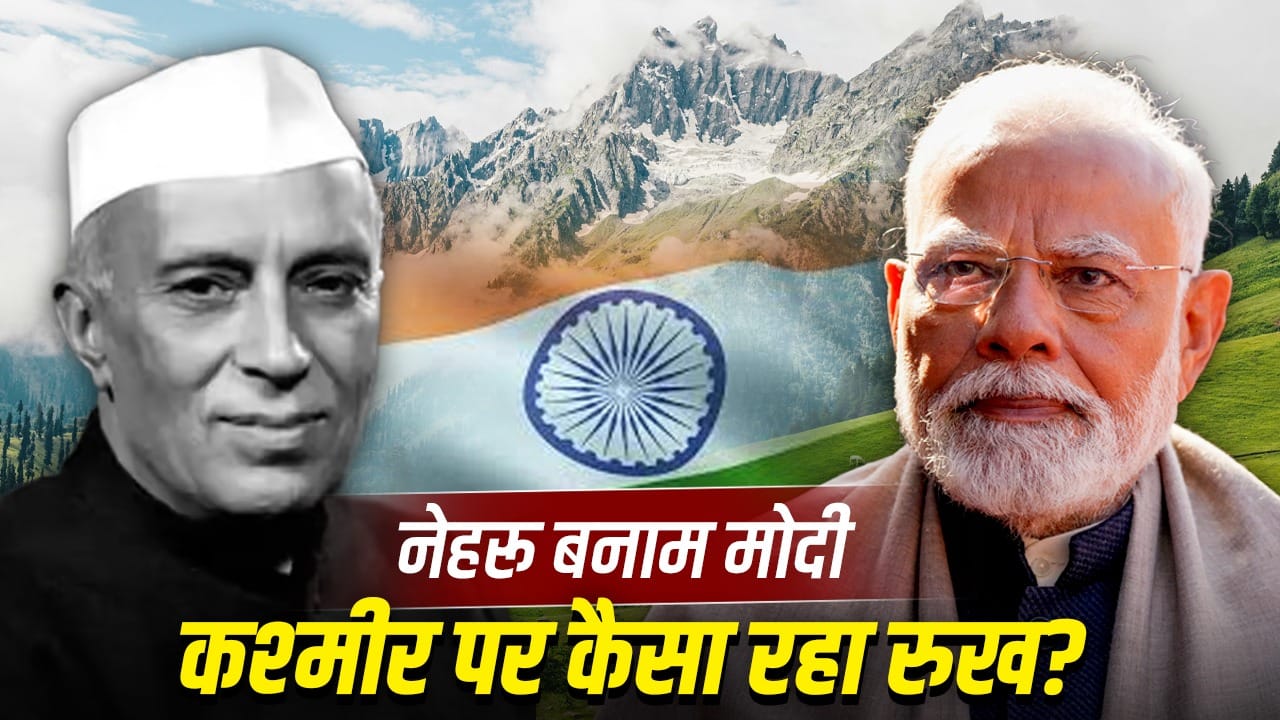
Nehru vs Modi on Kashmir
The biggest achievement of Narendra Modi, leaving behind Pandit Jawaharlal Nehru as the elected Prime Minister, is to convert the issues related to the identity of his party into ground reality. Bharatiya Jana Sangh (later BJP) since its inception has been opposed to Pandit Nehru’s policies on the question of Kashmir and the special status given to the state. The founding president of the party, Dr. Shyama Prasad Mukherjee, died in custody in Srinagar on June 23, 1953, during the movement against “two constitutions in one country – two heads and two marks.”
By abolishing Article 370 and 35A on August 5, 2019, Modi gave a direct challenge to Pakistan as well as those forces in Kashmir who were threatening that the hands raising the tricolor in the valley would disappear in the event of the abolition of these provisions.
The thinking of Pandit Nehru and Sangh Jan Sangh on the question of Kashmir has been on two opposite sides. As Prime Minister, Modi has really changed the thinking and promises of the ancestors of the mother organization Sangh and the party. Read his story…
Kashmir has always been on the agenda of Jan Sangh-BJP.
While addressing a huge public meeting in Jammu in August 1952, Dr. Shyama Prasad Mukherjee had said, “I will get you the Indian Constitution or I will sacrifice my life for it.” Even after the merger of Jammu and Kashmir with India, the situation at that time was that the tricolor could not be hoisted in any part of the state. A special permit was mandatory to enter Jammu and Kashmir from any state in the rest of India. Even the Supreme Court, Election Commission and Comptroller and Auditor General had no authority in this state. This was the infancy stage of Bharatiya Jana Sangh. But the party under the leadership of Mukherjee was vocal with the slogan “Two legislations in one country – two heads and two symbols”.
The issue of Kashmir dominated the first convention of the party in Kanpur in February 1953. Despite the opposition of Sardar Patel, Prime Minister Nehru had handed over the question of Kashmir to the United Nations. The party decided to launch a movement against it. Jammu and Kashmir Police arrested Dr. Mukherjee on 11 May 1953. He died under suspicious circumstances on 23 June 1953 while in custody. Bharatiya Jan Sangh and further BJP always kept the abolition of special status of Kashmir on their agenda.
The picture changed with the rise of Modi
BJP had to complete a difficult journey to reach power at the Centre. The party’s top leader Atal Bihari Vajpayee led NDA between 1998-2004. Led two governments. The real challenge during his government, which was running on the crutches of several parties, was to complete its tenure. The 1998 government left within a year. Between 1999 and 2004, much of his energy was spent on wooing his allies. But with Narendra Modi’s entry into central politics in 2013 and BJP’s resounding victory in the 2014 elections amidst the buzz of Modi-Modi, the entire picture of the Center changed. Modi’s big success was that he freed the country from the era of coalition governments running at the Center for the previous two and a half decades. His victory in the 2019 elections was even bigger.
Freed from the pressures of alliance, Modi not only provided stable governments but also created a strong image of India on the national and international front along with development. This was the time when he fulfilled the party’s old promises of abolishing Article 370 and Section 35A from Kashmir and building Ram Temple in Ayodhya. Of course, he could not get an absolute majority in the 2024 elections due to the slight lack of seats, but the message of his third government’s tenure so far is very clear that while giving full respect to the allies, he is not ruling under any pressure.
Kashmir is a big challenge
The question of Kashmir has been a challenge for India since independence. Due to this, India faced three wars with Pakistan in 1947, 1965 and 1999. The matter did not stop here. The Pakistan sponsored series of unrest and terrorism has been going on continuously in the state. BJP has been believing that the problem of Kashmir is the result of wrong decisions and policies of Pandit Nehru. Its leaders kept saying that if Nehru had not sidelined Sardar Patel on the issue of Kashmir, the country would not have had to face this difficult situation. By the time Modi came to power, the situation in Kashmir had become very critical. The unholy nexus of infiltrators and terrorists coming from across the border, arms and separatist forces of the valley had established parallel power there. Decades ago, lakhs of Kashmiri Pandits were evicted from the valley.
The elected government and elections of the state remained symbolic. Terrorist incidents, stone pelting and violence and crowd gathering at the funeral of any terrorist killed by the security forces were a direct challenge to the integrity of India. At this stage, major surgery and tough decisions needed to be taken regarding Kashmir. Moving away from the additions and subtractions of politics, it should be accepted that Modi has secured his place in history by displaying his ability on this delicate issue.
Modi created history
After the abolition of Articles 370 and 35A, the decisions of Modi government regarding Jammu and Kashmir can be a subject of debate. Complete abolition of statehood. Ladakh to be made a separate union territory. Even after the assembly elections, there may be a complaint about Jammu and Kashmir not being given the status of a full state. But it cannot be denied that stone pelting has stopped in Kashmir during Modi’s rule. There has been a significant reduction in terrorist incidents. Pakistani misdeeds in Pulwama and Pahalgam have been given a befitting reply through Operation Balakot and Operation Sindoor.
The back of the state’s separatist forces has been broken by stopping funding and other stringent measures. Those who challenge the tricolor have been crushed strictly. A lot of positive things have also happened. There was strong voting in elections from local body to state assembly. There have been no complaints of rigging in elections for a long time. Modi’s opponent in the state is the government of National Conference’s Omar Abdullah. But he is in coordination with Lieutenant Governor Manoj Sinha.
Modi does not hesitate in taking tough decisions
As a result of the abolition of the special status of Jammu and Kashmir, it has become possible to implement the Indian Constitution and the laws made under it there. With this, refugees from West Pakistan, Valmiki community and some other groups have got full civil rights and voting rights. After a long period of unrest, record number of tourists increased in the valley. Along with business activities, development, construction and industrial factories are expanding rapidly. Something new is also being added continuously in terms of educational institutions and medical facilities. The gap of distrust is closing. Because of Pakistan, Kashmir is still a major center of concerns for India.
But with his firm attitude and clear thinking, Modi has been successful in giving a clear message not only to Pakistan but also to every separatist thinking person in Kashmir that his government will not lag behind in responding to every wrongdoing with full force. The way Jawahar Lal Nehru kept looking for a solution to the Kashmir problem made it more complicated. Modi believes in action and does not hesitate in taking it. This stance of Modi has taught a tough lesson to Pakistan and the separatist forces of the valley.