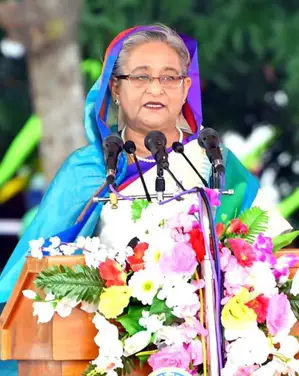
Geneva, Oct 5 Bangladesh’s former Prime Minister Sheikh Hasina warned that the country is grappling with “a serious constitutional crisis”, asserting that its future must be determined by the “free and informed will” of its people rather than fear or force.
Hasina made the remarks during the recent seminar, titled “Bangladesh’s Constitutional Crisis: Right to Education, Arbitrary Detention and Fabricated Tribunal Verdicts,” at the Geneva Press Club.
The event brought together former political leaders, lawyers, human-rights advocates, researchers and international experts from Europe, Asia and Africa.
According to the Awami League, Bangladesh’s constitutional order, rule of law, human rights, political participation, judicial independence and the future of its democratic institutions came under extensive discussion during the seminar at the Geneva Press Club.
Addressing the gathering virtually, Hasina said the events of July and August 2024 failed to bring peace or prosperity in Bangladesh.
She accused the current BNP administration of “political retaliation, arbitrary detention, politically influenced legal proceedings and actions,” arguing that such measures are damaging the educational and professional futures of students and citizens because of their political identities.
Hasina cited a series of incidents involving alleged violence, killings, arrests and insecurity in different parts of Bangladesh, saying many such incidents never reach the media.
She argued that “the situation should no longer be viewed solely as political instability but as a crisis involving law, public security and the responsibilities of the state.”
The former Prime Minister also voiced concerns over repression in universities and educational institutions, alleging that students had lost their enrollment or certificates, while young professionals had been suspended from employment because of political affiliation.
Stressing that political identity should never be treated as collective criminal liability, Hasina said that “anyone accused of a crime should be held individually accountable through due process”.
On detention and the justice system, she said thousands of Awami League leaders, activists and supporters had been detained, prosecuted or forced into hiding in Bangladesh.
Questioning the use of criminal and anti-terrorism laws, Hasina alleged that due process, equal treatment and judicial independence were under pressure.
She also criticised attempts to remove the Awami League from political life through judicial and tribunal processes, warning that “if judicial institutions are used for political retaliation, public confidence in the justice system will suffer. “
Referring to capital punishment, she said the “state should not exercise the power to take a person’s life where the fairness and independence of the judicial process itself are in question.”
Highlighting the ban on Awami League, Hasina further argued that an election cannot be genuinely representative if a major political force and its supporters are excluded from political participation.
“Bangladesh’s future must be determined by the people of Bangladesh,” she said, emphasising that this should happen through free and informed public choice rather than fear, force or administrative orders.
Hasina called on the United Nations, democratic governments, human-rights organisations, the legal community and Bangladesh’s international partners to closely monitor the dire situation in the South Asian nation.
She urged an end to arbitrary detention and politically motivated persecution, restoration of judicial independence and due process, protection for students and professionals, adequate medical care for people in state custody, and guarantees for freedom of expression, association and peaceful political activity.