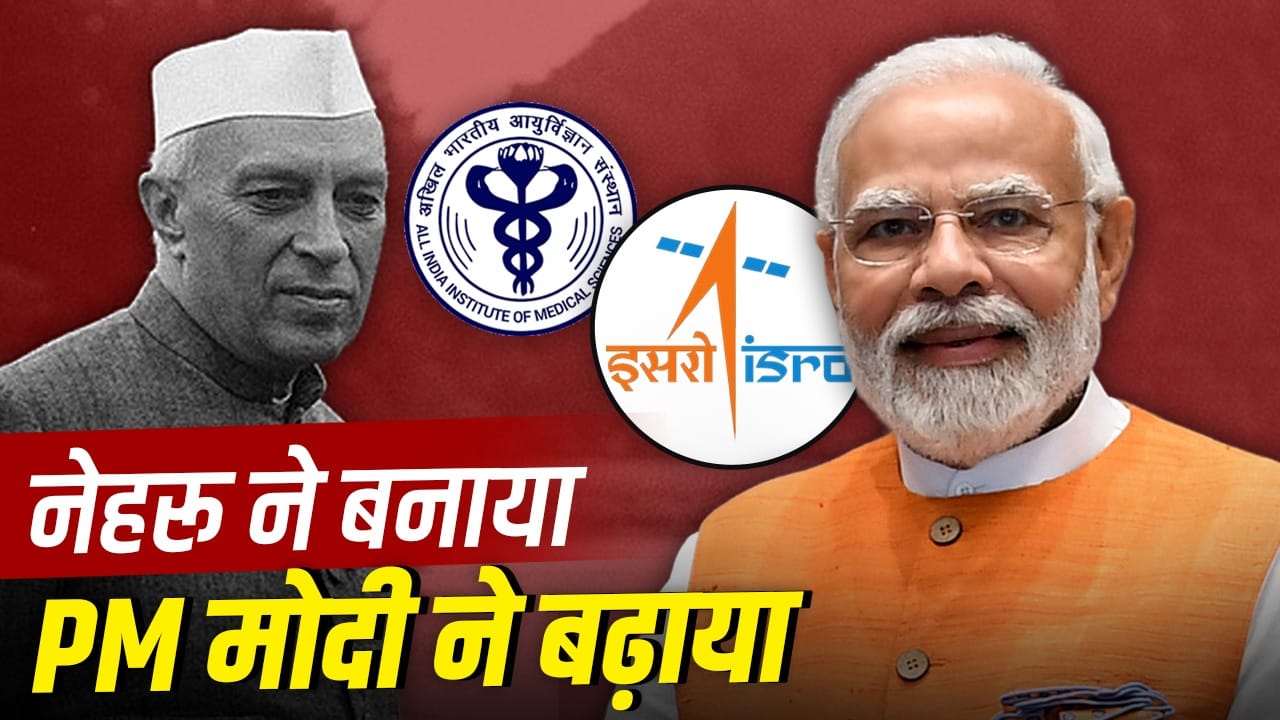
PM Modi vs Pandit Jawaharlal Nehru
India’s progress is not the story of a single day. This is a long journey. Many leaders have contributed in this journey. The country’s first PM Jawaharlal Nehru gave the idea of modern institutions. Today’s PM Narendra Modi linked many institutions with the needs of the new era. Opened new institutions. Institutions like IIT, AIIMS and ISRO are in front of us as great examples. Now when PM Narendra Modi is going to break the record of the country’s first Prime Minister Pandit Jawaharlal Nehru, some questions are floating in the air.
People are asking that if Nehru built IIT, AIIMS, established ISRO, how much did Modi take his campaign forward? Let us understand in detail.
If institutions are built then the country will be built.
Nehru’s emphasis was based on scientific thinking. He believed that if institutions are built then the country will be built. He believed that a poor country would gain strength from knowledge. During his period, big institutions were built for education, research, engineering and health. Today IIT, AIIMS, nuclear energy, space research and scientific laboratories are the identity of India. The roots of many of these are found in the Nehru period. Nehru understood that the country does not change by speech alone. Institutions are needed for this. Need good teachers. Need laboratories. Need a hospital. Scientists need a free environment.
Technology India’s Initial Laboratory
The IIT system started after independence. The first IIT started in Kharagpur in the year 1951. After this, IITs were also established in Bombay, Madras, Kanpur and Delhi. Foreign cooperation was also taken in these institutions. At some places there was cooperation from the Soviet Union, at some places from Germany and at some places from American universities. This was a special policy of Nehru. India had to be made self-reliant. But, there was also learning from the world. IIT gave engineers to India. Scientists gave. Gave entrepreneurs. Indian leadership visible in big tech companies. The impact of IIT is still being seen in the startup world.
IITs got expansion in Modi era
The IIT network grew further during the Modi government. When he took oath as PM in 2014, there were 16 IITs in the country. This number increased to 23 just two years ago. New campuses like IIT Palakkad, Tirupati, Bhilai, Goa, Jammu and Dharwad became part of this expansion. ISM Dhanbad also got the status of IIT. Seats also increased. In the year 2014, there were about 10 thousand seats in B.Tech in IIT. Now this number is around 20 thousand. This is a big change. Now more students are getting opportunities. The name of IIT has reached small towns and new states. But there is also a challenge, it takes time for the new IITs to attain the same level as the old ones. There is a shortage of faculty. There was also delay in building the permanent campus. Continuous work is needed on the quality of research, hence the contribution of the Modi era is visible in its expansion and reach. Now there is a need to strengthen the quality equally.
AIIMS becomes a big model of treatment and medical education
The country’s first AIIMS was built in Delhi in the year 1956. This was one of the major achievements of the Nehru government. Even today, patients from far and wide like to get treatment here even after standing in long queues. The role of the then Health Minister Rajkumari Amrit Kaur was also very important in this. The goal of AIIMS was clear. World class hospitals should be built in India. Medical education should be better. The poor patient should get good treatment. Research and treatment go together. AIIMS Delhi has served as the most trusted government hospital in the country for a long time. Treatment also took place here. The doctors also got ready. Research was also done on new medical methods. This model told India that even a government hospital can be excellent.
Big expansion of AIIMS during Modi era
Modi government tried to take the AIIMS model to many states. Till the year 2014, apart from AIIMS Delhi, some new AIIMS were in the process of starting. By the year 2024, 22 AIIMS in the country have reached the approved or developed stage. OPD has started in many places. MBBS classes and hospital services started at many places. Gorakhpur, Nagpur, Bilaspur, Deoghar, Guwahati, Rajkot and other places joined this expansion. This was an attempt to reduce the pressure on big cities. Eastern India, North-East, Central India and smaller states got direct benefits from it.
There was a huge expansion in medical education also. In 2014, there were approximately 51 thousand MBBS seats in the country. Now this number has increased to more than one lakh. The number of medical colleges also increased. This is important for the health infrastructure. With the opening of AIIMS, some problems are also emerging. There is a shortage of doctors in many new AIIMS. Buildings were built at some places, but full service started slowly. It takes time to prepare equipment and specialist departments. So here too the real test is quality.
Nehru created the land, the institution was formed later
One thing has to be understood about ISRO. It was established in the year 1969. Meaning, after Nehru’s death. But the foundation of India’s space program was prepared during the Nehru period only. In the year 1962, the Indian National Space Research Committee was formed which later became known as ISRO. This was the initial committee of Indian space research. Vikram Sarabhai was its main face. The environment of Homi Bhabha and scientific institutions was also helpful in this. In the year 1963, the first sounding rocket was launched from Thumba. This was the beginning of India’s space journey.
Pictures of rocket parts being carried on bicycles and bullock carts became symbols of this period. Nehru gave place to scientists. He linked science with nation building. This thinking later became the strength of ISRO.
Space program gets new identity in Modi era
India’s space achievements came into limelight during the Modi government. Mangalyaan was launched in 2013 and reached Mars orbit in 2014. This was a historic moment for India. In the year 2017, ISRO launched 104 satellites simultaneously. This was a world record. Chandrayaan-2 mission was launched in 2019. The lander was not successful, but the orbiter continued. Chandrayaan-3 made history in the year 2023.
India became the fourth country to make a soft landing on the Moon. India became the first country to land near the south pole region of the Moon. Aditya-L1 Sun Study Mission launched in the year 2023. Next year it reached its designated halo orbit. The Exposat mission was also launched in the same year. It is related to the study of subjects like black holes and neutron stars. In the year 2023, the Central Government brought a new space policy. Because of this, private companies got an opportunity. Today several dozen start-ups are working in this field. This is a big change.
Budget and market changes
The budget of the space department also increased. In the year 2013-14 it was around Rs 5-6 thousand crores. In the year 2024-25, it has traveled to more than Rs 13 thousand crores. This increase is significant, but India’s space budget is still much smaller than that of America, China and Europe. Still, India is known for carrying out big missions at low cost. This is the special strength of ISRO.
Where is the difference visible?
Nehru’s contribution was in the basic structure. He imagined scientific India. He made higher education and research a national priority. Modi’s contribution is visible in expansion, visibility and implementation. He expanded the institutions to new districts and states. He connected space with the private sector. He made science a matter of public pride. Nehru’s era was an era of construction. Modi’s era is the era of expansion and branding. The challenges of both were different. The means of both were different.
Now what is the big question before India?
Will the new IITs become as strong as the old IITs? If yes, for how long? Will the poor really get timely treatment in the new AIIMS? Will private space companies take India forward in the global market? If the answer is yes, then India’s scientific journey will accelerate further. Nehru’s beginning and Modi’s expansion will then become two chapters of the same national story. This story is bigger than politics. This is the story of India’s potential.