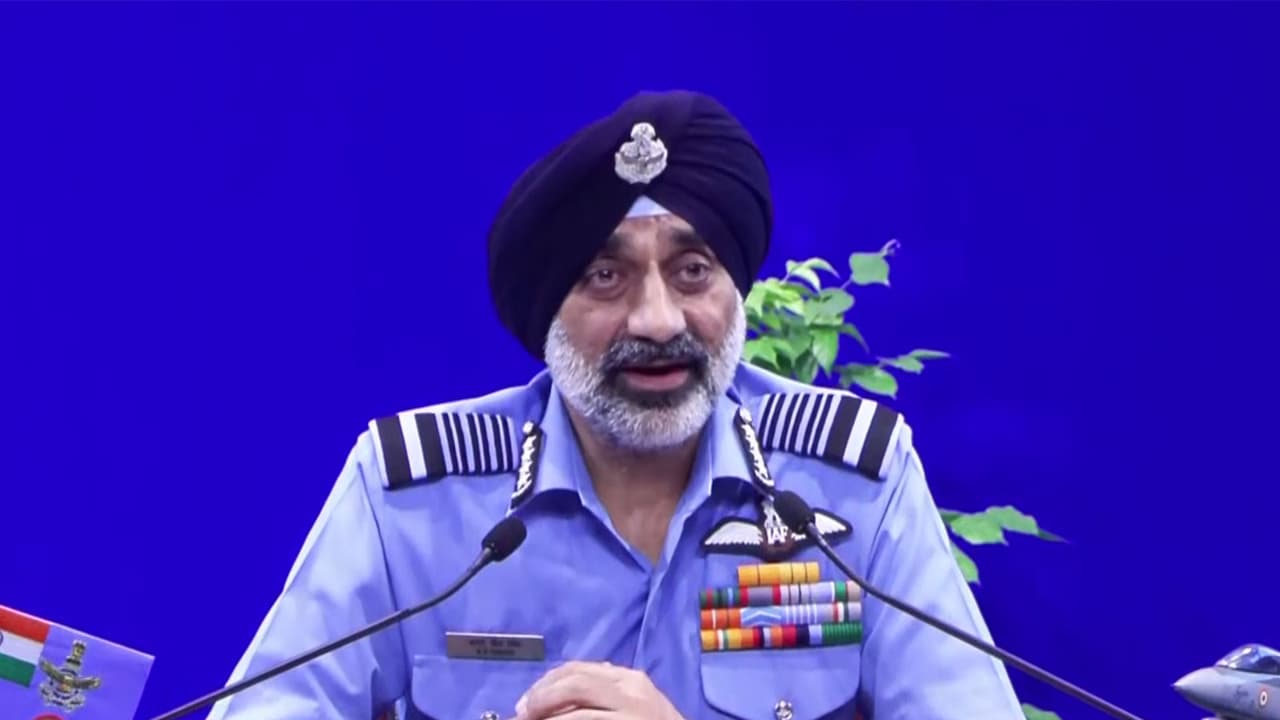
IAF Chief AP Singh said drones are ‘evolutionary’ not ‘revolutionary’ and ruled out a separate drone force. He stressed integrating unmanned systems and loitering munitions with other weapons for a combined effect on the battlefield.
IAF on Drones: ‘Evolutionary, Not Revolutionary’
Indian Air Force Chief Air Chief Marshal AP Singh on Saturday said drones were “evolutionary” rather than “revolutionary” for the force and ruled out the creation of a separate drone force, stressing that unmanned systems and loitering munitions would be more effective when integrated with other weapons and platforms.
Addressing the IAF’s annual press conference in New Delhi, Singh said drone capabilities had existed within the Indian Air Force for decades and were now being expanded in terms of numbers, types and capabilities. “Drones are not revolutionary to the Indian Air Force, but evolutionary. We are growing the number of drones and loitering munitions. Whether we need a separate drone force, I don’t think so. They should be a part of the same setup, and we have to be operating together,” Singh said.
He said different weapon systems should not operate in isolation and stressed the need for coordinated operations to achieve the desired battlefield effect. “These have to be together along with other weapons so that they bring in that effect. We cannot be operating one type of weapon separately somewhere and another type of weapon separately. So we have not thought of having a separate drone force,” he said.
Singh noted that the IAF already has specialised units dealing with such capabilities and said their numbers could be increased if required. “Loiter ammunition did help us in creating chaos and also taking down some of the AD assets,” he said, while reiterating that drones and loitering munitions had been part of the IAF’s capabilities for decades.
“So, if I can say drones are not revolutionary for the Indian Air Force; yes, they are evolutionary. So, we are growing in drones, number of drones, number of loiter ammunitions, and type of drones and type of loiter ammunition is increasing,” Singh said.
The IAF chief’s comments come as unmanned aerial systems and loitering munitions are increasingly being incorporated into modern military operations. He said the force’s approach was to integrate these systems with other weapons rather than operate them as an independent arm.
Addressing Fighter Aircraft Strength
Singh also addressed the IAF’s fighter aircraft strength and ongoing acquisition programmes. He acknowledged that the force’s aircraft numbers were declining and said delays in planned inductions had affected the IAF. “Everybody understands this fact that our numbers are decreasing, the aircraft that were supposed to come, on which we were relying, they have also come slow,” he said.
He said the IAF was looking towards platforms including Tejas Mark-1A, Multi-Role Fighter Aircraft (MRFA) and the future Mark-2 fighter to bridge existing and anticipated gaps.
Singh also said that if there were further delays in the Advanced Medium Combat Aircraft (AMCA) programme, the IAF may have to examine other options, while noting that Russia had offered the Su-57. He clarified that no decision had been taken on the offer.
The IAF chief said all major aircraft programmes needed to be pursued through a “whole-of-nation approach” to ensure timely delivery and operational capability.
(Except for the headline, this story has not been edited by Asianetnews Editorial staff and is published from a syndicated feed.)