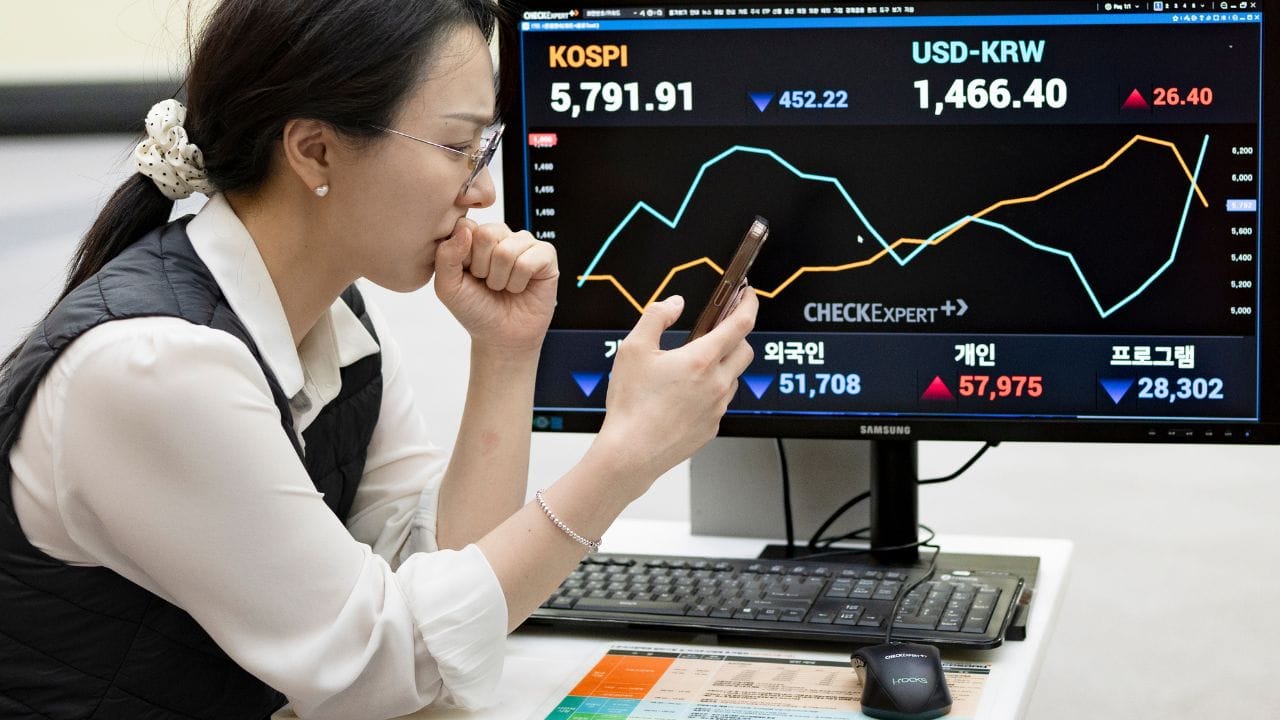
There was a big fall in the South Korean stock market on Monday.
On Monday, there was a huge decline in South Korea’s benchmark Kospi and it fell by 8.23 percent. The biggest reason for this was the fall of stocks related to Artificial Intelligence. In fact, the Kospi index had become quite dependent on semiconductor stocks. Whose fall created panic in the entire stock market. The special thing is that when Kospi saw a decline of up to 9 percent, trading had to be stopped for 20 minutes. The Kospi has fallen by about 14 percent from last week’s record high.
The biggest impact of selling has been seen on big companies and semiconductor giants. Samsung shares fell by more than 10 percent, while SK Hynix shares fell by more than 7 percent. According to experts, as soon as investors started booking profits, the market’s attention was drawn to the ‘concentration risk’ (risk of excessive dependence on one place). Much of Kospir’s rise was dependent on the performance of some AI-related stocks, which increased the risk of the entire market falling if the market mood changed.
Big fall in Samsung Electronics and SK Hynix
Samsung Electronics and SK Hynix together make up about half of KOSPI’s weighting and have contributed about two-thirds of the benchmark’s gains this year. Even after Monday’s selloff, both these stocks are up 138% and 196% respectively since the beginning of the year. This sudden fall has come after the spectacular rise of South Korean shares. The Kospi has been one of the world’s best-performing stock indices this year, largely due to the AI-driven rally in semiconductor stocks.
How much has Kospi increased this year?
If we look at the figures, Kospi has increased by 79 percent in 2026. The demand for AI infrastructure has increased rapidly in the last one year. Technology companies around the world are racing to create advanced AI models and increase computing capacity. The boom led to a flood of orders for high-bandwidth memory chips, prompting investors to rush into Korean chipmakers, which are at the center of the global AI supply chain.
Why did Kospi fall?
Rising geopolitical tensions following Israel’s new attacks on Lebanon further reduced risk appetite in Asian markets; Due to these attacks, oil prices and the US dollar went up. Despite the already existing ceasefire between the two countries, geopolitical tension increased further after Israel launched new attacks on Lebanon on Sunday. Oil prices rose by more than $3 per barrel on Monday as tensions flared up again. This gave rise to new concerns about major regional conflicts and the resumption of crude oil supplies from the Strait of Hormuz.
Profit-booking in shares of AI-related companies, excessive dominance of a few companies in the index and increasing geopolitical uncertainty – all these together have created difficult conditions for Kospi. Because of this, the market which was one of the strongest equity markets this year, turned into the market with the biggest losses on Monday.