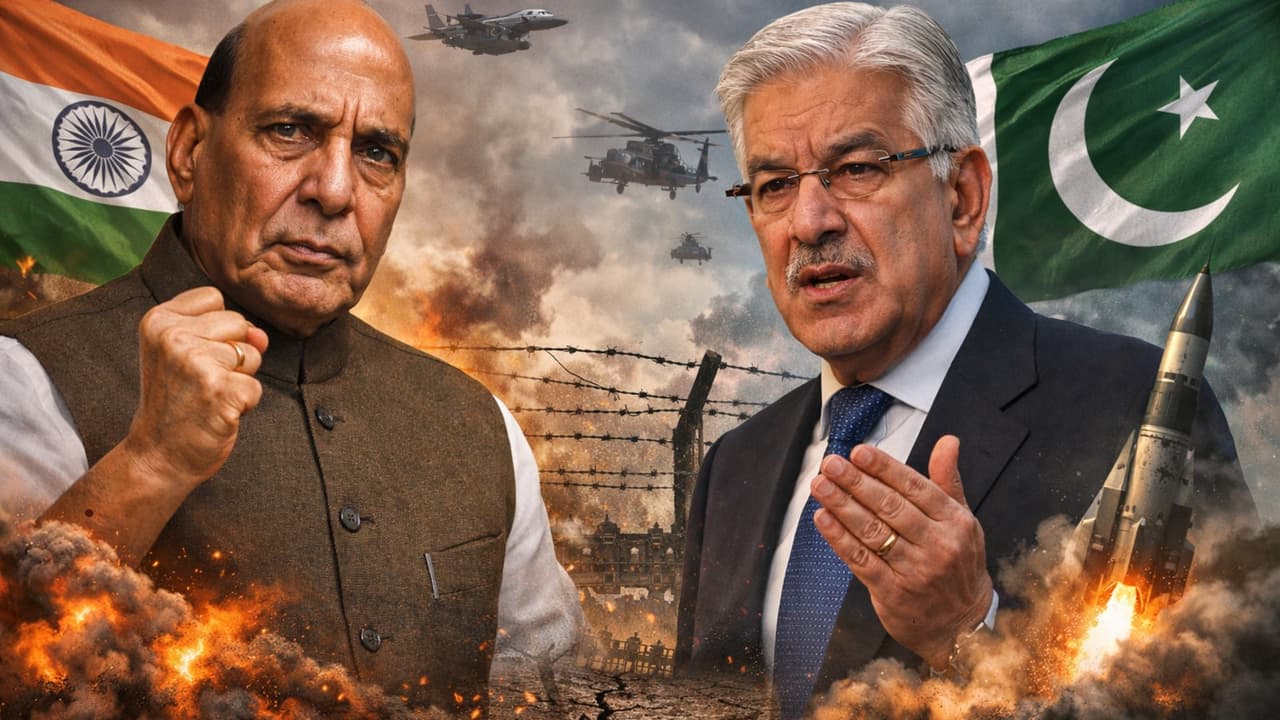
The yearbook of a Stockholm institute for 2026 records a doubling of armed conflicts between the two countries. According to the report, a record expenditure of $2.9 trillion was spent on the military worldwide and the use of cyber warfare was seen for the first time in the conflict between India and Pakistan.
New Delhi: There was a military confrontation between India and Pakistan in May 2025. This was the first time that cyber operations were openly used in a military conflict between these two nuclear-armed neighbours. Stockholm International Peace Research Institute (SIPRI) in its annual yearbook released this week has described this incident as a turning point for the security of South Asia.
SIPRI Yearbook 2026 is considered to be the most closely monitored report on military trends worldwide. The report paints a picture of a world where arms control norms are weakening, competition between great powers has intensified and new military technologies are spreading rapidly. The report calls this “an unstable strategic environment” in which there are no longer any strong institutional defenses.
India-Pakistan crisis
The cross-border firing between India and Pakistan between May 7 and 10 was the most serious military crisis between the two countries in more than two decades. SIPRI has projected this conflict to be one of six inter-state armed conflicts recorded worldwide in 2025. This number is double the three conflicts recorded in 2024. The report described its cyber aspect as an important and worrying development.
The open use of cyber operations alongside conventional military force is indicative of how future conflicts in South Asia will be fought. Security analysts have long warned that incorporating cyber capabilities into conventional warfare complicates command-and-control systems and increases the risk of misunderstanding, especially between two countries that both possess nuclear weapons and have limited lines of communication. India’s defense spending is set to grow by 8.9 percent in real terms to $92.1 billion in 2025, making it the world’s fifth-largest military spender.
At the same time, Pakistan remained among the top five arms buyers in the world in the five-year period from 2021 to 2025. Ukraine, India, Saudi Arabia and Qatar were also in this list. Together they bought 35 percent of the world’s total major arms imports.
China’s growing stockpile
SIPRI estimates that China’s stockpile of nuclear weapons will increase from 600 to about 620 during 2025. It’s part of a modernization and expansion program that analysts say shows no signs of slowing down. China remained the world’s second largest military spender, with an estimated expenditure of approximately $336 billion. This is an actual increase of 7.4 percent compared to last year.
The report also highlights the growing naval nuclear aspect in the Indo-Pacific. Submarine-based nuclear delivery systems are on the rise among all four nuclear-armed countries in the region – China, India, Pakistan and North Korea. SIPRI says it raises fears of a naval nuclear arms race in a region already rife with disputes over territorial claims and strategic rivalries.
China’s military build-up is taking place against the backdrop of increasing competition with the US in the areas of technology, trade and security. Washington has responded by deepening defense ties with regional partners including India, Japan, South Korea and Australia and strengthening security commitments under the Quad framework. Due to these reasons, an action-reaction cycle has been created, due to which military expenditure is increasing in the entire region.
Record spending around the world
Global military spending is set to reach $2.9 trillion in 2025, a new record and the eleventh consecutive annual increase. NATO members agreed to raise their collective spending target to 5 percent of GDP at their summit in The Hague in June 2025. This is a huge increase from the long-standing 2 percent benchmark, which many countries were struggling to meet. The overall European defense budget increased by a massive 14 percent, largely due to the ongoing war in Ukraine and changed threat perception following a full-scale invasion by Russia in 2022.
Presenting the report’s findings, SIPRI Director Karim Haggag said the combination of weakening arms control frameworks, new military technologies and great power competition is creating instability that existing international institutions are ill-equipped to deal with. “The structural conditions that allow misunderstanding and tension to grow are worsening,” he said. He called for renewed investment in multilateral arms control and risk reduction mechanisms.
Special risks of South Asia
Multiple risk factors coexist in South Asia. Since independence in 1947, India and Pakistan have fought three full-scale wars and several smaller military confrontations, including the 1999 Kargil conflict and the 2019 air standoff following the Pulwama attack. Both countries have adopted nuclear deterrence principles that contain elements of ambiguity. Now the addition of cyber capabilities to the mix has opened up new avenues of escalation that existing confidence-building measures were not designed to deal with.
India has resorted to military modernisation, diplomatic diversification and strategic partnerships to manage the threat from both Pakistan and China. Its defense budget reflects this two-front challenge. Despite being beset by severe economic difficulties, Pakistan has relied heavily on arms transfers, primarily from China, to maintain military parity.