
The U.S. 10-year Treasury yield soared past 5.3% on Wednesday, while 30-year yield crossed 5.6%.
- Economist Peter Schiff pointed out in a post on X that rising yields were a sign of how bear markets work.
- Major market experts predict long-term yields are likely to stay higher for longer amid sticky inflation, rising energy prices from the ongoing war in the Middle East, and rising corporate debt.
- Barclays Capital reportedly believes the U.S. 30-year yield could reach 6% amid the market selloff, which has yet to price in the risk of a sustained productivity growth.
Yields on the 10-year U.S. Treasury soared past 5.3% on Wednesday, crossing key levels not seen since 2002. A deepening bond rout amid inflationary concerns has weighed on markets both domestically and globally over the past month.
The 30-year U.S. Treasury has also been rising, breaching the 5.6% level and notching multi-decade highs.
The rise in yields comes despite a recent hike in benchmark interest rates from the Federal Reserve and a slew of buybacks meant to ease the pressure on bonds.
However, inflation in the U.S. continues to remain above the central bank’s 2% target range. Meanwhile, growing corporate debt amid an AI surge have been adding to market pressures.
On Wednesday, U.S. Personal Consumption Expenditures inflation came in lighter than expected. The Fed’s preferred gauge of inflation rose 3.4% year over year in August, below the 3.7% forecast, while core PCE increased 3%, also undershooting expectations.
Schiff: Bond Bear Market Could Have Further To Run
Economist Peter Schiff pointed out in a post on X on Wednesday that this was a sign of how bear markets work.
“After an initial rally following a lower-than-expected rise in the Aug. PCE, Treasuries then sold off to new lows. The yield on the 10-year is now 5.3% and the 30-year 5.65%. It’s still early in what will be the biggest bond bear market in history,” he said.
Where Are Long-Dated Treasury Yields Headed?
Major market experts are predicting that long-term yields are likely to stay higher for longer amid sticky inflation, rising energy prices due to the ongoing war in the Middle East and corporate debt that does not seem to be waning.
“Year-to-date yield moves up have been substantial,” Dominic Pappalardo, chief multi-asset strategist for Morningstar Wealth, said as per a post. “They’ve been driven mostly by inflation concerns.”
Pappalardo believes that the outlook for bonds depends on two key factors: “How high will rates go from here, and what will bring them back down?”
As per the strategist, elevated energy prices from the Iran war have been keeping inflation above target, and it is likely that yields will remain high for some time.
Oil prices have been rising in recent weeks, with Brent crude prices sustaining levels above $100 per barrel for weeks now.
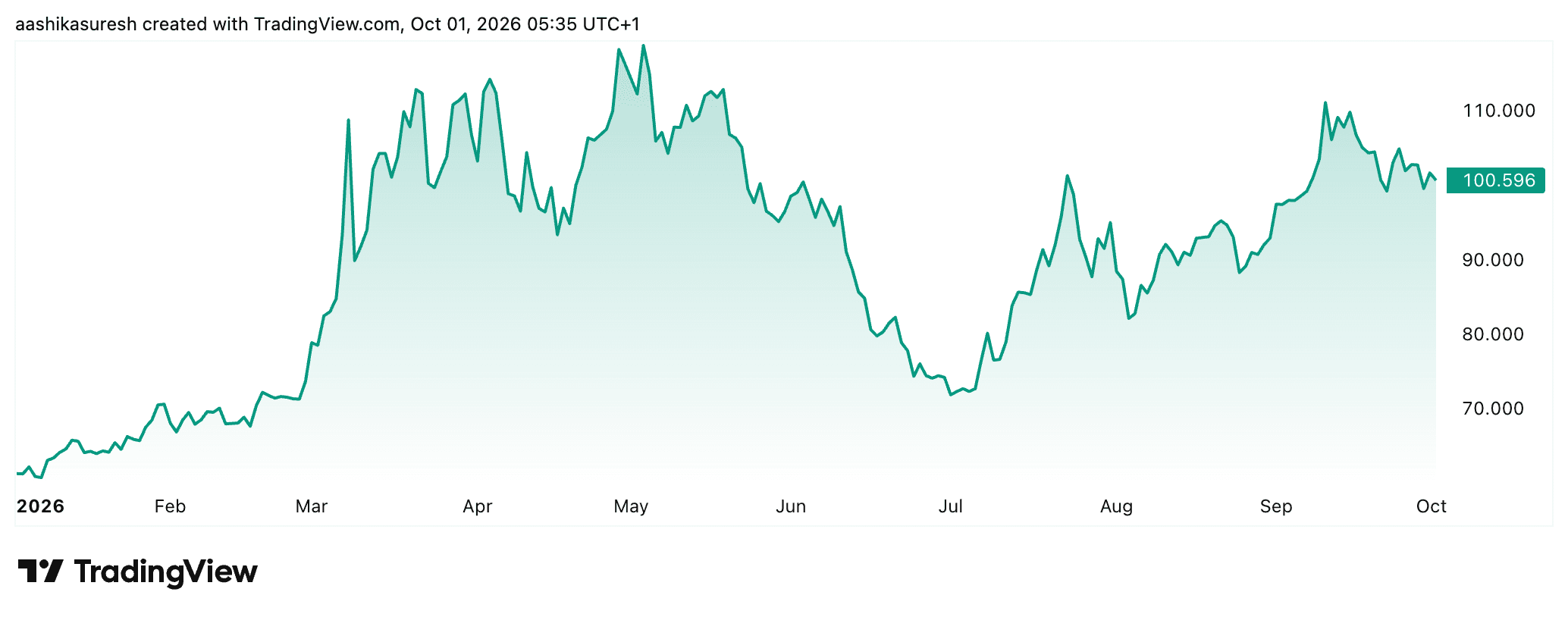
“You would expect energy prices to start to work their way back lower, taking the top off inflation and pushing it closer to the 2% target,” Pappalardo said.
The strategist also noted that after the Federal Reserve’s recent 25 basis point rate hike, more are on the table. As per CME FedWatch tool data, markets are pegging the odds of a rate hike in October at 37.6%, while the probability is over 96% for a hike in December.
Market commentary service The Kobeissi Letter said in a post on X earlier this week that the bond market is now pricing-in four more rate hikes by June 2027, a total of +125 basis points including September’s hike.
“Just 9 months ago, markets had expected at least 100 basis points of rate CUTS by June 2027. That’s a +225 basis point differential in interest rate expectations in a matter of months,” it said.
“The bond market is trading like 7%+ inflation is back and the Fed is about to start raising rates by 50 basis points at a time. This is unsustainable.”
Could The 30-Year Treasury Yield Hit 6%?
Meanwhile, Barclays Capital reportedly believes that the U.S. 30-year yield could reach 6% amid the market selloff which has yet to price in the risk of a sustained increase in productivity growth.
According to a report from Bloomberg, the head of U.S. rates research at Barclays Capital, Anshul Pradhan, said in a report that markets “continue to assume that today’s elevated neutral rate will ultimately prove cyclical rather than secular.” Under the cyclical framework, investors expect the Fed to raise interest rates to curb inflation, but see the hikes as temporary rather than permanent.
“All else equal, a repricing of long-run estimates higher to short-run ones would over time push the fair value of 30y yields to 6%,” the report said. This level was last seen in 2000.
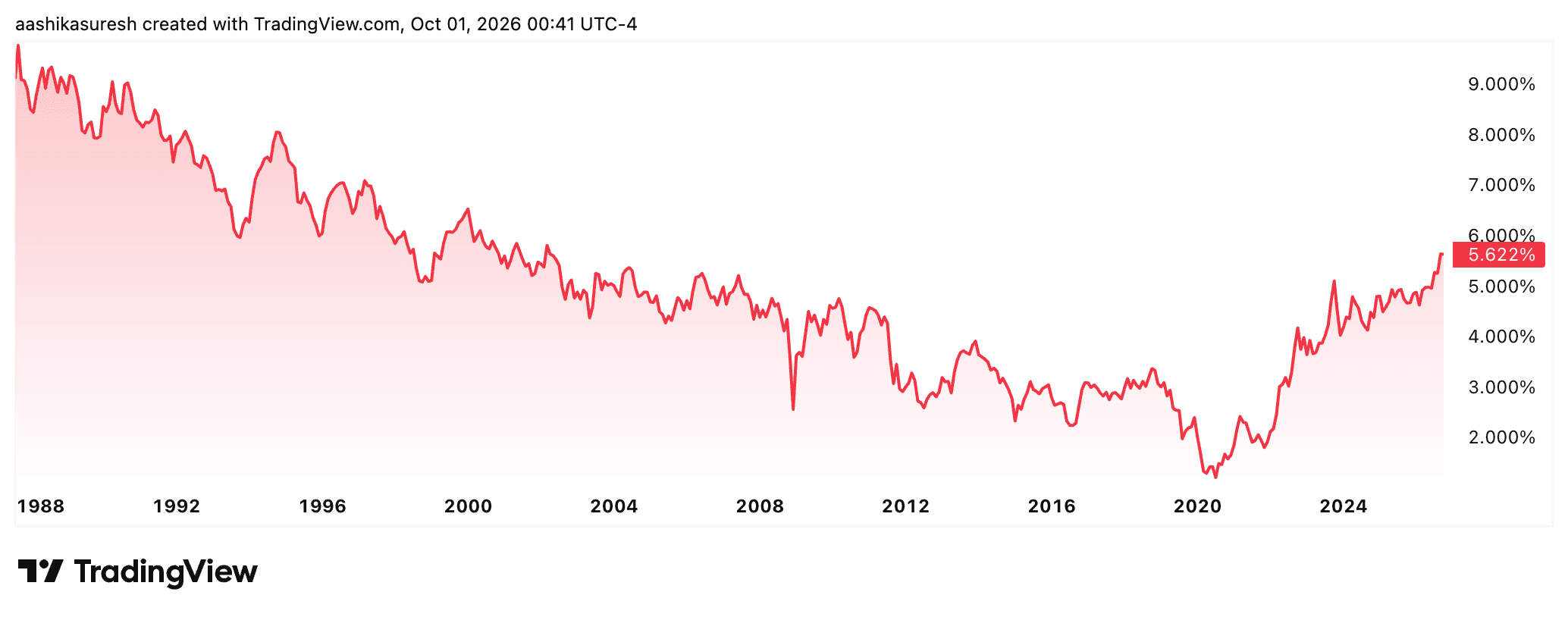
Pradhan also said that Treasuries could rally if a slowdown in capital spending weakens growth and reduces the Fed’s need to keep rates high, benefiting intermediate maturities. Conversely, rising yields and interest costs could worsen the fiscal outlook and increase demand for higher compensation, putting the most pressure on 10- to 30-year Treasury yields.
Bond ETFs Are Feeling The Pain
As bond yields increase, bond prices are falling. Bond prices and yields have an inverse relationship.
The iShares 20+ Year Treasury Bond ETF (TLT), an exchange-traded fund that tracks long-term U.S. government debt, fell to an all-time low on Wednesday.
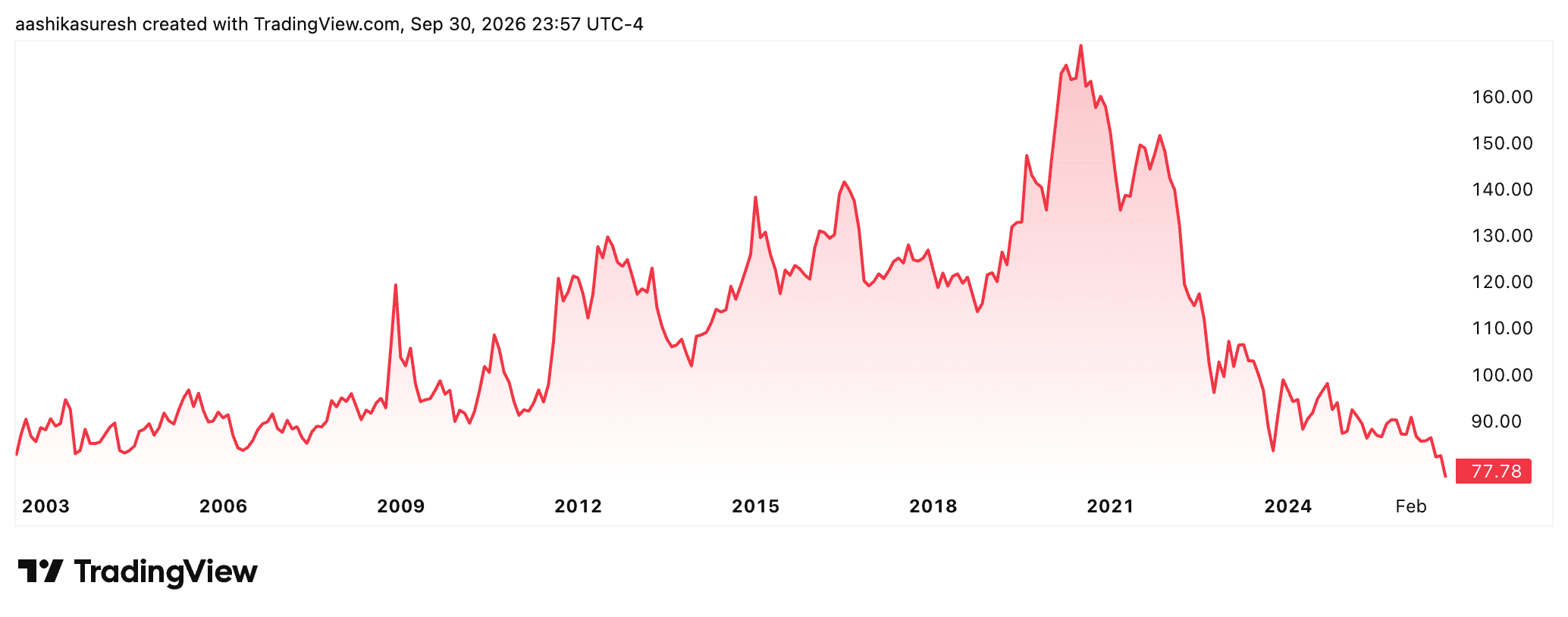
Meanwhile, iShares 10-20 Year Treasury Bond ETF (TLH) also fell to historic lows.
Are Rising Yields Bad For Stock Markets?
While bond yields have been soaring in recent weeks, stock markets have not fallen as dramatically, although they have experienced a fair bit of volatility.
Ark Invest’s Cathie Wood said in a post on X that the movements today show that the market “is working.” Wood noted that in 2017, interest rates increased as the Fed put the market on training wheels. “Long duration equities had a fabulous year. Let the market work!” she said.
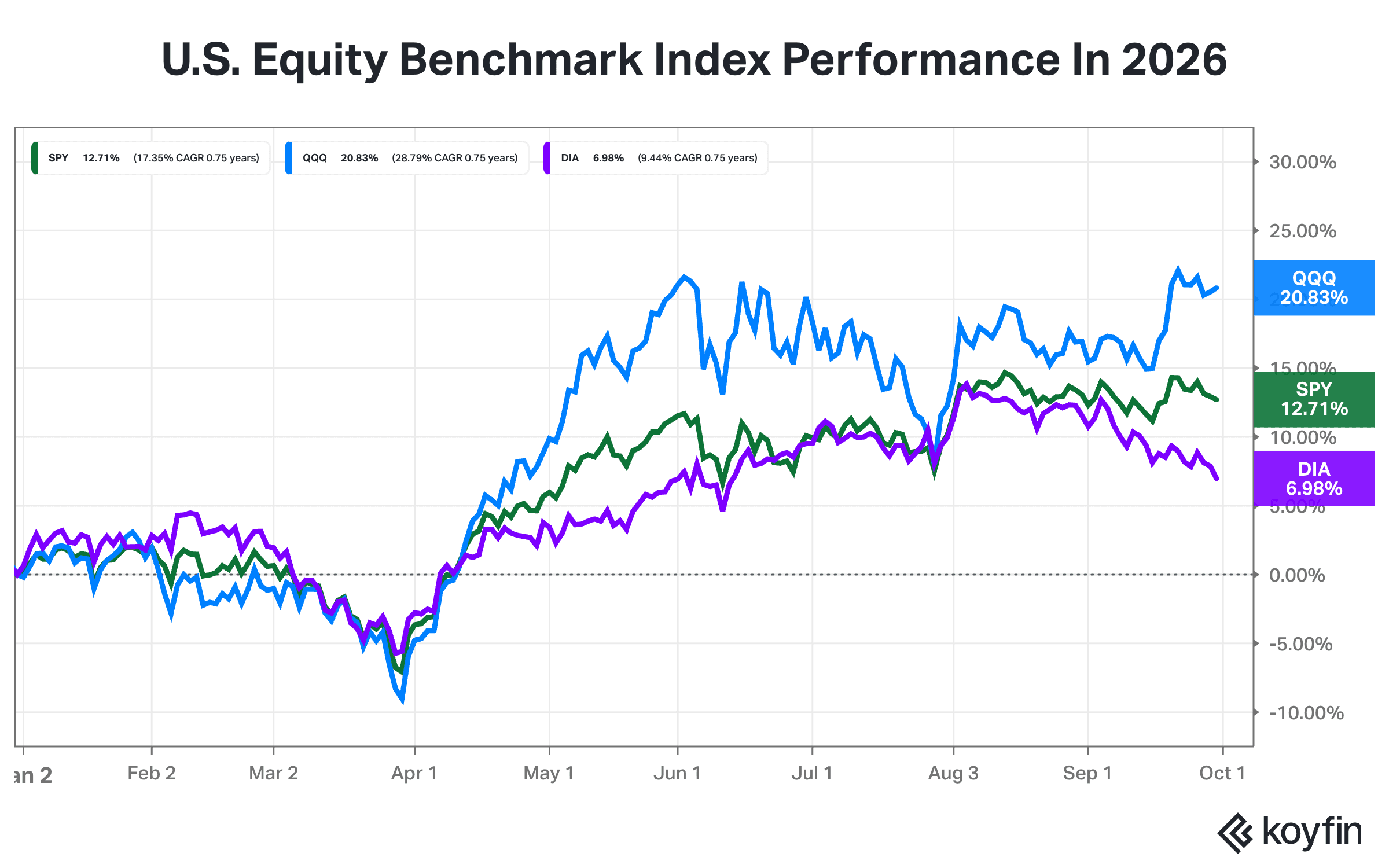
U.S. stocks have been rising steadily off late, with the S&P 500 and Nasdaq indexes notching fresh highs.
The SPDR S&P 500 ETF Trust (SPY) is up more than 12% in 2026, while the tech-heavy Invesco QQQ Trust Series 1 (QQQ) has gained more than 20% in the same time. Even the State Street SPDR Dow Jones Indust Avg ETF Trust (DIA) is up nearly 7% year-to-date.
Charlie Bilello, Chief Market Strategist at Creative Planning, said in a post on X, “The 30-year Treasury yield ended the day at 5.64%. That seems really high until you zoom out and learn that the yield was actually higher than this every single day in the 1980s and 92% of days in the 1990s. Recency bias is a powerful force.”
Meanwhile, Yardeni Research said in a post that rising bond yields, despite some improvement in September PCE inflation, reflected strong economic and labor-market data that reinforced expectations for further Fed rate hikes. The firm noted that the more optimistic interpretation is that stronger-than-expected growth suggests the economy’s neutral interest rate is higher than previously thought, meaning monetary policy may still be accommodative rather than restrictive.
For updates and corrections, email newsroom[at]stocktwits[dot]com.<