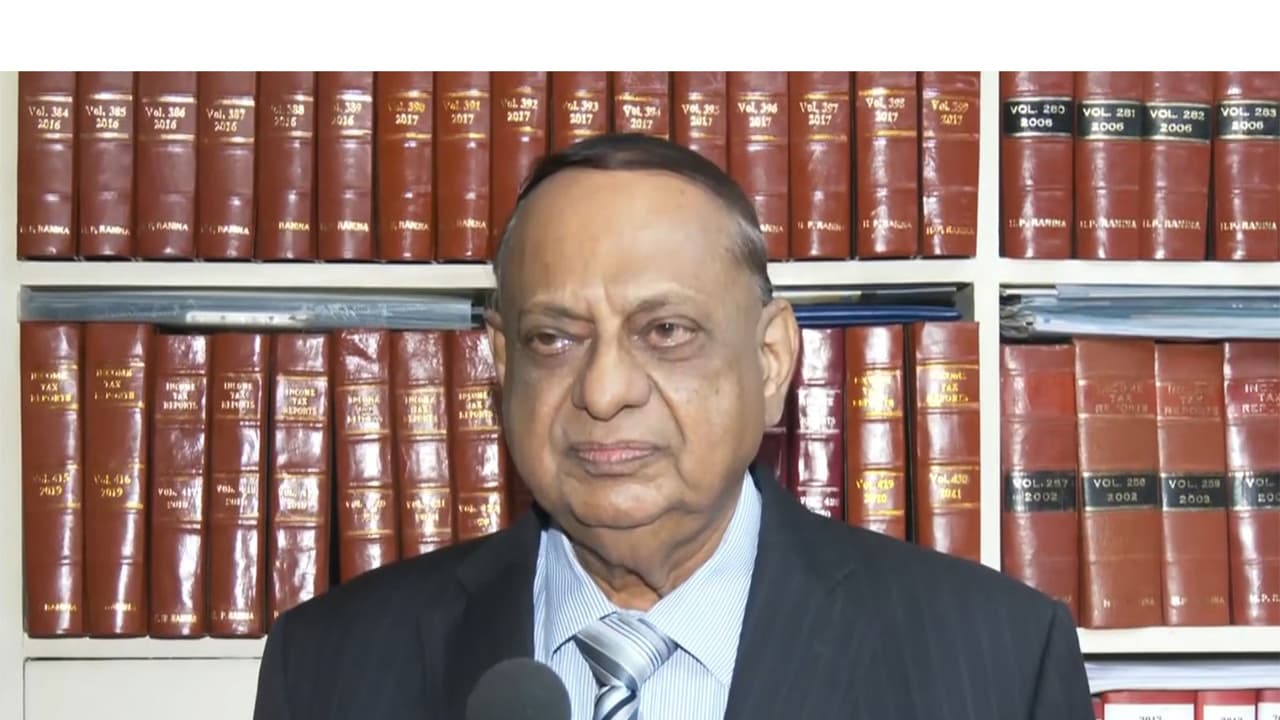
Corporate law expert HP Ranina states that in the Tata Sons dispute, the shareholder majority held by Tata Trusts is absolute, and minority objections lack legal power. The chairman’s extension and major corporate shifts depend on their vote.
In the high-stakes battle at the Bombay House, shareholder majority remains absolute and minority objections do not hold legal firepower against the Tata Trusts and its governing Articles of Association, an expert has said.
Speaking with ANI in Mumbai, corporate law expert HP Ranina talked of key legal challenges surrounding the chairman’s extension, RBI listing mandates, and minority shareholder rights and said shareholder majority remains absolute.
Chairman’s Extension and Affirmative Vote
Clarifying the legal framework governing the reappointment and extension of Tata Sons’ chairman, N. Chandrasekaran, Ranina emphasised that the company’s Articles of Association mandate an affirmative vote from the majority of directors nominated by Tata Trusts. “Under the Articles of Association, it is stipulated that there must be an affirmative vote of the majority of the trustees who are nominated as directors,” Ranina said. “Unless the affirmative vote is given by the directors who are nominees of Tata Trusts, the appointment cannot go through. The Supreme Court decided this point three years ago, holding that the affirmative vote requirement is entirely valid.”
RBI Listing Mandate and Regulatory Status
Asked whether merging operating entities into Tata Sons to avoid the Reserve Bank of India’s (RBI) mandatory listing for upper-layer NBFCs constitutes regulatory evasion, Ranina explained that regulatory status depends strictly on asset composition. “If a company’s primary income ceases to arise from investments, it stops being classified as a Non-Banking Financial Company,” Ranina noted. “Once the merger goes through and Tata Sons becomes an operating entity, it only needs to inform the RBI for de-registration. No prior permission is necessary.”
Shareholder Power vs. Director Authority
On the question of whether Tata Trusts, holding nearly 66 per cent equity, can force structural restructurings onto a resistant board, Ranina asserted that major corporate shifts rest entirely with shareholders rather than directors. “Directors have no power to decide this; it is a decision of the shareholders,” Ranina stated. “At the AGM, the Trusts hold 66 per cent voting rights and can pass the resolution. Directors are not the ultimate decision-makers on mergers.”
Minority Shareholder Rights
On claims regarding regarding minority protections and exit rights, Ranina highlighted that private limited companies operate under distinct legal parameters. “This argument was rejected by a three-judge Supreme Court bench,” Ranina said. “Holders of an 18.37 per cent stake in a private company have no legal power to object or demand board representation.”
Ranina said that Tata Trusts’ nominee directors must act in strict alignment with collective trust instructions rather than personal discretion.
Shareholding Structure
In Tata Sons’ shareholding structure, Tata Trusts hold around 66 per cent, while the Shapoorji Pallonji Group owns 18.37 per cent. Tata Group companies together hold around 13 per cent in Tata Sons. These include Tata Motors Passenger Vehicles, Tata Steel, Tata Chemicals, Tata Power, Indian Hotels, Tata Consumer Products and Tata Investment Corporation.
Recent Developments and Board Disagreement
The issue around Tata Sons’ listing and leadership intensified in September 2026 after the Reserve Bank of India rejected Tata Sons’ application to remove its “Upper Layer” NBFC status, keeping the company’s obligation to list unchanged. Following this, the Tata Sons board voted 4-1 to reappoint N Chandrasekaran as Executive Chairman for a third five-year term and decided to initiate steps to comply with the listing requirement. Noel Tata, representing Tata Trusts, voted against the decision, with Tata Trusts holding a 66 per cent stake in Tata Sons Private Limited (TSPL). Tata Trusts has opposed the reappointment and public listing, calling the board’s decision illegal. The Trusts have also proposed a strategic reorganisation of TSPL that would result in the holding company ceasing to be classified as an NBFC or Core Investment Company (CIC), with the stated aim of changing its regulatory position and keeping Tata Sons private. (ANI)
(Except for the headline, this story has not been edited by Asianetnews Editorial staff and is published from a syndicated feed.)