The final rule is expected on Monday. The December proposal targeted 34.5 mpg by 2031, down from 50.4 mpg.
- Trump said he approved looser fuel economy standards, promising cheaper cars and more U.S. auto jobs.
- NHTSA projected $930 in upfront savings per vehicle, alongside higher fuel use and spending through 2050.
- Cox forecasts Ford and GM will lose U.S. market share through the third quarter.
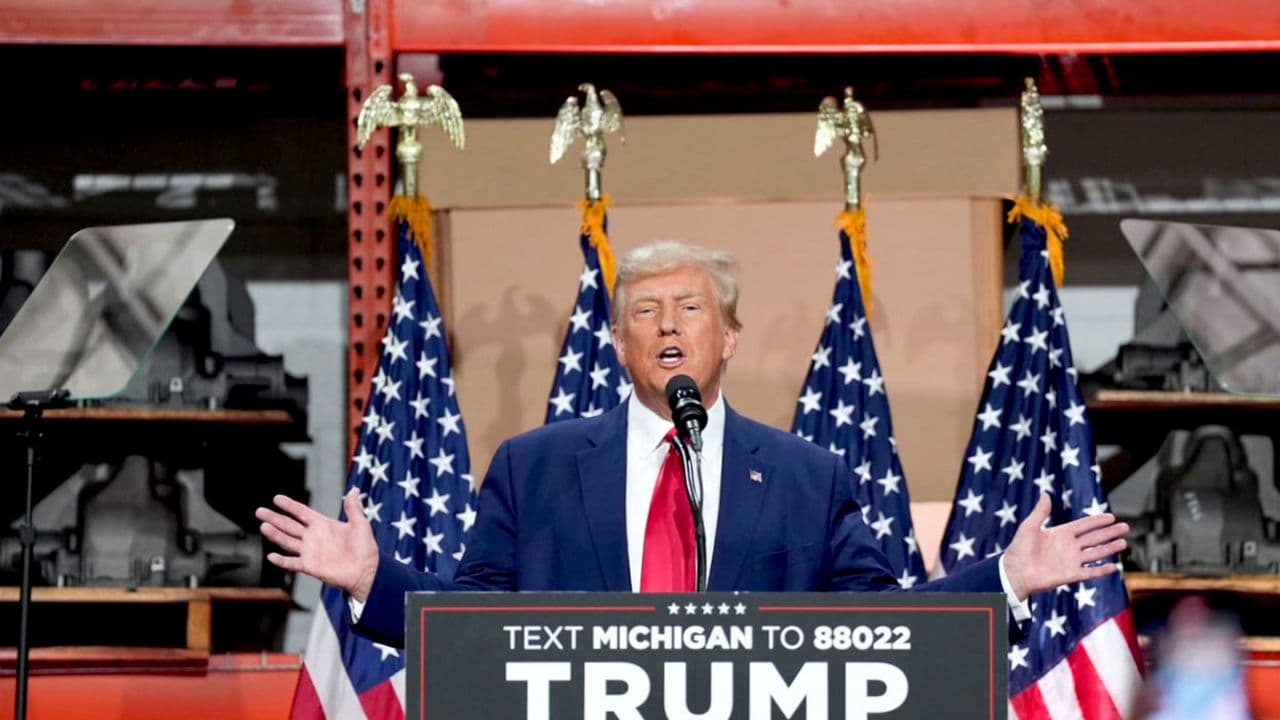
Shares of Stellantis (STLA), Ford (F) and General Motors (GM) climbed overnight late Sunday after U.S. President Donald Trump said that he had approved less stringent federal fuel economy standards, promising cheaper cars and more U.S. auto jobs.
Shares of STLA rose 1% overnight, while GM gained 0.2% and F edged up 0.1%.
Trump Touts Fuel Economy Rollback
Trump called it a “BIG DAY FOR AMERICAN AUTO WORKERS AND CAR BUYERS” in a Truth Social post. He said the new standards would end the Biden administration’s “EV Mandate,” save families thousands on a new car and allow automakers to build more vehicles in the U.S.
“Every Manufacturer, from General Motors to Ford to Stellantis, has called me wanting to build here, and now they can,” Trump said. “The Plants are coming back, and Jobs are returning,” he added, pointing to Michigan, Ohio, Indiana, and South Carolina. Trump announced his approval on Saturday. Transportation Secretary Sean Duffy subsequently said that further details would come on Monday.
So far this year, the legacy automakers have posted mixed returns. Ferrari (RACE) is up about 13%, GM has gained 2%, and F is barely positive. Toyota (TM) has fallen 11%, while STLA has lost 58% of its value.
U.S. EV makers are all in the red: Tesla (TSLA) is down 17%, Rivian (RIVN) 22%, and Lucid (LCID) about 57%. Chinese EV makers have also declined, with Nio (NIO) down 30%, Li Auto (LI) 32% and XPeng (XPEV) 50%.
What The Proposed Fuel Economy Rules Would Change
The Trump administration is moving to replace tougher Corporate Average Fuel Economy (CAFE) standards adopted under former President Joe Biden. NHTSA’s December proposal projected a fleetwide average of about 34.5 miles per gallon for model-year 2031 vehicles, compared with about 50.4 mpg under the Biden-era rule.
The proposal would reset standards beginning with model year 2022, then increase them by 0.5% annually through 2026 and 0.25% annually from 2028 through 2031, with a transitional standard for 2027. Trump also promised “LOWER PRICES.” NHTSA estimated that its proposal would reduce the average upfront price of a new vehicle by about $930. The agency projected it would result in 100 billion additional gallons of fuel consumed through 2050 and $185 billion more in fuel spending.
Detroit Automakers Outline US Production Plans
The three Detroit automakers have already announced major domestic production plans. Stellantis outlined a $13 billion U.S. investment over four years, including five new vehicles and more than 5,000 jobs. While GM announced about $4 billion over two years to expand U.S. production of gasoline and EVs, Ford said it will increase U.S. Lincoln production beginning in 2030 and phase out Lincoln imports from China for the American market.
Ford And GM Lose US Market Share
Even as Washington prepares to loosen mileage requirements, buyers are showing a strong appetite for efficiency. Cox Automotive forecasts Ford’s U.S. sales will decline 8.8% through the first three quarters of 2026, taking its market share to 12.5% from 13.4% a year earlier. GM’s sales are projected to fall 6.2%, with its share slipping to 16.7% from 17.4%.
Stellantis is projected to buck the trend, with year-to-date sales up 2.8% and its share rising to 7.8% from 7.5%. Still, Cox expects the Detroit three together to hold just over 36% of the U.S. market at the end of the quarter, their lowest share on record.
Cox said consumers have been moving toward hybrids and passenger cars, categories in which Asian automakers have an advantage. It projects year-to-date sales gains of 1.1% for Toyota and 5.6% for Honda, and expects Hyundai Motor Group to outsell Ford in the third quarter. Higher fuel prices have made the product mix more consequential, even as Cox raised its full-year U.S. new-vehicle sales forecast to 16.1 million from 15.8 million.
How Do Retail Traders Feel About GM, F, STLA?
On Stocktwits, retail sentiment for GM, F, and STLA was ‘bullish’ amid ‘high’ message volume.
One user said, “Stellantis will be a 250 billion market cap in 5 years. About 90 dollar a share. A whopping 1900% return. Most of us will regret selling at 13.”
View this Stocktwits post
Another user said, “$F long time ( several year) holder and can honestly say this stock sucks. Hard to stay bullish but yeah I’m sure we will see the usual ” run” from here to 14 again. Yawn.”
View this Stocktwits post
For updates and corrections, email newsroom[at]stocktwits[dot]com.<