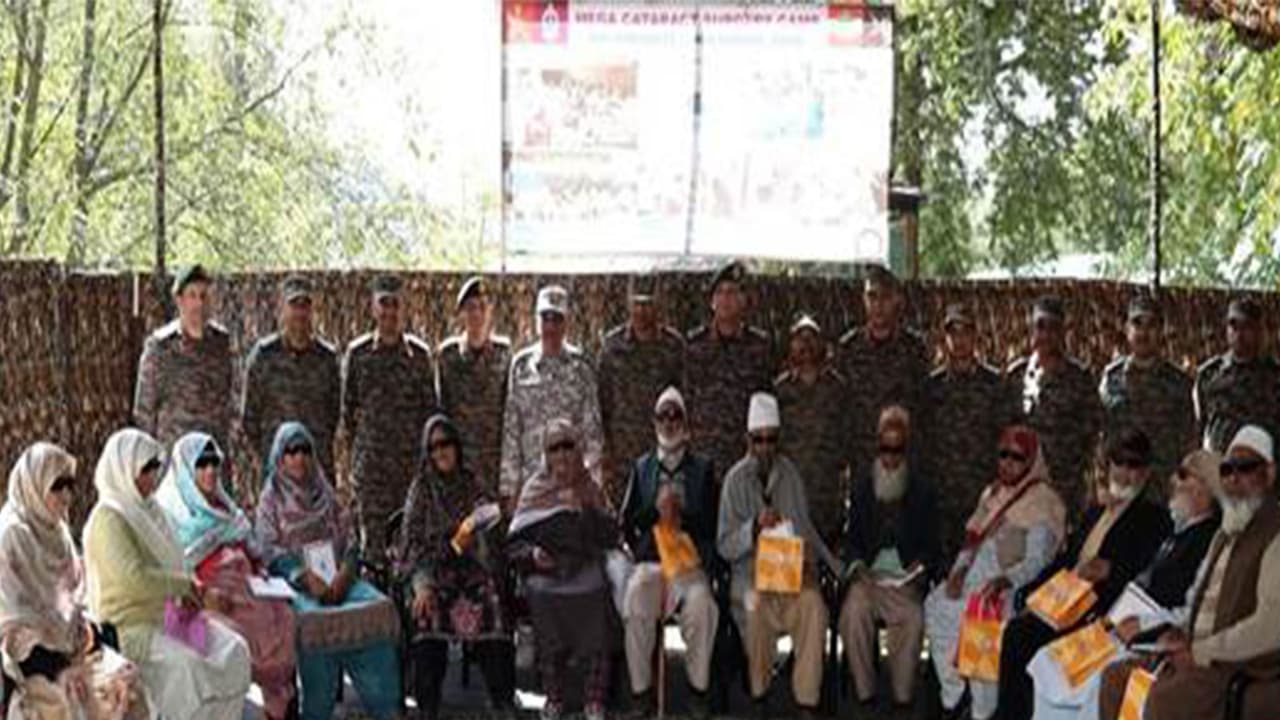
Under Operation Drishti, Army surgeons performed 220 sight-restoring surgeries in an underground theatre in Tangdhar, a shelling-prone LoC sector. The camp, led by Brig Sanjay Kumar Mishra, brought advanced eye care to remote border villages.
Along the Line of Control, help has to be carried across mountains and sometimes through the shadow of shelling. Inside an underground operation theatre at Tangdhar, a shelling-prone sector under threat throughout, surgeons of the Armed Forces Medical Services successfully completed 220 sight-restoring surgeries over two days in the 10th Mega Eye Surgical Camp under Operation Drishti, the first mega eye surgical camp of its kind at the LoC. As per the official release, most were cataract surgeries, along with selective retinal procedures and minimally invasive glaucoma surgery (MIGS).
Karnah (Kupwara) is a shelling-prone zone, and during Operation Sindoor it was among the most vulnerable locations on the LoC, absorbing an estimated 1,500 shells in three days. A forward surgical centre in the area was recently attacked, underlining how critical a protected medical facility is to this sector. The operation theatre remained under threat throughout the camp, yet the surgeons operated on, sheltered by the underground theatre that allowed delicate microsurgery to proceed safely.
Bringing Advanced Care to the LoC
The camp was led by Brigadier Sanjay Kumar Mishra, Head of Ophthalmology at Army Hospital (Research & Referral), Delhi Cantonment, whose team carried advanced phacoemulsification, vitreoretinal and glaucoma equipment across mountainous terrain. Patients from Khawarpora, Tangdar, Tadd, Bagbela, Yangdar and neighbouring hamlets came after screening and a broadcast on Radio Rooh-e-Karnah, and the Indian Army guided each one from arrival to recovery.
Restoring Sight, Rebuilding Lives
Five lives that changed under the operation include Ghulam Rabani, 87, from Khawarpora, who had been living in a world of shadows and familiar voices, needing to be led even to the courtyard and sitting in a bunker during shelling, unable to see the faces around him. After cataract surgery, he saw his family again and wept, as did his loved ones. He had waited long to see the faces of his grandchildren.
Md Younis, 66, from Tangdar, had endured the shelling of his border village before his eyesight gradually faded, leaving him dependent on the family he had always worked to support, with even small errands becoming a quiet humiliation. Radio Rooh-e-Karnah changed his mind, and today he looks at the mountains of his village and speaks of returning to work without holding anyone’s hand.
Hamida Begum, 55, from Bagbela, could no longer recognise faces or manage her household without assistance, and when shelling came, she could not see to guide her children to safety. What hurt her most was becoming a burden. When the bandage was removed after surgery, she saw her family beside her and smiled through her tears.
Manguti Begum, 81, from Yangdar, sat through the shelling in darkness, hearing the danger but unable to see it, and believed her eyes would close on a dark world. Her family carried her over rough mountain paths to Tangdhar, and after surgery, she raised her hands in prayer for the soldiers, doctors and paramedics who gave her sight.
Operation Drishti’s Broader Impact
Operation Drishti, the Armed Forces Medical Services’ series of mega-surgical eye camps envisaged by Raksha Mantri Shri Rajnath Singh, has so far screened over 1.5 lakh patients and performed more than 3,500 surgeries across 10 cities. At Tangdhar, it has brought advanced eye surgery to remote LoC villages, in keeping with Operation Sadbhavna. Surgeons kept a life-saving medical facility working under constant threat and showed that complex microsurgery can be done safely underground. It has deepened trust between the Army and border communities and offers a model for other hard-to-reach areas.
Official Commendation
Over the two days, the camp was visited by the Chief of the Army Staff, General Dhiraj Seth, who interacted with patients and distributed medicines and gifts. Director General Armed Forces Medical Services Air Marshal Sandeep Thareja also visited the camp and appreciated the efforts of the local team and the team of surgeons for their exceptional Surgical skills.
In a theatre beneath the mountain, patients walked in with dimmed vision and walked out with hope. The Army gave the people of Karnah back their faces, their families and their tomorrow.
11th Camp to be Held in Srinagar
The 11th camp in this series will be held in Srinagar from 27 to 29 September 2026, with the formal closing ceremony on 30 September 2026 graced by the Lieutenant Governor of Jammu & Kashmir, Manoj Sinha. (ANI)
(Except for the headline, this story has not been edited by Asianetnews Editorial staff and is published from a syndicated feed.)