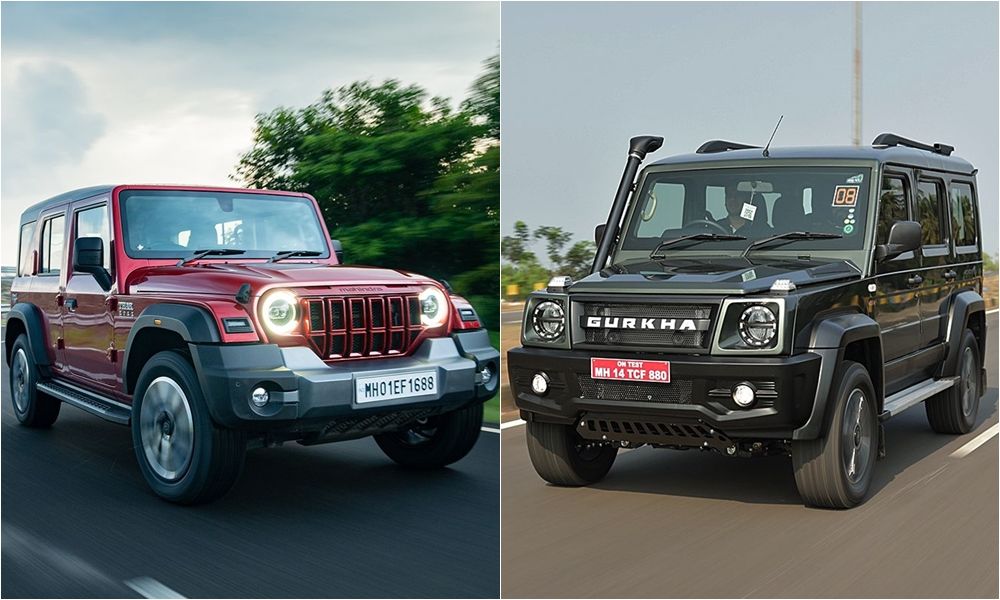
SUVs are the flavour of the day, and everyone is going for them. While there are a lot of crossovers pretending to be one, if you are someone planning to get a proper SUV, then there are very few choices in the mass-market segment. Two top choices among them are the and 5-Door. Now there are a few more options if you are not looking for a 4×4. But if 4×4 is also part of your checklist, then the Mahindra Thar Roxx and the Force Gurkha 5-Door are the ones to go for.
But you are not buying just an off-roader. You want an SUV that can also handle what the concrete jungle throws at you. So, the big question is – which of these is better for daily use? Let’s find out.
Size & Driveability
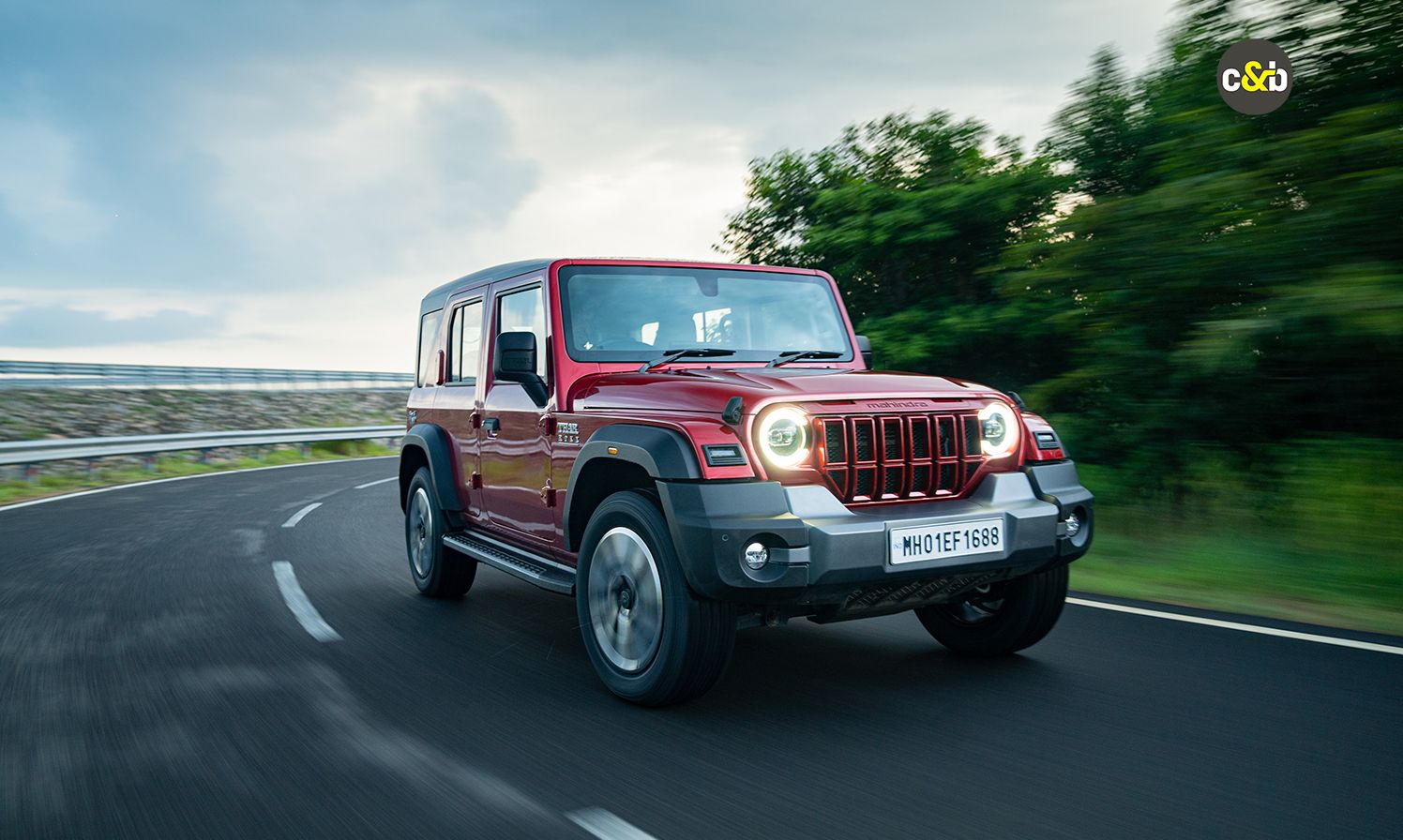
Both the Mahindra Thar Roxx and the Force Gurkha are big SUVs, and you will need a couple of days to get used to them if you regularly drive through narrow lanes or stop-and-go traffic. However, the learning curve is a bit easier in the Thar Roxx despite its longer footprint. What makes things easier is the fact that the former comes with the option of an automatic transmission, and you get electric power steering. The Gurkha, on the other hand, is only offered with a manual transmission and hydraulic power steering.
Also, after spending some time in the Thar Roxx, you tend to forget about the size. But in the Gurkha, the feeling that you are in a big SUV always tends to linger. So, while the Gurkha might be more capable off-road, in the urban jungle the Thar Roxx feels a bit more at home.

| Dimensions | Mahindra Thar Roxx | Force Gurkha |
| Length | 4428 mm | 4390 mm |
| Width | 1870 mm | 1865 mm |
| Height | 1923 mm | 2095 mm |
| Wheelbase | 2850 mm | 2825 mm |
| Ground Clearance | 226 mm | 233 mm |
Cabin Space & Layout

On paper, the Thar Roxx might offer more wheelbase, but for all practical purposes, the Gurkha’s cabin feels more spacious and airy. That’s thanks to the higher headroom and the larger windows. One upper hand it has over the Thar Roxx is that the Gurkha 5-Door is a proper 7-seater (2+3+2) SUV – 2 up front, 3 in the middle row and 2 in the third row. In fact, the third row gets individual seats, but it can only be accessed via the tailgate.
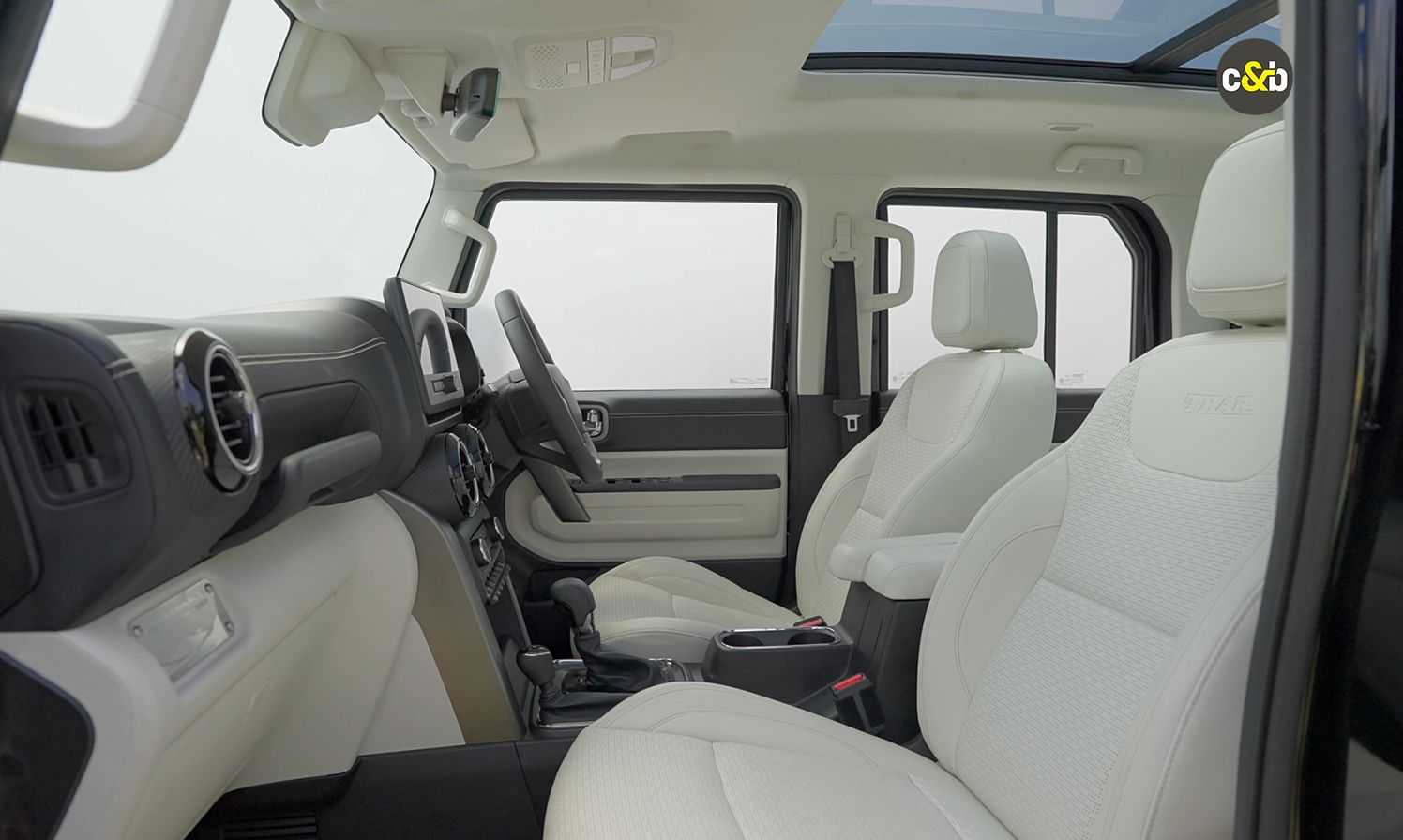
The Thar Roxx, on the other hand, is only a 5-seater, but where it excels is in comfort and finesse. Comfortable seats, easy ingress and egress, better fit and finish inside the cabin. Overall, a more premium touch and feel is what you get.
Features & Safety

In terms of creature comforts, the Thar Roxx comes with some important advantages. The higher variants offer you nicer displays with wireless connectivity, automatic AC and a sunroof as well. The quality of plastics used for the buttons and panels is much better than what you get in the Gurkha. Same goes for the seats. Better cushioning, nicer upholstery and ventilated front seats with power adjustment for the driver. Overall, the Thar Roxx is a nicer car to be in because it has been designed for someone who’s largely going to use it as a lifestyle vehicle and not an off-roader.

In terms of safety, the Thar is a better car, period. Six airbags, ABS with EBD, ISOFIX and a host of electronic aids like Electronic Stability Control, Hill Assist, Traction Control and more all come as standard. Higher variants also get a 360-degree camera, auto-dimming IRVM, rear disc brake and, of course, Level 2 ADAS functions.

The Gurkha, on the other hand, is a proper off-roader. That is why the plastics are rough and tough. The display on offer is a dealer-level fitment, and the seats are upholstered in fabric covers and come with manual adjustment. That said, Force offers multiple USB ports, power windows, a steering wheel that can be adjusted for height and reach, and electronically adjustable ORVMs, adding some amount of convenience.

Safety-wise, the Force Gurkha only covers the basics – dual airbags, front disc brakes with an Anti-locking Braking System with electronic brake force distribution and rear parking sensors. The list also includes rear parking sensors with a bad rear camera, three-point seatbelts and a tyre pressure monitoring system. However, the rear seatbelts don’t get pretensioners, and the centre middle-row passenger only gets a lap belt instead of a 3-point seatbelt.
Engine & Transmission

The Mahindra Thar Roxx comes with the option of both the 2.0-litre mStallion turbo petrol and the 2.2-litre mHawk diesel. The petrol engine comes in two states of tune: 158 bhp & 330 Nm (MT) and 174 bhp & 380 Nm (AT). The diesel motor, on the other hand, also comes in two states of tune – 150 bhp & 330 Nm torque (MT & RWD AT) and 172 bhp & 400 Nm (4×4 AT).
The Force Gurkha only comes with a 2.6-litre, four-cylinder diesel engine that makes 138 bhp and a meaty 320 Nm of peak torque. In terms of transmission, you only have the option of a 5-speed manual gearbox.

While the Gurkha’s performance is more than decent, compared to the Thar Roxx, it’s not so great. Plus, while the Gurkha might be great off-road, the Thar Roxx is better on the highway.
Price
The Thar Roxx is offered in a total of 7 variants and more than twice as many iterations based on the drivetrain and transmission choices. Prices start at Rs. 12.52 lakh and go up to Rs. 23.53 lakh (ex-showroom).

The Force Gurkha 5-Door, on the other hand, is only offered in one variant, priced at Rs. 17.63 lakh (ex-showroom). However, here you get 4×4 as a standard fitment. But on the Thar Roxx, the closest 4×4 diesel manual variant is the AX5, which is priced at Rs. 19.42 lakh (ex-showroom). However, it’s still pretty well equipped compared to the Gurkha.
Verdict
The Force Gurkha 5-Door is the more focused off-roader, with standard 4×4 and a proper 7-seat layout. But for daily use, the Thar Roxx makes more sense. It is easier to drive, more comfortable, better equipped and offers more engine, transmission and drivetrain choices.

The Gurkha is built primarily around its off-road ability, while the Thar Roxx does a better job of balancing off-road capability with everyday usability. If you are looking for a 4×4 that will spend more time on the road than off it, the Thar Roxx is the more practical choice.