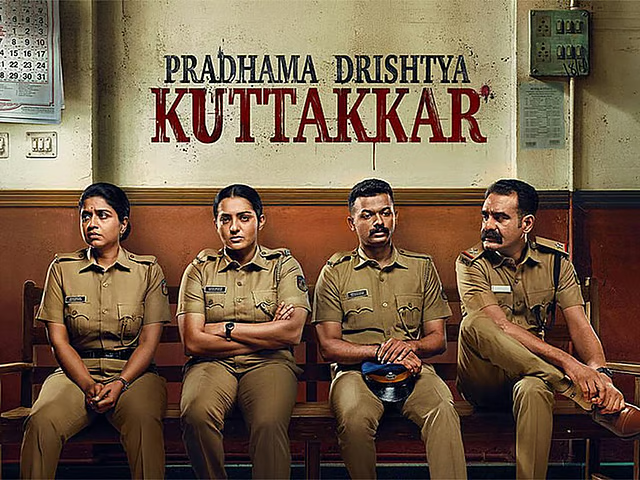
We’ve all seen enough films where the police chase someone who’s trying to hide a crime. Director Shahad Nilambur’s Pradhama Drishtiya Kuttakkar (Prima Facie Guilty) turns that around, and asks what happens when the ones doing the hiding are the police themselves. I walked out thinking, once again, that nobody does this sort of thing quite like Malayalam cinema.
Parvathy Thiruvothu plays Aleena Abraham, a young widow who joins the force on compassionate grounds after her husband, a policeman, dies in the line of duty. She’s not out to save the world. She has a family depending on her, and the job is how she keeps them going. It put me in mind of Ronth, last year’s night-patrol drama, which also showed policing for what it mostly is: long, thankless shifts, drunk drivers, petty offenders, and the odd night that goes horribly wrong.
This is one of those nights. Aleena and three junior colleagues, played by Mathew Thomas, Sidharth Bharathan and Unnimaya Prasad, bring in a man for drunk driving. There’s a scuffle at the station and the gun in Aleena’s hand goes off. The man is dead, and then they find another body in the boot of his car. The station’s CCTV footage only gets wiped after 14 days, so the four of them have two weeks to make sure nobody looks their way.
People have been calling this the new Drishyam, and I’d gently disagree. Drishyam was a commercial entertainer, built around a man clever enough to outthink everyone. This film is far more grounded. Its characters are grey and ordinary, and they’re making it up as they go. What stayed with me was their desperation. You feel it in almost every scene, and it’s much more unsettling than any twist.
The first half had me hooked. It’s a bold idea told simply, without fuss, and I’m always a little in awe of how often Malayalam filmmakers pull that off.
Vijayaraghavan comes in as the senior officer investigating the case, a man who has written books about his investigations and firmly believes there is no perfect crime, only a perfect investigation. Aleena happens to be a fan of his work, which gives their scenes together a lovely tension. The moment I keep thinking about is when she more or less asks him to let them go, because it was a mistake. She isn’t scheming there. She’s simply out of options.
It left me wondering why these officers couldn’t just own up. It was an accident, after all. Is it because the image of police brutality is so entrenched that no one, not even their own department, would give them the benefit of the doubt? The film doesn’t answer that, and I’ve been turning it over since.
My only real complaint is the second half, which slows down considerably. At close to three hours, it could easily have lost 20 minutes.
What carries the film through is the acting. Parvathy, in uniform for the first time in a Malayalam film, is excellent, frightened and resourceful and never once overdone. And that’s the thing I love about Malayalam cinema in general: it isn’t only the leads who are good. Even the smallest parts are played by people who know exactly what they’re doing. The emotions feel measured and real, and nobody overacts. A look does the work that another industry might hand to a shouting match.
Pradhama Drishtiya Kuttakkar isn’t Drishyam, and I think it’s better off for it. It’s a gripping, beautifully acted film that makes you question how quickly we decide who’s guilty.