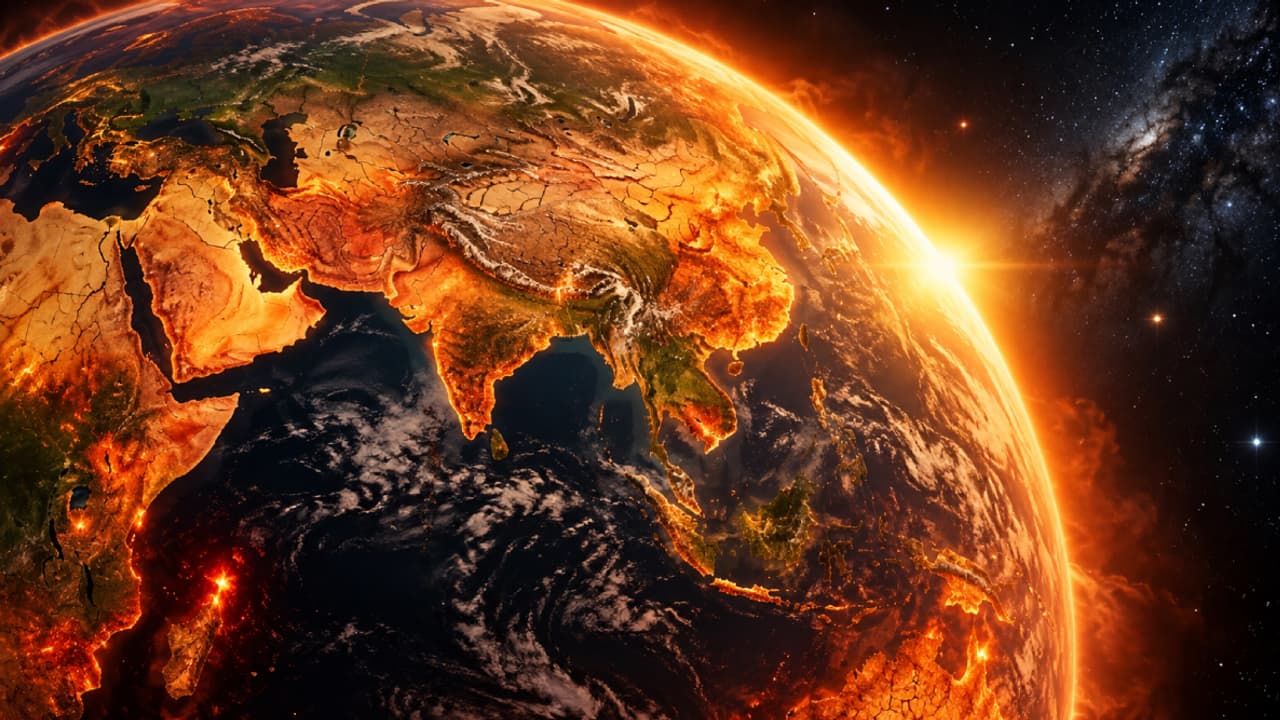
Scientists are closely tracking a rapidly intensifying Pacific climate pattern that could reshape weather across continents, influencing temperatures, rainfall, agriculture and public health in the months ahead.
A rapidly strengthening El Niño in the Pacific Ocean is raising concerns among meteorologists and disaster experts as forecasts point to one of the most intense events recorded in modern observations.
Scientists expect the phenomenon to continue developing through the coming months before reaching maximum strength in early 2027. The event has the potential to influence temperatures, rainfall patterns, agriculture and public health across multiple continents.
Weather agencies and researchers are warning that the combination of a powerful El Niño and an already warming climate could amplify droughts, floods, heatwaves and other extreme weather events worldwide.
Recent data from the United States National Oceanic and Atmospheric Administration shows sea surface temperatures across the equatorial Pacific have climbed well beyond the threshold used to define El Niño conditions.
The World Meteorological Organization has described the developing event as a very strong one, capable of producing significant disruptions to both temperature and precipitation patterns around the globe.
Researchers from the University of Chicago’s Climate Impact Lab estimate that the event could contribute to approximately 451,000 excess deaths linked to heat by February if conditions unfold as projected.
El Niño is the warm phase of the naturally occurring El Niño-Southern Oscillation cycle. It develops when trade winds weaken and warmer-than-normal waters accumulate across parts of the Pacific Ocean.
Although it is a natural climate phenomenon that typically appears every two to seven years, its effects can extend far beyond the Pacific region.
The pattern often pushes global temperatures higher while altering rainfall distribution across large parts of the world, bringing severe dryness to some regions and unusually heavy rainfall to others.
Why This Event Is Drawing Unusual Attention
The current event stands out because of the exceptional ocean temperatures already being observed.
Measurements this month showed equatorial Pacific temperatures exceeding normal levels by more than three degrees Celsius, making it one of the strongest anomalies recorded during an El Niño period.
Scientists classify El Niño events according to how much ocean temperatures exceed average conditions. The current readings place the phenomenon firmly within the strongest category.
While El Niño itself is not caused by climate change, researchers emphasize that a warmer planet can intensify its impacts.
Global temperatures have already risen significantly above pre-industrial levels due to greenhouse gas emissions. As a result, when El Niño develops, it does so on top of an already elevated temperature baseline.
This overlap can result in more severe heatwaves, greater drought intensity, stronger rainfall events and increased risks of wildfires and crop failures.
The last major El Niño event, combined with broader climate warming, contributed to record global temperatures and was associated with damaging floods, severe fires and deadly heat events across several countries.
Many researchers believe the current event may serve as another demonstration of how natural climate variability and long-term warming can interact.
Impacts Expected Across Food, Water And Health
Agriculture is expected to face significant challenges if current forecasts materialize.
Regions that typically become drier during El Niño episodes, including parts of Australia, Southern Africa and Central America, may experience increased stress on crops and water supplies.
In India, concerns have already emerged over rice production, with expectations of a notable decline linked to drought conditions associated with the developing weather pattern.
The effects could extend well beyond crop yields.
United Nations forecasts suggest nearly 50 million people may face acute hunger by the end of 2027 because of disruptions associated with the event. Southern Africa and parts of South America are expected to be among the most vulnerable regions.
Flood risks are also increasing in areas that often experience heavier rainfall during El Niño years. Parts of South America and sections of Central Asia could receive significantly above-average precipitation, raising the possibility of damaging floods.
Health experts are paying particular attention to heat-related impacts.
The Climate Impact Lab estimates that countries including Nigeria, Indonesia and Sudan could experience some of the highest numbers of excess heat-related deaths if temperatures rise as projected.
Researchers stress that emergency preparedness measures, early-warning systems and protections for vulnerable populations could substantially reduce those risks.
The developing El Niño is also likely to influence hurricane activity in parts of the Pacific and contribute to heat extremes far from its point of origin.
As the phenomenon strengthens toward its expected peak, governments, farmers and emergency agencies around the world are preparing for what could become one of the most consequential climate events of the decade.