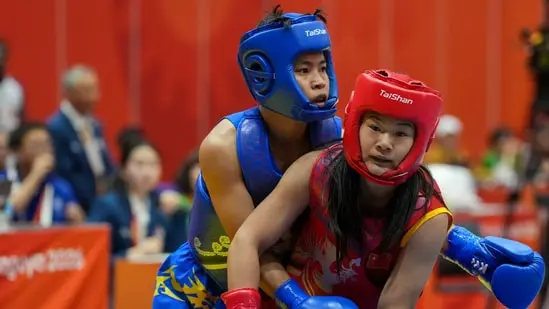
Teqball, soft tennis and now Wushu. The lesser-known sports have entered the spotlight during the opening week of the 2026 Asian Games, leaving Indians curious about disciplines they may have barely heard of before.
On Thursday, Roshibina Devi Naorem secured a historic Asian Games medal in the women’s 60kg category. With a second consecutive silver at the Asiad, she became the first Indian Wushu player to win a hat-trick of medals at the Games.
Incidentally, this medal came 20 years after India won its first-ever medal in the sport at the 2006 Doha Games, where M. Bimoljit Singh finished third in the men’s 60kg Sanda event. And yet, Roshibina’s silver, which etched her name in the Asian Games record books, once again sparked questions about the sport: What is Wushu? What does “Wushu” mean? What type of sport is it? And what is its history?
Let’s start with the first: what is Wushu?
Wushu is a collective term for Chinese martial arts and is sometimes referred to as Kung Fu. Modern competitive Wushu is governed by the International Wushu Federation (IWUF), which was founded in 1990 to oversee the development and regulation of Wushu worldwide.
Wushu mainly comprises two disciplines – Taolu, which involves choreographed routines, and Sanda, a full-contact combat sport.
Wait… so what are Taolu and Sanda?
Taolu is a judged competition focused on the precision, speed, balance and execution of choreographed movements. It includes both unarmed routines and routines performed with traditional weapons such as swords, broadswords, spears and staffs.
At the Asian Games, Taolu is divided into several events, including Changquan, Nanquan, Taijiquan and weapon-based events such as Daoshu, Gunshu and Taijijian.
Changquan, which translates to “Long Fist”, is a style of Wushu that originated in northern China. It emphasises extended kicks, fast movements and acrobatic techniques. The modern competitive form places a strong emphasis on flexibility, speed and athleticism.
Nanquan, which translates to “Southern Fist”, developed from martial arts styles in southern China. It features low and stable stances, powerful and fast hand techniques, explosive movements and a distinctive vocal expression known as fasheng.
Taijiquan is characterised by slower, relaxed and circular movements, while Taijijian is its sword-based counterpart. Both require control, balance and precision.
Daoshu and Gunshu are weapon-based Taolu events. Daoshu involves a short, curved blade, while Gunshu uses a long staff. Competitors perform set routines that are judged for their execution and difficulty.
The other major Wushu discipline, Sanda, is a full-contact combat sport that incorporates techniques from Wushu and other Chinese martial arts.
Taolu athletes are judged on factors including execution and difficulty. Sanda, on the other hand, is direct head-to-head combat, with athletes using punches, kicks, throws and other permitted techniques to score points against their opponents.