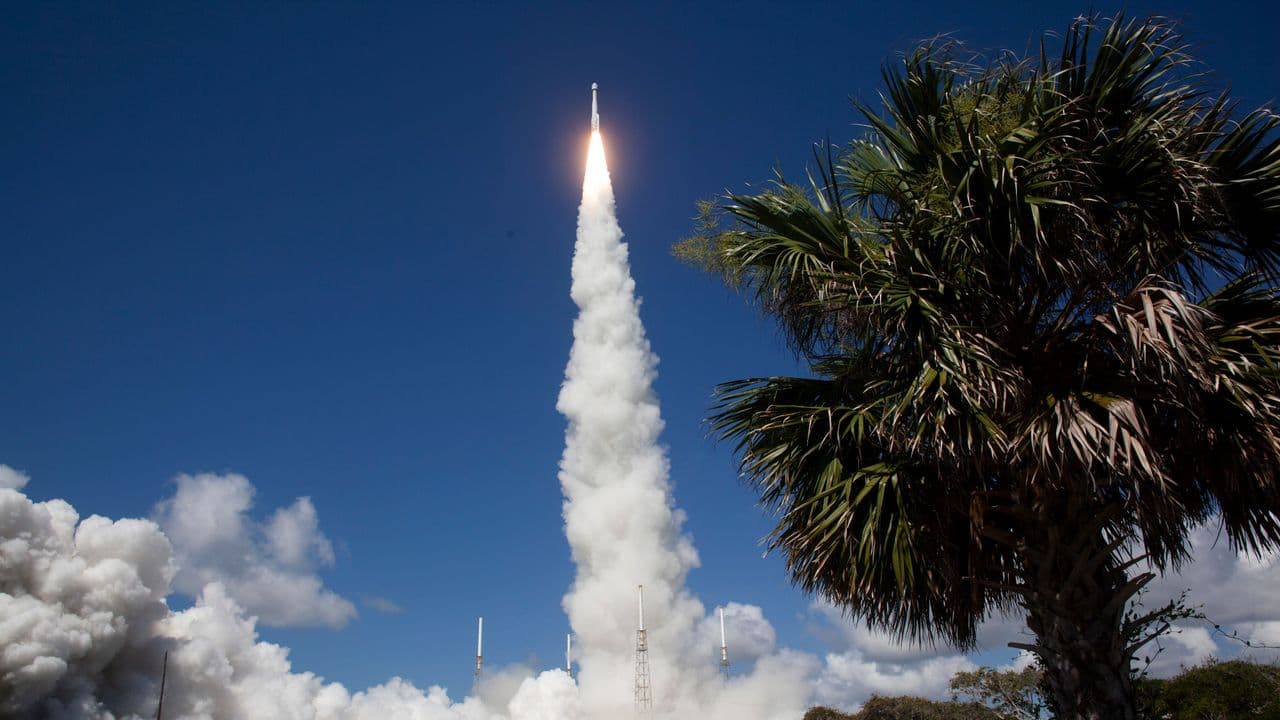
Driven by late-stage growth rounds, mega-deals, and landmark public market events, private investment in the commercial SpaceTech sector reached an all-time trailing 12-month high of $23 billion.
- Investments in the Space Sector reached a record $23 billion in the 12 months ending Q2 2026, more than double the $9.7 billion in Q2 2025.
- Late-stage Series D+ funding jumped 123% year over year to $7.2 billion—representing 47% of total capital—as investors shifted focus from early-stage diversification to scaling proven category leaders.
- Mergers and acquisitions expanded nearly fourfold year over year, including major satellite communications deals such as Amazon’s $11.6 billion acquisition of Globalstar and Rocket Lab’s $8 billion acquisition of Iridium.
Global venture capital investment in space technology companies reached an all-time high of $23 billion in the 12 months through June 2026, driven by an influx of late-stage growth capital and landmark market developments.
According to the Q2 2026 Seraphim Space Index, quarterly venture deployment reached $7.5 billion across 141 deals, confirming a structural shift in SpaceTech from a speculative niche into an institutional-grade asset class.
A major catalyst for the sector’s mainstream validation was SpaceX’s (SPCX) historic initial public offering. The launch and satellite constellation giant raised $85.7 billion in gross proceeds, briefly sending its market capitalization above $2 trillion.
The report notes that the listing has created a significant liquidity event expected to recycle capital into early-stage startups and angel networks.
SPCX stock slipped 2.2%, RKLB stock eased 1.5%, and Intuitive Machines slipped 5% on Wednesday
Larger Deal Sizes In Private Space Tech
As SpaceTech matures, investors are increasingly concentrating capital on established category leaders. While Seed-stage deals represented 47% of total volume, late-stage Series D+ rounds grew 123% year over year.
Series D+ financings accounted for $7.2 billion, or 47% of total investment value for 2026 year-to-date. Consequently, average deal sizes grew to $72.5 million in Q2 2026, compared to $68.1 million in Q1.
“Capital continued to favor businesses with significant infrastructure and hardware requirements,” the report stated, highlighting that nine of the top 10 deals in Q2 were completed by capital-intensive hardware and infrastructure firms.
The quarter’s largest deal was a $600 million Series D round by U.S.-based in-space defense firm True Anomaly. Other major rounds included Germany’s STARK ($570 million), Finland’s ICEYE ($520 million), China’s ADA Space ($517 million), and U.S.-based Impulse Space ($500 million).
M&A Activity And Global Competition Accelerate
Mergers and acquisitions grew approximately fourfold compared to the prior trailing 12-month period. Industry players such as Rocket Lab (RKLB), York Space (YSS), Firefly (FLY), and Intuitive Machines (LUNR) actively acquired platforms to gain scale.
In satellite communications, acquisitions increasingly focused on access to licensed spectrum, regulatory rights, and existing customer networks rather than orbital hardware alone.
For instance, Amazon agreed to acquire Globalstar for $11.6 billion to advance its Leo direct-to-device service. Rocket Lab announced an $8 billion agreement to acquire Iridium, transitioning into an end-to-end communications and launch infrastructure provider.
US, The Epicenter For Space Deals
Geographically, North America maintained its dominant position, accounting for $13.7 billion across 250 deals over the trailing 12 months, including 75.9% ($5.7 billion) of all capital raised in Q2.
However, Asia continued to narrow the deal-volume gap, recording 212 deals over the trailing 12 months. China, in particular, demonstrated key technological parity milestones, including the successful ocean-net recovery of a Long March-10B first-stage booster on July 10, marking the first time a nation outside the U.S. successfully completed a controlled propulsive return of an orbital-class booster.
Looking ahead, space investment activity shows no signs of slowing down. Industry observers point to a potential $10 billion external funding round by Jeff Bezos’ Blue Origin—which is targeting a return to flight for its heavy-lift New Glenn rocket by late 2026—as the next potential landmark event in space capital formation.
SPCX, RKLB, LUNR Stock: Retail View
Retail sentiment on Stocktwits was ‘neutral’ for SpaceX and ‘extremely bullish’ for Rocket Lab and Intuitive Machines.
SPCX stock rose 0.8% year-to-date, LUNR stock rose 0.2% and RKLB stock added 1.8% year-to-date.
For updates and corrections, email newsroom[at]stocktwits[dot]com.<