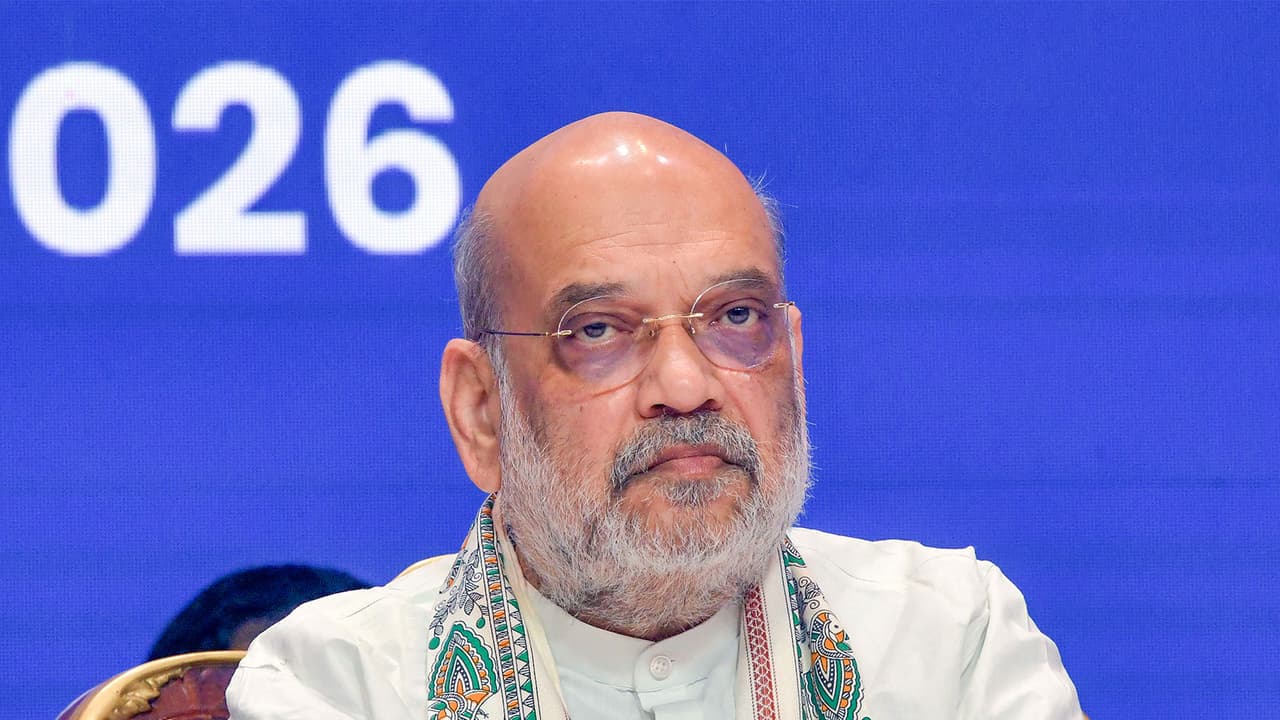
Union Home Minister Amit Shah has announced a target to make India drug-free by December 31, 2029. He emphasized the need for collective efforts from all levels of administration and unveiled a ‘Vision Document’ to dismantle drug networks.
Union Home Minister Amit Shah on Tuesday set a target to uproot drug trade from India by December 31, 2029 seeking “collective efforts in one direction” from all stakeholders comprising school principal, Patwari, PSI of Police Station, Directors General of Police, Chief Secretaries in the states and the Union Home Secretary.
Shah made the announcement while inaugurating the 3rd National Conference of Anti-Narcotics Task Force (ANTF) Heads of states and Union Territories (UTs) in New Delhi.
Addressing an event, Shah said under the leadership of Prime Minister Narendra Modi, the country has been taking one step after another over the past five years towards achieving the difficult goal of a drug-free India.
“The time has now come to deliver a decisive blow against narcotics, which have become the most serious threat to the country and the world, and to achieve victory through collective efforts,” Shah said.
He said that “by December 31, 2029, the country will collectively succeed in uprooting the drug trade from India.”
Noting that the fight against drugs is the most difficult of all battles, Shah said we will have to fight this problem unitedly and with passion, and we must achieve victory.
To build a Viksit Bharat by 2047, to save future generations and to connect the youth with India’s development, he further said the only option before us is to make India drug-free.
The Home Minister said “whatever we have done so far is not enough.”
“Until the Principal of every school, the Patwari of the village, the Police Sub-Inspector (PSI) of the police station, the Director General of Police and the Chief Secretary of the state, and even the Home Secretary of the Government of India, work in one direction, we will not achieve success,” mentioned the Home Minister while addressing the gathering that included ANTF heads from 36 states and UTs, along with representatives of concerned government departments and other stakeholders.
He said that today’s conference is the most important because this time we will move forward towards complete victory by fixing “target, tmeline and accountability.”
Vision Document 2026-2029
Terming the ‘Vision Document 2026-2029’ as the Gita for all those involved in fight against drug menace, Shah stated that the “targets and timelines” have also been fixed in the Vision Document prepared with great effort after discussions with more than 35 departments in fight against drug menace, and that it will also be reviewed after some time.
He said we have prepared the complete roadmap after taking suggestions from all stakeholders, and it has been given to everyone with definite targets.
Shah added that the MHA or the NCB cannot do all this alone. “We all have to fight this battle with top priority and complete dedication, and we have to win it as well.”
Amit Shah said that in the first Anti-Narcotics Task Force (ANTF) conference we had created an institutional mechanism and strengthened it. In the second ANTF conference, we discussed capability, action and execution in order to convert that mechanism into action. Today, the third ANTF conference will convert this roadmap into a decisive battle.
New Strategy to Dismantle Networks
Noting the emerging challenges such as synthetic drugs, diversion of precursor chemicals, new communication technologies, dark-net, drug markets, crypto, dead-drop delivery systems, and international drug networks, he suggested to “constitute a team of officers, who think ‘out-of-the-box,’ in every state, and success should be shared and implemented across the entire nation.”
Union Home Minister stated that instead of maintaining a seizure-centric approach, we must move forward with the objective of dismantling entire networks.
“Our priority, along with backward-forward investigation, must also include financial investigation and tracing digital links. Our strike must hit the funds earned by drug dealers.”
Three-Level Attack and Legal Framework
Amit Shah suggested to hit the cartels at three levels: the entry point, the inter-state distribution system, and the local sales networks within districts.
Further, he said, districts will be categorized into three clusters: those where drugs are manufactured or enter the country, those serving as transportation corridors, and those where consumption takes place.
The minister stated that we must increase the utilization of Prevention of Illicit Traffic in Narcotic Drugs and Psychotropic Substances (PITNDPS), as there is a strong need for it in the country.
“A complete roadmap from investigation to conviction must be formulated in coordination with public prosecutors. A dedicated campaign must be launched to deport foreign accused present in India and blacklist them so they can never re-enter the country. Moreover, the fugitives who are supplying drugs to the country from abroad should be caught and brought before the Indian courts. By targeting borders and production centres, all loopholes must be plugged.”
He further said that over 100 targets have been categorized across these four pillars.
Grassroots Campaign with Nashamukt Mitras
Under the target of registering 1 lakh Nashamukt Mitras outlined in the Vision Document, various ministries have registered 46,780 Nashamukt Mitras so far, and they are already operational.
To take this campaign to the grassroots level, Shah also said, Nashamukt Mitras will visit 10 lakh schools, colleges, and institutions across the country in the coming days to caution the youth and sensitize campus directors.
(Except for the headline, this story has not been edited by Asianetnews Editorial staff and is published from a syndicated feed.)