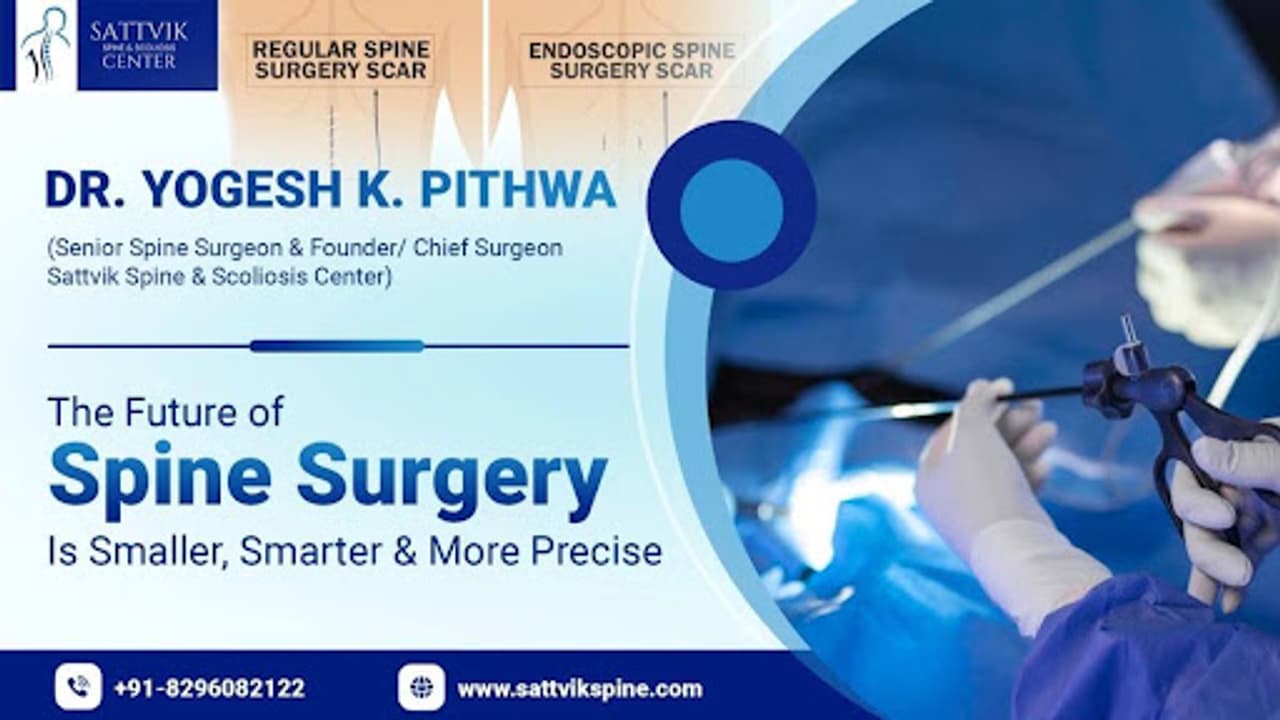
Advanced endoscopic techniques are changing the way some spine procedures are performed. Explore how minimally invasive approaches may affect surgical access, recovery, hospital stays and the patient experience.
Dr. Yogesh K. Pithwa, (Senior Spine Surgeon & Founder/ Chief Surgeon Sattvik Spine & Scoliosis Center)
The next-generation endoscopic spine surgery techniques are transforming patient recovery. In contrast to traditional open spine operations, full-endoscopic procedures use tiny incisions and a camera-equipped tube to remove disc herniations or decompress nerves. Recent studies show that patients undergoing endoscopic decompression experience dramatically less blood loss, shorter hospital stays and faster return to normal activities, while achieving clinical outcomes comparable to open surgery. For example, one meta-analysis of over 1,000 patients found endoscopic discectomy had significantly greater patient satisfaction, far lower blood loss and a shorter hospital stay on average than open discectomy. These advances are particularly welcome in India, where demand is rising for “keyhole” spine surgery that can get working-age patients back on their feet in weeks, not months.
Advance Endoscopic Techniques:
Endoscopic spine surgery encompasses several approaches. In transformational endoscopic discectomy, the surgeon accesses the disc space through the foramen (back of the spine) to remove herniated disc tissue. An interlaminar approach (through the small space between vertebrae) may be used for central or L5–S1 herniation. Biportal endoscopic techniques use two small portals (one for the camera, one for instruments) to expand access and versatility. Endoscopic tools (high-definition cameras, lasers, drills) allow precise removal of disc fragments, bone spurs or thickened ligaments. These methods address lumbar and cervical disc herniations, foraminal stenosis and select cases of central canal stenosis or cervical radiculopathy. (Extensive deformities or multi-level instability may still require fusion with open surgery.) Multiple trials and meta-analyses show endoscopic techniques achieve outcomes equivalent to open surgery for lumbar stenosis, herniations and cervical radiculopathy. In India, a growing number of specialized centers (including Sattvik Spine) have invested in training and equipment to offer these high-precision procedures.
Evidence-based Recovery Benefits
Studies consistently report faster recovery after endoscopic spine surgery. Because only millimeter-scale incisions are made and muscle tissue is largely spared, patients have less immediate postoperative pain and require less analgesia (though formal pain scores were not always published, surgeons observe a gentler recovery). Operative blood loss is markedly reduced (one meta-analysis found an average of 124 mL less blood loss in endoscopic discectomy). Most strikingly, hospital stays are much shorter: instead of 3–7 days typical for open lumbar surgery, many endoscopic cases are done as outpatient or overnight stays. In practice, most patients go home within 24 hours after endoscopic spine surgery, often walking that same day. Study confirms these resource benefits: compared to open laminectomy, endoscopic decompression had significantly shorter length of stay and nearly all endoscopic patients went directly home.
These shorter stays translate into faster return to work and activities. Prior analyses have shown that minimally invasive spine surgeries (including endoscopic and tubular techniques) enable earlier return to work than traditional open operations. In real-world practice, many patients resume desk jobs within 1–2 weeks of an uncomplicated endoscopic discectomy (compared to 4–6 weeks for open surgery). Even labor-intensive jobs are typically restarted in a few months rather than half a year.
Patient Section And Limits
Endoscopic surgery is not appropriate for every case. Ideal candidates have localized pathology (e.g. a contained disc herniation, foraminal or lateral recess stenosis) that can be addressed through a small portal.
Not suitable: very large central stenosis, major spinal deformity (scoliosis/kyphosis), or multi-level instability generally still require open or fusion surgery. Because of the steep learning curve, surgeons with special endoscopic training should perform these procedures. Early in their experience, surgeons must choose simple cases; the learning curve may require 50–100 cases before outcomes are consistently excellent. In inexperienced hands, complication rates can be higher: one review noted overall reported complications range up to ~20% (including dural tears, nerve injury or reoperation). Thus, careful patient selection and strict indications are essential. Other limitations include need for specialized equipment and imaging (real-time X-ray or navigation), and the fact that some fusion procedures are still in development for full-endoscopic approaches.
About the Author
Dr. Yogesh K. Pithwa is a Senior Spine Surgeon and Founder of Sattvik Spine & Scoliosis Center, Bengaluru, specialising in the comprehensive management of spinal disorders. With expertise in advanced and minimally invasive spine procedures, he focuses on evidence-based treatment, appropriate patient selection and preserving spinal function while helping patients achieve a safe and effective recovery. His clinical interests include endoscopic spine surgery, minimally invasive spine surgery, spinal deformities, scoliosis, degenerative spine conditions and complex spinal disorders.
Sattvik Spine & Endoscopic Centre
472 ,new no. 25, 45th Cross Rd, 8th Block, Jayanagar, Bengaluru, Karnataka 560082
Ph: +91 80420 68257, +91 82960 82122
Website: sattvikspine.com/