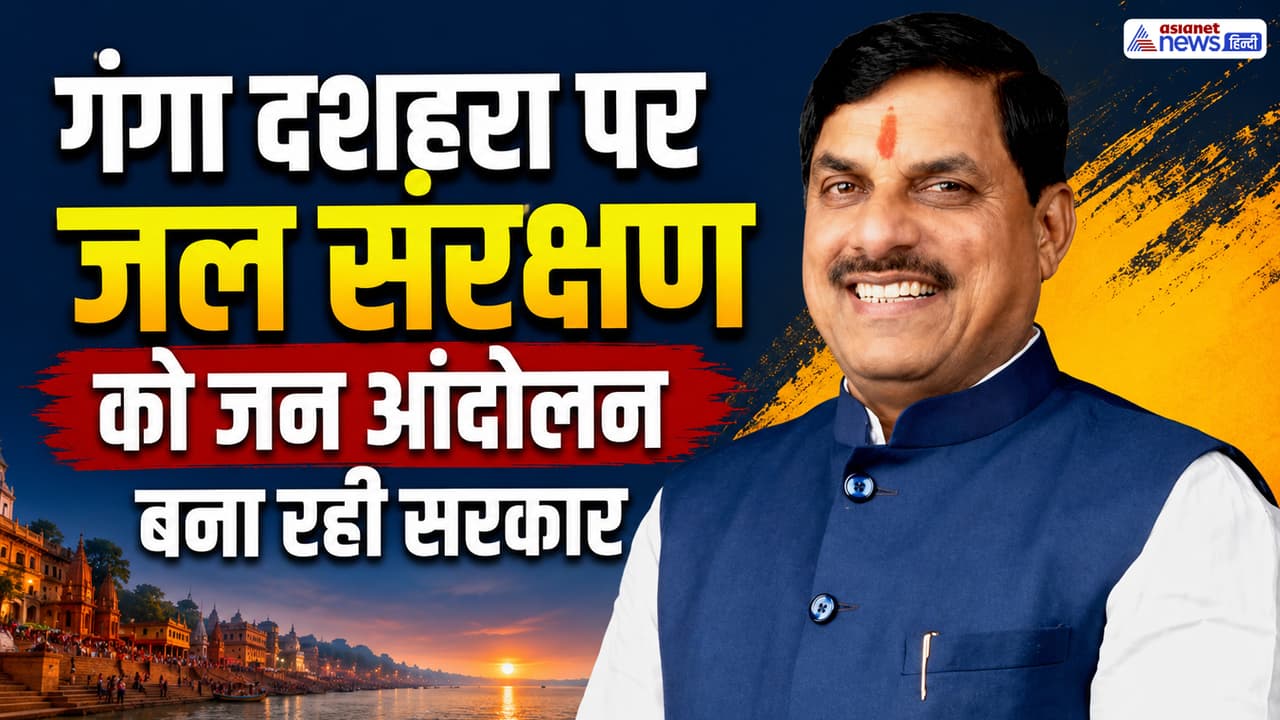
Underlining the importance of water conservation on the occasion of Ganga Dussehra, emphasis was laid on Prime Minister Modi’s water schemes and Madhya Pradesh’s Jal Ganga Augmentation Campaign. Work is being done to ensure water security for the future by making water conservation a mass movement.
In Indian culture, rivers are not just a source of water but are considered to be goddesses. Among these, Mother Ganga’s place is considered to be the highest. Ganga Dussehra festival, celebrated on the tenth day of Shukla Paksha of Jyeshtha month, is celebrated to commemorate the descent of river Ganga on earth. It is also known as Ganga Dussehra, Ganga Dashami and Dussehra. This festival is considered a symbol of the importance of water and gratitude towards it. The meaning of Ganga is not only a river but also associated with sacred and clean water. This is the reason why water conservation is today being linked to the development and future of the country.
Prime Minister Narendra Modi made water conservation a mass movement
Prime Minister Narendra Modi has taken many big steps towards making water conservation a national level mass movement. He transformed resolutions like “If there is water, there is tomorrow” and “Water in every house” into a nationwide campaign. The Ministry of Jal Shakti was formed under his leadership. Also, schemes like Jal Jeevan Mission, Namami Gange, Amrit Sarovar Mission and Jal Shakti Abhiyan have given a new direction to water conservation in the country. Through these schemes, special work is being done on construction of water structures, river conservation, rain water harvesting and groundwater recharge in villages and cities.
Water conservation increased through Amrit Sarovar and Catch the Rain campaign
Under Amrit Sarovar Yojana, a target was set to construct and revitalize 75 reservoirs in every district of the country. Till now more than 70 thousand Amrit Sarovars have been prepared. Due to this, improvement in rain water harvesting, irrigation and ground water level has been seen. Similarly, the “Catch the Rain” campaign worked to link rain water conservation with public participation. Prime Minister Modi has been continuously emphasizing that saving water is not only the responsibility of the government but the duty of every citizen. Check dams, rain water harvesting systems and revival of traditional water sources across the country have helped in reducing water crisis.
The country’s water situation is improving due to water conservation.
The impact of water conservation campaigns is now visible on the ground. Ground water level has increased in many areas and there has been relief in water stressed areas. A reduction has also been recorded in the number of over-exploited water units. Prime Minister Narendra Modi’s aim is not just to start schemes, but to make water conservation a part of people’s habit and culture. There is also a continuous emphasis on making children “Water Warriors” and developing a sense of responsibility in the society.
Jal Ganga Enhancement Campaign becomes a big mass movement in Madhya Pradesh
Madhya Pradesh, rich in natural water resources, is also working rapidly in the direction of water conservation. “Jal Ganga Augmentation Campaign” being run by the state government has become a big mass movement at the state level. In the year 2025, this campaign was run from 19 March to 30 June and it has been continued on a large scale in the year 2026 also. Its objective is to conserve, rejuvenate and enhance water sources. Under the campaign, deepening, cleaning and reconstruction of rivers, ponds, stepwells, wells and check dams is being done. Besides, work is also being done on rain water harvesting and ground water recharge on a large scale.
Farmers and rural areas are getting big benefits
Madhya Pradesh is an agriculture-based state, where farming and rural economy depend on water. Increasing population, irregular rainfall and falling groundwater level have worsened the water crisis. Farm ponds, stopdams, ridge-to-valley model and new water structures are being constructed through Jal Ganga Samvardhan Abhiyan. This is providing irrigation facilities to the farmers and helping in increasing their income. Works related to water conservation are being done in the state at a cost of about Rs 2,500 crore. Participation of Gram Panchayats, women, youth and public representatives is also becoming a major strength of this campaign.
Conservation of cultural heritage along with water conservation
The ancient stepwells, ponds and traditional water structures of Madhya Pradesh are the cultural identity of the state. Their renovation is not only promoting water conservation but also strengthening tourism and cultural pride. Through programs like Paani Chaupal, farmers are being given information about drip irrigation, low water crops and modern technologies. Due to this, awareness about water conservation is increasing in the society.
There is a need to make water conservation successful through public participation.
Jal Ganga Augmentation Abhiyan has become not just a government scheme but a campaign of collective participation. Its objective is to create a water secure and prosperous future for the coming generations. Making water conservation a part of lifestyle is the greatest need of the hour. If water sources are saved today, only then water crisis can be avoided in future.
(Author- Chief Minister of Madhya Pradesh)