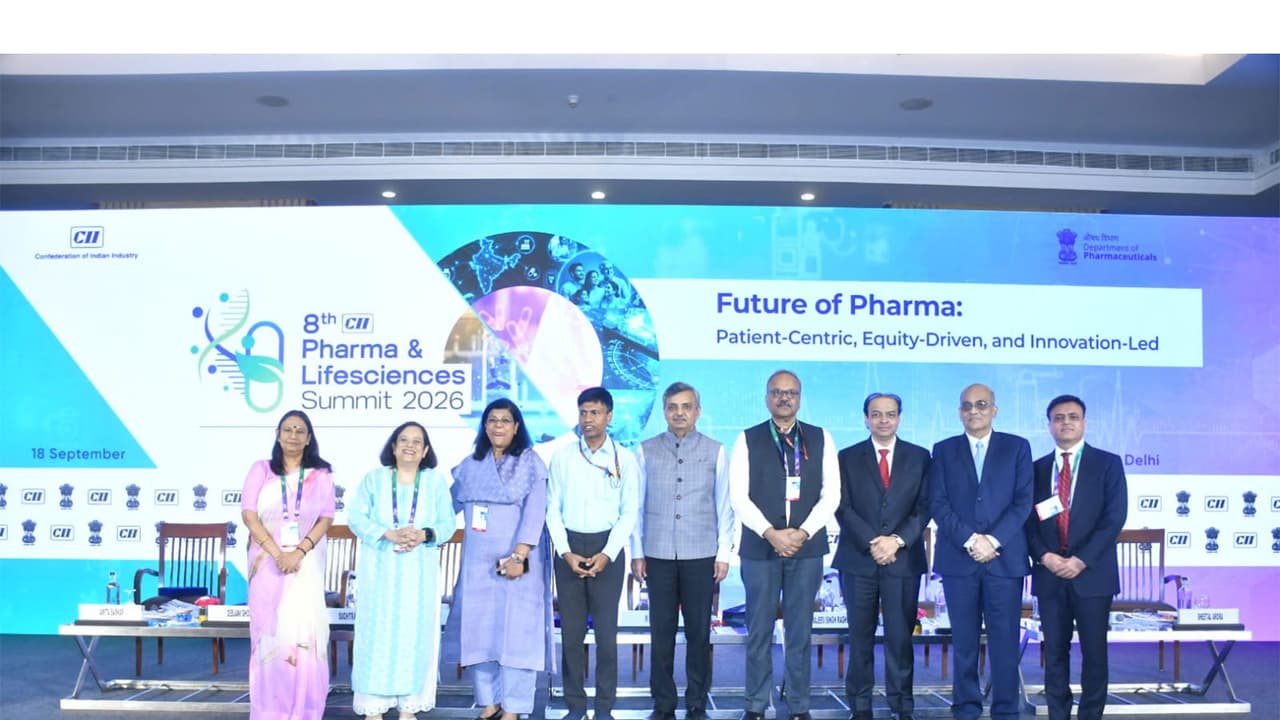
At the 8th CII Pharma Summit, leaders called for academia-industry partnerships and increased R&D investment. The government announced major regulatory reforms are expected within two months to boost innovation and streamline approvals.
NITI Aayog on Academia-Industry Partnership
He highlighted how personalised partnerships are required to take place with the necessary background already set with infrastructure, talent, and institutions. He further urged a holistic approach to bring in the best of global institutions as well as pharma regulations into the country to ensure global growth. “We have the ecosystem, deregulation is happening, we need to enhance investments in Research and Development,” he mentioned.
Impending Regulatory Reforms
Manoj Joshi, Secretary, Department of Pharmaceuticals, Ministry of Chemicals and Fertilisers, Government of India, said, “I am quite hopeful that in the next one or two months we will be making a lot of changes in the regulatory system,” he said, outlining a reform agenda spanning the RCGM approval process, state regulatory approvals, faster turnaround on queries and testing across institutions, and moving towards parallel processing, including allowing manufacturing without repeated inspections, rather than sequential approvals. He added that he was encouraged by the risk-taking he had observed across the Industry, citing companies setting up manufacturing plants and CRDMOs, increasing funding for research, and a growing number of startups willing to take risks. He also called for deeper collaboration between academia, Government laboratories and Industry. “Let’s work together so that we can achieve the ambition which we have set for India to grow, and to innovate, both in small and large molecules,” Joshi said.
CDSCO on R&D Freedom and Digitisation
On the regulatory front, Dr Rajeev Singh Raghuvanshi, Drugs Controller General (India), Central Drugs Standard Control Organization (CDSCO), Ministry of Health and Family Welfare, said, “Freeing up R&D from any permissions from the regulators is a big change.” The second reform, he said, was removing the need for permission to study and design the protocol, which increases predictability in the system. On the digitisation front, he said, “Today, most of the regulatory systems in India are completely digital, which is a big change in the mindset.” He added that a further reform under way is the development of a new digital drug regulatory system, along with simplified processes and the introduction of AI interventions. He mentioned that global clinical trials are increasing; these reforms will have a structural impact on the complete regulatory chain of the country.
Shaping the Next Technological Era
Debjani Ghosh, Distinguished Fellow, NITI Aayog and Chief Architect, NITI Frontier Tech Hub, posed an essential question: as we move ahead to rapidly develop technology in healthcare, do we know how to control what we are building? She mentioned, “We have extraordinary opportunities in front of us to help shape the next technological era. Not as a large market, but as an innovator, as a shaper of standards, as a shaper of the roles of the game. And as we do that, India is best placed, given our history, to change the most important thing in the tech conversation.”
From Policy Support to Commercial Scale
Suchitra K Ella, President-Designate, CII and Co-Founder & Managing Director, Bharat Biotech International Limited, highlighted the Government interventions such as Biopharma SHAKTI, with an outlay of Rs 10,000 crore over five years, BioE3, and the Rs 1 lakh crore Research, Development, and Innovation framework intended to bring greater private-sector participation into high-impact research. She emphasised that “policy support is the beginning, not the destination.” The real test would be whether industry could translate these investments into technologies, products, and companies that create lasting value, by narrowing the gap between scientific discovery and commercial scale. “India should increasingly aspire to be a technology developer and owner, not only a technology adopter or manufacturer,” she added. She highlighted how ROTAVAC, JENVAC and the RTS, S malaria vaccine are examples of how partnerships between public institutions and industry have translated scientific capability into affordable, India-relevant solutions for diseases disproportionately affecting children and underserved populations, “providing a strong foundation for building more systematic pathways from research to development and scale.”
Transitioning from Scale to Innovation Leadership
Shreehas Tambe, Chairman, CII National Committee on Pharmaceuticals and Chief Executive Officer & Managing Director, Biocon, said over the past few decades, India has built manufacturing excellence, delivered affordability, and established a strong global presence. We have now become the pharmacy of the world; the opportunity before us is to build a strong foundation and transition from scale to leadership in innovation. The next chapter must take India beyond our traditional strength towards global leadership in biopharma, biotechnology, and innovation.
A Defining Moment for Indian Pharma
On India’s pharmaceutical transformation, Amitabh Dube, Co-Chairman, CII National Committee on Pharmaceuticals and Country President, Novartis Healthcare Private Ltd. said, “India stands at a defining moment. The Government has shown a strong intent to move from a volume- to value-based pharmaceutical industry through initiatives such as the RDI schemes and the recently announced Biopharma Shakti Mission.” (ANI)
(Except for the headline, this story has not been edited by Asianet Newsable English staff and is published from a syndicated feed.)