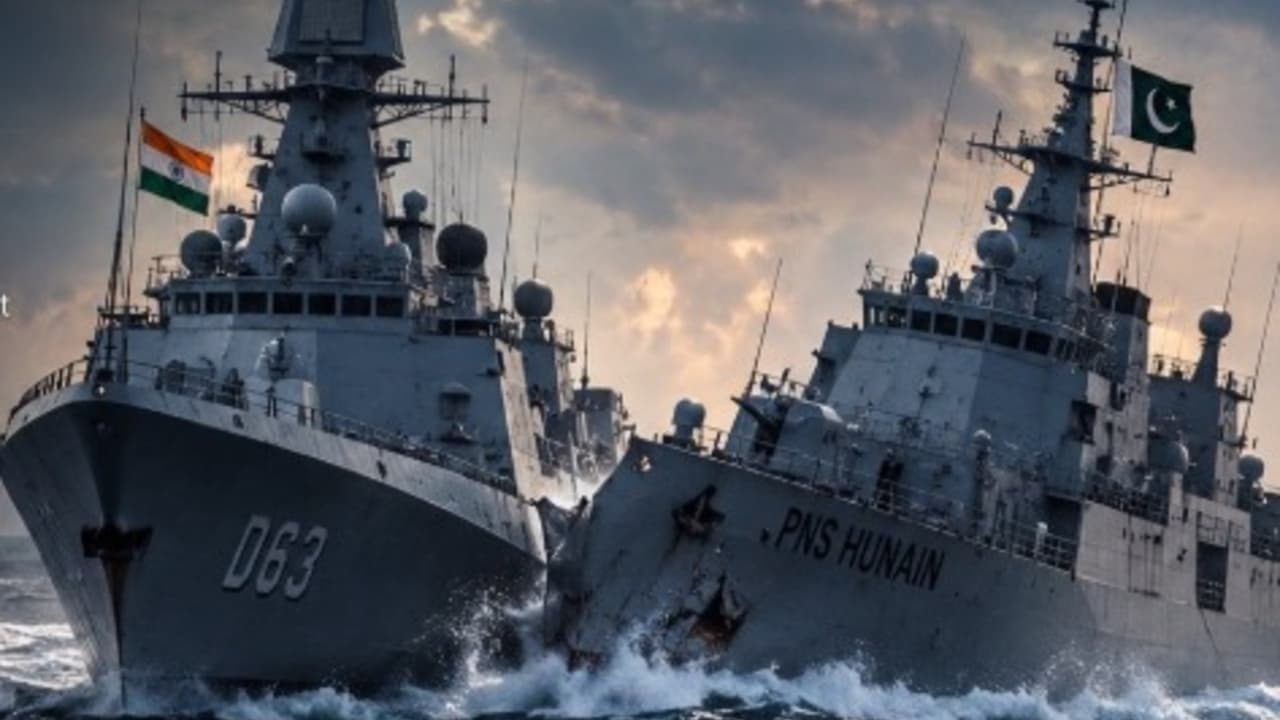
Pakistani patrol vessel, PNS Hunain, brushed an Indian warship during routine surveillance in international waters of the North Arabian Sea. It violated int’l COLREGs maritime rules and 991 bilateral agreement on military manoeuvres. Experts warn such reckless maritime conduct poses serious risks to commercial shipping in critical energy corridors.
On the evening of 15 September, in international waters of North Arabian Sea, roughly 120 to 130 nautical miles east of the Omani coast, a Pakistan Navy vessel closed on an Indian warship engaged in routine surveillance. The Pakistani ship, identified as the patrol vessel PNS Hunain, ignored repeated warnings issued on Channel 16, the maritime distress and calling frequency, then abruptly increased speed and crossed the Indian warship’s bow from starboard, its own bow brushing the Indian hull. No injuries were recorded, no structural damage was sustained, and the Indian vessel resumed its mission.
That nobody died is the least significant fact about the episode.
The rules that were disregarded that evening are not Indian rules. They are the International Regulations for Preventing Collisions at Sea of 1972, the COLREGs, which bind every vessel on the high seas, warships included. Rule 13 places the entire burden of keeping clear on a vessel overtaking another, regardless of which side the approach comes from; Rule 8 demands that any avoiding action be positive, taken in ample time, and evident to the other ship; and Rule 2 requires the ordinary practice of seamen to govern throughout, obliging every vessel to take whatever action necessary to avoid collision once risk exists, irrespective of who technically holds the right of way. A manoeuvre conducted at speed, across the bow of a larger vessel, after warnings have gone unanswered, satisfies none of these. Whatever one concludes about the contact itself, the manoeuvre that produced it was a decision.
New Delhi’s protest rested on a second instrument. The Ministry of External Affairs described the conduct as being in direct contravention of Article 10 of the April 1991 Agreement between India and Pakistan on Advance Notice on Military Exercises, Manoeuvres and Troops Movements. The citation carries an unmistakable echo. In June 2011, after PNS Babur came close to INS Godavari in the Gulf of Aden, India lodged a formal protest invoking precisely the same two authorities: the collision regulations and Article 10 of the 1991 agreement. Fifteen years, two incidents, one script.
Indian officials describe the latest episode as the second such close-manoeuvre incident in six months. Conduct that recurs on this pattern is no longer plausibly explained as inexperience on the bridge.
The consequence extends far beyond two grey hulls. The North Arabian Sea is not empty ocean. It is the approach corridor to the Strait of Hormuz, through which a substantial share of the world’s seaborne crude and liquefied natural gas transits, and it is presently crowded with naval traffic on both sides. India has been running Operation Urja Suraksha over the same period to escort shipping
bound for its ports. Warships, escorts, tankers and bulk carriers are compressed into the same lanes, in the same weather, under the same rules.
This is why the merchant fleet has a direct stake in the standard of seamanship displayed on 15 September. A frigate can absorb a glancing blow and steam on. A laden very large crude carrier
cannot. It requires several kilometres to stop and answers its helm with a delay measured in minutes, not seconds. A navy that treats collision-avoidance rules as discretionary when the other vessel is armed and manoeuvrable is a navy that has normalised habits it will carry into encounters with vessels that are neither. The risk is not hypothetical: it is a hull breach, a spill in one of the world’s most sensitive energy corridors, and war-risk premiums that climb for every operator on the route, irrespective of flag.
Islamabad has advanced a different account. Its Foreign Office summoned India’s Chargé d’Affaires, alleging that an Indian vessel conducted aggressive manoeuvres in dangerously close proximity within Pakistan’s Exclusive Economic Zone during the SEASPARK-26 exercise, and invoked the same 1991 agreement. Two features of that submission deserve attention. An EEZ confers rights over resources, not sovereignty over the water column; freedom of navigation is preserved there under the Law of the Sea Convention, and its invocation cannot convert lawful transit into trespass.
That is the strategic hazard. The 1991 agreement was drafted to govern the notification of exercises; it is not an incidents-at-sea regime of the kind the United States and the Soviet Union concluded in 1972, with agreed signals, defined standoff distances and an annual review mechanism. India and Pakistan have never built that architecture. In its absence, each encounter is arbitrated by the judgement of a duty officer, and the machinery available afterwards consists of a summons and a démarche.
Three steps follow. India should publish the evidentiary record, including track data and bridge audio, because in a contest of competing narratives the documentary record is the only effective remedy. It should press, through third parties if necessary, for a bilateral incidents-at-sea agreement. And it should raise the matter where commercial shipping is represented, at the International Maritime Organization, so that the question ceases to be read as a subcontinental quarrel and is recognised for what it is.
The high seas are held in common. A state that observes the rules of the road only when convenient is not asserting its sovereignty. It is borrowing against everyone else’s safety.
Ashu Maan is an Associate Fellow at the Centre for Land Warfare Studies. He was awarded the Vice Chief of the Army Staff Commendation card on Army Day 2025. He is pursuing a PhD in Defence and Strategic Studies. His research focuses include India-China territorial dispute, great power rivalry, and Chinese foreign policy.
(Disclaimer: The opinions expressed are solely those of the author and do not reflect the views or stance of the organization. The organization assumes no responsibility for the content shared.)