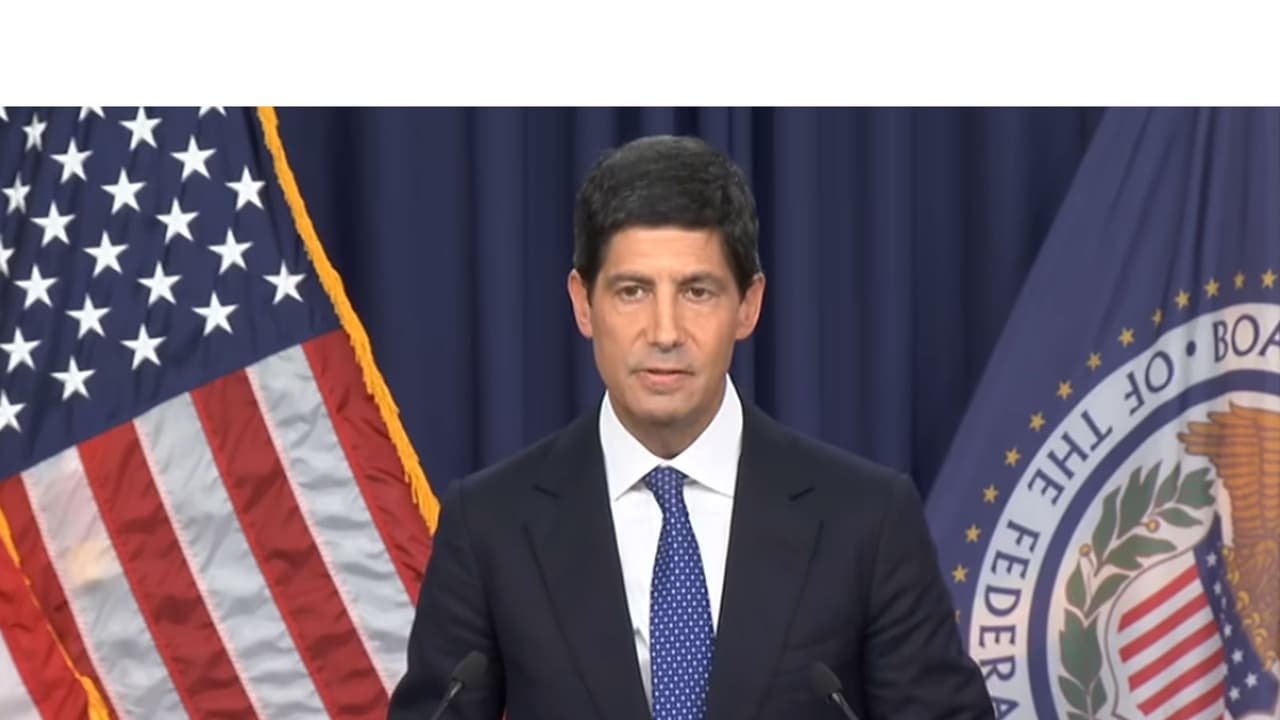
Federal Reserve Chairman Kevin Warsh urged for an AI task force to study its economic implications for monetary policy. This followed an FOMC decision to raise interest rates to 3.75-4% to tackle elevated inflation and support price stability.
Fed Chair Calls for AI Task Force on Monetary Policy
US Federal Reserve Chairman Kevin Warsh called for a task force to be established to assess the implications of artificial intelligence for future monetary policy, saying it should report by the end of the year, as AI could have significant effects on both demand and supply in the economy.
Warsh made the comments at a press conference after the Federal Open Market Committee (FOMC) raised the federal funds target range by 25 basis points to 3.75-4 per cent, citing elevated inflation and continued strength in the US economy.
“We care very much about what’s happening in artificial intelligence. We care much about the implications on the demand side of the economy and ultimately on the supply side of the economy,” Warsh said. “I think it’s so important that we establish a task force that should report by the end of the year to help us think about the implications for our future policy conjecture,” he said.
Warsh, however, said decisions on the broader risks and opportunities arising from AI would remain with other parts of the government, while the Fed would focus on their implications for monetary policy. “But the policy decisions that are made about the risks and rewards, the challenges and opportunities, those are decisions made by other parts of the government. I’m going to leave it to them to make those political decisions, those policy decisions,” he said.
FOMC Raises Interest Rates to Combat Inflation
On the rate hike, Warsh said the Fed’s focus on stable prices would particularly benefit the least well-off, who he described as people who generally do not own financial assets, have equity in their homes or hold assets in 401(k) plans and instead rely on regular paycheques.
“The least well-off are the ones who have the most to gain from stable prices,” Warsh said, adding that the decision was aimed at delivering on the Fed’s mandate of price stability. “The plain fact is that inflation is too high and has been for too long,” Warsh said.
The comments came as the FOMC unanimously raised interest rates by a quarter percentage point, saying inflation remained elevated. Warsh said recent inflation readings had not shown sufficient improvement and that the central bank remained focused on returning inflation to its 2 per cent objective.
US Economic Outlook and Projections
At the same time, Warsh said the US economy had strengthened, with resilient domestic spending, strong productivity growth and robust capital investment. The unemployment rate was around 4.1 per cent, while the Fed’s median projections see real GDP growth at 2.3 per cent this year and 2.4 per cent next year.
The Fed’s median projection puts total PCE inflation at 3.7 per cent this year and 2.3 per cent next year, while the federal funds rate is projected at 4.1 per cent at the end of this year and next year.
Warsh said the central bank would continue assessing economic developments before making future policy decisions, rather than prejudging its next moves. He also said he did not believe the Fed needed to weaken the labour market to achieve its inflation objective, arguing that price stability could support more durable economic growth.
(ANI)
(Except for the headline, this story has not been edited by Asianet Newsable English staff and is published from a syndicated feed.)