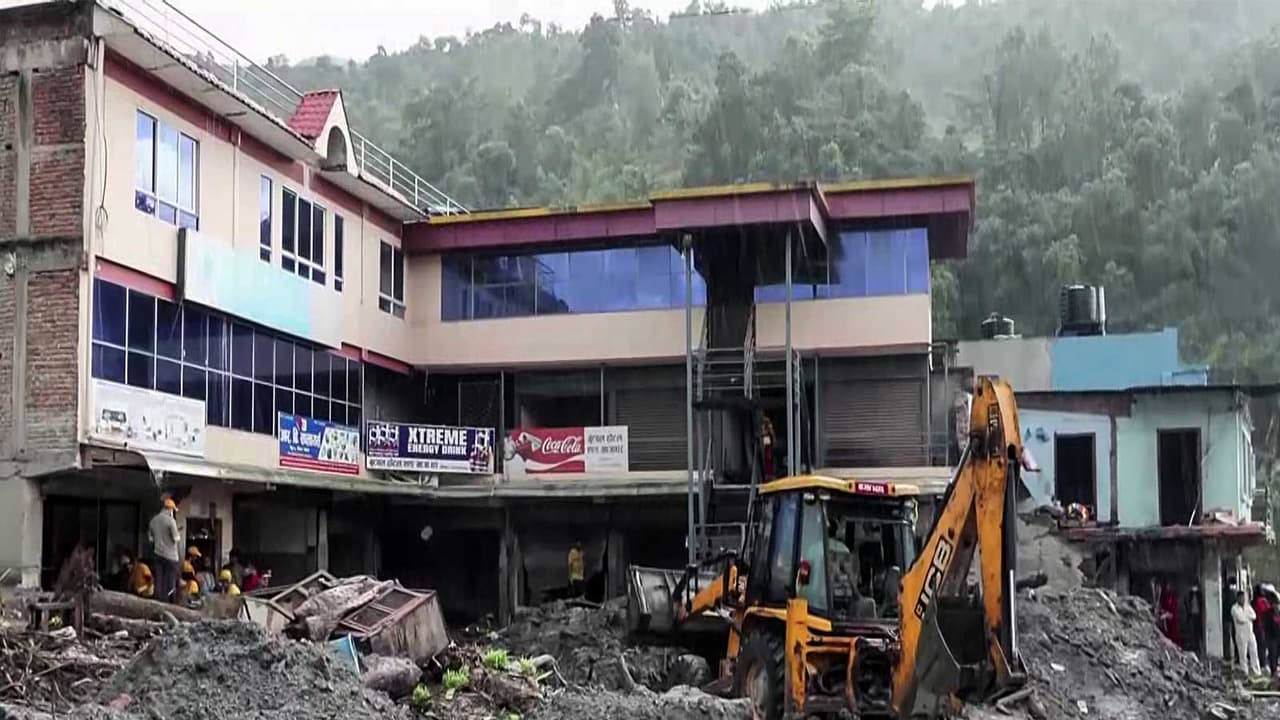
A 5.0 magnitude quake hit Nepal with limited impact due to its depth. The nation is already reeling from devastating floods, with over 1,300 dead and 4,000 missing. Massive international and domestic rescue operations are ongoing.
Moderate Earthquake Strikes Nepal
Kathmandu [Nepal], September 9 (ANI): A moderate earthquake of magnitude 5.0 jolted parts of Nepal late Tuesday evening. According to official data from the National Centre of Seismology, the seismic activity occurred at 9:38 PM IST. The epicentre was recorded at latitude 29.022° N and longitude 83.978° E in northwestern Nepal. The event registered at a depth of 143 kilometres below the surface.
Due to the relatively deep focus of the earthquake, surface impact is expected to be limited. No immediate casualties or major structural damage have been reported as the situation is being assessed.
Ongoing Flood Crisis and Casualty Report
This comes as Nepal is confronting a catastrophic humanitarian crisis as search and rescue operations enter their fourteenth day following the devastating Bhote Koshi River floods that hit the nation last month. According to the data compiled up to 8 PM, Nepal Police informed that 1,366 casualties have been reported, while 4,077 individuals remain unaccounted for across the disaster zone. The official breakdown of recovered victims includes 533 men, 339 women, and 502 partial human remains. Out of the total recoveries made so far, police authorities have successfully verified and handed over 102 bodies to their families for final rites. To preserve unidentified remains safely, 1,147 bodies have been buried underground under strict forensic guidelines.
Details on Missing Persons
The Police highlighted a staggering missing person count of 4,077 individuals, comprising both domestic residents and foreign visitors. Missing Nepalese citizens account for 3,469 people, broken down into 2,907 men and 562 women. Foreign nationals account for 598 missing individuals, which includes 269 men and 329 women.
Rescue and medical response efforts led by Nepal Police personnel have accounted for 9,254 rescued or injured individuals, including 6,380 men, 2,824 women, and 50 unidentified cases. In addition, 3,030 displaced people are receiving shelter across designated holding centres managed by authorities.
Victim Identification Efforts
To support victim identification, specialised teams have collected 2,698 DNA samples, comprising 1,286 samples from deceased victims and 1,412 samples from relatives searching for their missing family members. Profiles and photographs of 1,310 unidentified victims have also been uploaded to the official website to assist the public in matching missing relatives.
Police Mobilisation and Community Outreach
The operations have required massive logistical deployment, with 7,975 Nepal Police personnel actively mobilised on the ground. During the disaster response, 65 police personnel were directly affected, and 25 officers remain out of contact. Parallel to rescue duties, police teams have conducted 158 community awareness and disaster guidance programs, reaching 43,943 local participants.
International Rescue Efforts and Diplomatic Outreach
Earlier in the day, according to an official update issued at 2 PM by the Nepal Ministry of Foreign Affairs, the missing people included around 600 foreign nationals from 35 countries. Despite the massive scale of devastation, rescue personnel have successfully saved 13,583 individuals so far, among them over 300 foreign nationals. Remarkably, four survivors were extracted alive over the past five days, including two Nepali nationals pulled from the Upper Trishuli 3A hydropower tunnel on September 4, a Chinese national rescued from the Upper Trishuli 1 tunnel, and a Nepali national retrieved from a damaged home in Betrawati on September 5.
Complex Search Operations at Hydropower Sites
Complex search and rescue operations remain active across several impacted hydropower facilities, including Mailung Khola, Upper Trishuli 1, 3A, and 3B, Chilime, Rasuwagadhi, and Langtang, the Ministry said in the update.
The Ministry highlighted that the rescue effort has drawn extensive domestic and international mobilisation. Specialised tunnel rescue teams from India, China, and the Republic of Korea are working in tandem with the Nepali Army, while Search and Rescue units from the United Arab Emirates, Malaysia’s SMART team, and Australia’s DART team are supporting operations on the ground. These teams are utilising advanced aerial drone reconnaissance, heavy excavators, and underwater drones to locate survivors and navigate flooded tunnels.
High-level diplomatic outreach continues as Prime Minister Balendra Shah and Foreign Minister Shisir Khanal maintain close contact with global counterparts. The Ministry expressed gratitude for the timely solidarity and support provided by dozens of partner nations, the United Nations, the World Bank, the Asian Development Bank, and the European Union.
Appeal for International Aid and Future Assessments
To strengthen ongoing relief and recovery efforts, the Ministry of Foreign Affairs and the National Disaster Risk Reduction and Management Authority (NDRRMA) have issued formal requests to the international community for specialised equipment. Required supplies include high-capacity drones, LiDAR systems, temporary Bailey bridges, underwater drones, portable generators, surge pumps, laboratory freezers, epidemic-prevention supplies, and rapid DNA testing kits. The government is also conducting two major evaluations: a Rapid Damage and Needs Assessment (RDNA) that will be published shortly, and a comprehensive Post Disaster Needs Assessment (PDNA) to estimate long-term reconstruction costs. Public and international contributions are being directed to the Prime Minister’s Disaster Relief Fund.
Field Conditions and Emergency Response Update
Field conditions remain critical across affected regions. The NDRRMA, in an update at 7 PM, reported that 3,328 displaced individuals are currently housed across 34 temporary holding centres in Rasuwa and Nuwakot. In addition, 38 emergency medical teams comprising 175 health personnel have provided treatment to over 4,722 patients, while psychosocial counselling has reached more than 4,100 people.
New Landslide Alert Issued
A separate alert was issued for settlements near Nayapul and Birethanti, urging local residents to move to higher ground due to a landslide blocking the Kimrung River.
Due to the high number of casualties, authorities have temporarily buried recovered bodies after completing essential forensic steps to preserve remains for eventual identification. Forensic teams from India, China, Japan, Singapore, and South Korea are assisting local authorities with DNA profiling. Families searching for missing loved ones are asked to contact the Nepal Police Hospital in Maharajgunj, Kathmandu, or submit DNA profile files electronically to the official websites.
Furthermore, a separate alert was issued for settlements near Nayapul and Birethanti, urging local residents to move to higher ground due to a landslide blocking the Kimrung River, the NDRRMA stated.
Chilime Tunnel Rescue Operation Progress
Meanwhile, Indian Ambassador to Nepal Naveen Srivastava said Indian and Nepalese teams continued efforts to manually clear debris and mud from the Chilime tunnel. In a post on X, Srivastava said, “Chilime Tunnel Rescue Operation update: India and Nepal teams continued their efforts to manually clear the tunnel of debris and mud. To overcome the challenge posed by sloping tunnel teams have deployed HDPE pipes to ensure smooth movement inside the tunnel.”
He said work was also progressing on creating a temporary track from Syafrubesi to the tunnel portal through controlled blasting. (ANI)
(Except for the headline, this story has not been edited by Asianet Newsable English staff and is published from a syndicated feed.)