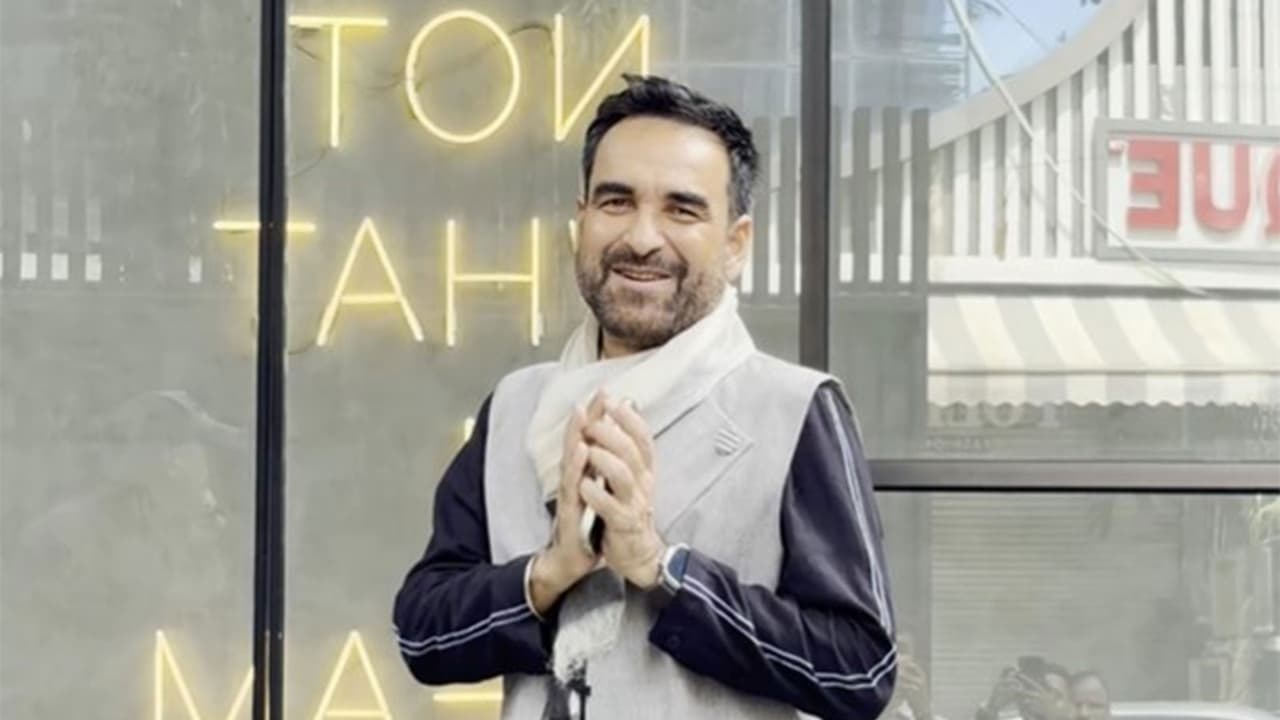
Pankaj Tripathi discusses ‘Mirzapur: The Movie’s’ theatrical release, reflecting on the transition from OTT to the big screen. He states that while scale and technical aspects change, the actor’s craft remains the same.
‘Mirzapur’s’ Leap to the Big Screen
Pankaj Tripathi’s Kaleen Bhaiya character has once again found a strong connection with audiences as ‘Mirzapur: The Movie’ continues its theatrical run, taking the much-loved franchise from the OTT space to the big screen. Reflecting on the challenges of making that transition, Tripathi had earlier spoken about how the larger format changes the scale and presentation of the story, while maintaining that the fundamental craft of an actor remains the same.
“The landscape is new, and the scale is bigger,” Tripathi said in a conversation with ANI, while discussing the move from the three-season series to a theatrical film. The actor’s comments offer an insight into what goes into bringing a franchise that audiences have traditionally watched at home into cinemas, where the viewing experience is collective and the scale considerably larger.
“People would have seen it on a 5-inch to a 100-inch screen. It was individual viewing. Now, it is coming for community viewing. Four hundred to five hundred people will see it together, and the screen is much bigger- 20 to 30 feet,” he said.
Actor’s Craft vs. Technical Changes
For Tripathi, however, the change in format does not fundamentally alter an actor’s approach to the craft. Having already spent three seasons playing Kaleen Bhaiya, he said the character and the performance process were familiar territory. “So, the rest of the challenges are for us. For the actor, particularly, we have already done it. Even if we do a series, it is still a movie for us,” he said.
Tripathi emphasised that understanding the demands of a particular screen format is part of an actor’s job, regardless of whether a project is made for streaming or theatrical audiences. “For us, it is important to understand the format of the screen. That is our work; that is our craft. It is the same whether it is OTT or the big screen,” he said.
At the same time, he pointed out that moving a story to cinema involves considerable changes behind the scenes. “But when the story is transformed for a bigger screen, the technical side, writing, and visuals change a lot in a movie,” Tripathi added.
Pankaj Tripathi on Staying Connected to Cultural Roots
Beyond ‘Mirzapur’, Tripathi also spoke about an aspect of his public persona that audiences have consistently associated with him, which is his grounded nature and his connection with Hindi and Indian culture. When asked about the importance of remaining connected to one’s roots at a time when Western culture has considerable influence on the entertainment industry, Tripathi compared cultural roots to the roots of a plant.
“I think it is very important. If a plant’s roots get weak, the plant falls down,” he said.
The actor described people as “moving plants”, suggesting that while individuals may travel and experience different cultures, their own roots remain an important part of who they are. “We are like moving plants. We are not fixed, but we have roots. And our roots are in our culture and in our language,” he said.
According to Tripathi, actors should remain curious and open to learning while also understanding their own identity and background. “As an actor, you should know, read, and explore. But you should know who you are, where you came from, and how you came here. You should know where you came from,” he said.
Tripathi also spoke about his personal connection to Bihar and Mumbai, describing both places as integral to his life. “The more I am from Mumbai, the more I am from Bihar. Half of my life is spent in Bihar and half in Mumbai. I visit and experience every culture of India,” he said.
He said his exposure to different people and cultures has come through everyday interactions as well as travel. “I see, meet, and talk to people. I eat with people. And I travel the world. So, when I travel, I learn, and I see their culture. It is not like I follow everything blindly,” he said.
Concerns Over Western Accents in Indian Children
Tripathi also raised questions about the influence of television and digital media on the way young children speak, particularly in relation to English accents. He said he had noticed children in cities being taught English with an American or British accent.
“So, one thing I often see in young children, but I still don’t understand the reason behind it, is that young children are taught English with an American accent,” he said.
The actor questioned whether popular entertainment and digital media could be contributing to the trend. “So, I thought, why is this happening? Is it because of movies? You were born in India. India has its own English, and we have our own accent,” Tripathi said.
He added that the influence of television and digital platforms on younger audiences is something worth examining. “So, I think about the effect of TV and digital media. How is it influencing young children to learn different accents?” he said.
‘Mirzapur: The Movie’ Box Office Success
Tripathi’s comments come against the backdrop of ‘Mirzapur: The Movie’ making a strong impact at the box office after its September 4 theatrical release. According to trade analyst Taran Adarsh, the film recorded an India net collection of Rs 17.10 crore for its Hindi version on Monday, following a strong opening weekend.
The film collected Rs 27.85 crore on Friday, Rs 32.50 crore on Saturday and Rs 36.50 crore on Sunday, taking its four-day India net total to Rs 113.95 crore.
Adarsh described the film as a “super-hit” and said its Monday performance indicated that audiences had “wholeheartedly embraced” it. A discounted ticket offer was also introduced for Tuesday, with Adarsh expecting it to provide another boost to footfalls.
The film’s limited Telugu release has also contributed to its box-office tally. The Telugu version collected Rs 26 lakh on Friday, Rs 28 lakh on Saturday, Rs 30 lakh on Sunday and Rs 15 lakh on Monday, taking its four-day India net collection to Rs 99 lakh.
‘Mirzapur: The Movie’ continues the story of the popular franchise and brings back some of its most recognisable characters, including Kaleen Bhaiya, played by Pankaj Tripathi, Munna Bhaiya, played by Divyenndu, and Guddu Pandit, played by Ali Fazal. The film follows the battle for the Mirzapur throne as new contenders enter the fight.
Presented by Amazon MGM Studios and Excel Entertainment, the film is directed by Gurmmeet Singh and written by Puneet Krishna. It is produced by Ritesh Sidhwani and Farhan Akhtar under Excel Entertainment, with Kassim Jagmagia and Vishal Ramchandani serving as co-producers. (ANI)
(Except for the headline, this story has not been edited by Asianet Newsable English staff and is published from a syndicated feed.)