Lucknow has been ranked first in the ‘Swachh Vayu Sarvekshan 2026’ among cities with a population over one million. Indore and Jabalpur secured the second and third positions respectively, while Delhi was ranked 30th in the same category.
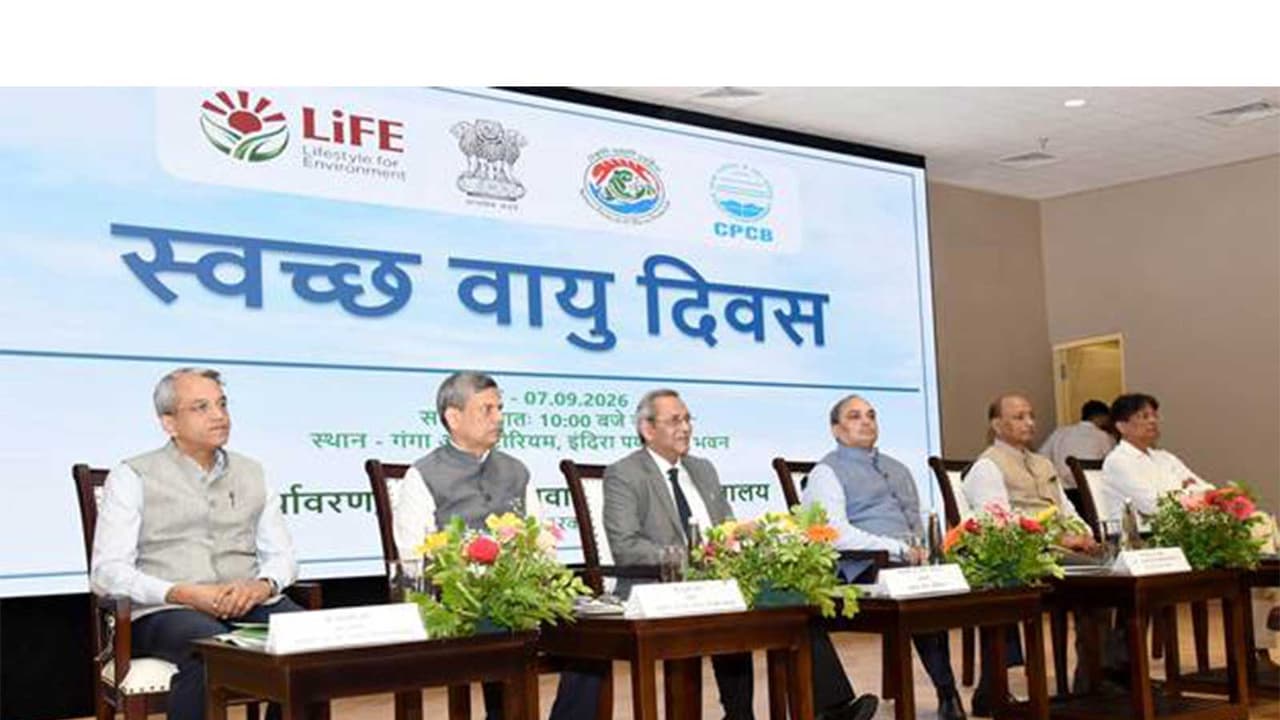
The Union Ministry of Environment, Forest and Climate Change (MoEFCC) organised the Swachh Vayu Diwas 2026 today, on the International Day of Clean Air for Blue Skies. The event was presided over by the Chairperson, National Green Tribunal (NGT), Justice Prakash Shrivastava, as Chief Guest. According to a release, other dignitaries gracing the occasion included Secretary (EFCC), Tanmay Kumar; Chairperson (CAQM), Rajesh Verma; DG (Forest) and Special Secretary (EFCC), Sushil Kumar Awasthi; Chairperson (CPCB), Amandeep Garg; and AS (EFCC), Ashutosh Agnihotri. Officials from Union Ministries, Multilateral organisations, Mayors, District Collectors and Municipal Commissioners of award-winning Cities and wards, besides officials from MoEFCC, CPCB and CAQM were present.
Swachh Vayu Sarvekshan 2026: City Rankings
Uttar Pradesh’s capital Lucknow has bagged the first position among cities with a population of over one million in the ‘Swachh Vayu Sarvekshan 2026’ for its proactive interventions in curbing air pollution. The city achieved the top rank driven by extensive measures, including the induction of electric vehicles into the municipal waste management fleet, deploying mechanised sweeping machines to suppress road dust, and effectively remediating legacy waste sites. Indore secured the second position in the million-plus population category, followed by Jabalpur in third place. Meanwhile, national capital Delhi stood at the 30th spot, and Mumbai was placed at the 37th rank. On the other end of the spectrum, Chennai, Jamshedpur, Kota, Kolkata, and Madurai featured among the bottom five performing cities in the category.
‘Clean Air a Fundamental Need’: NGT Chairperson
In his address, Justice Shrivastava appreciated the efforts of Union and State Governments under the National Clean Air Programme (NCAP). He stated that this is an occasion to recognise efforts made by cities/wards across the country to ensure the quality of air is maintained within the prescribed parameters.
“The awardees have shown that clean air is not an aspiration but a practical goal that can be achieved with proper planning and ground-level implementation, ” he noted.
The Chairperson highlighted that clean air is a fundamental need rather than a luxury. He stated, “Development and Environmental conservation are not at cross purposes but can go together while maintaining the quality of life for the citizens. It is the responsibility of each citizen to ensure that generations to come are able to live in a clean environment”.
Justice Shrivastava called air pollution a complex challenge as it doesn’t know political boundaries and a multitude of sources contribute to it.
The Chairperson stressed that the frontline institutions are the urban/rural local bodies that ensure the effective implementation of the National vision. With the Swachh Sarvekshan Awards, the Government recognises the efforts of all stakeholders in the field of air quality management, who put in efforts to ensure that the air quality remains within the prescribed limits, he stated.
“It is essential that local bodies strive for prevention of pollution generation at source by making citizens aware; adopt latest technologies to tackle the issue; and engage in an all-inclusive and whole-of-society approach to address the issue”, he added.
Government’s Multi-Pronged Approach to Tackle Air Pollution
In his address on the occasion, Secretary (EFCC), Tanmay Kumar informed that the Government of India is taking a multi-pronged, coordinated and scientific approach towards tackling air pollution as per Prime Minister Narendra Modi’s vision. Public representatives are being incorporated in this mission to encourage participation of citizens to fight air pollution as well as ensure capacity building of all stakeholders.
Kumar talked about the NCAP that provides a framework where cities have their own strategies to ensure clean air, while the PRANA portal tracks various parameters of air quality management for 130 cities under NCAP.
He said that fighting air pollution is a continuous programme, not a one-off activity. It requires a citizen-led movement in mission mode to achieve a clean environment for generations to come. He congratulated all the awardees for their efforts and encouraged them to make air quality management a jan-bhagidari movement.
NCAP Achievements and Award Methodology
The awards were based on participation and ranking of all 130 cities in 3 groups (Population below 3 Lakh; 3-10 Lakh; & above 10 Lakh), through the process involving self-assessment by cities, approval by the State-level Monitoring Committee, evaluation by CPCB, field verification by Independent Committees and selection of the 10 best-performing cities.
During Swachh Vayu Diwas, progress and achievements made under the NCAP, a flagship initiative launched to improve air quality across 130 cities in 24 States/UTs, were highlighted. A performance linked grant of ₹ 16,425 crore has been provided to 130 NCAP cities as critical gap funding to implement air pollution mitigation measures.
NCAP has shown positive results in terms of achieving reduction in PM10 levels in 2025-26 with respect to the levels of FY 2017-18: 108 out of 130 cities have shown improvement in PM10 levels, 72 cities have achieved reduction in PM10 concentrations of more than 20%, 26 cities have recorded reductions exceeding 40% and 14 cities have met National Ambient Air Quality Standards (NAAQS)
Compendium of Best Practices Released
During the event, the Compendium of Best Management Practices under NCAP was released. It highlights best practices and successful air quality improvement measures implemented by cities and State Pollution Control Boards/Committees under NCAP, in various sectors namely, Road dust control, Vehicular pollution, industrial pollution, Solid and Construction & Demolition (C&D) waste management, Control of open burning, Greening, Use of technology and Public Outreach. These best practices would be helpful in replicating them by other cities and SPCBs. (ANI)
(Except for the headline, this story has not been edited by Asianet Newsable English staff and is published from a syndicated feed.)