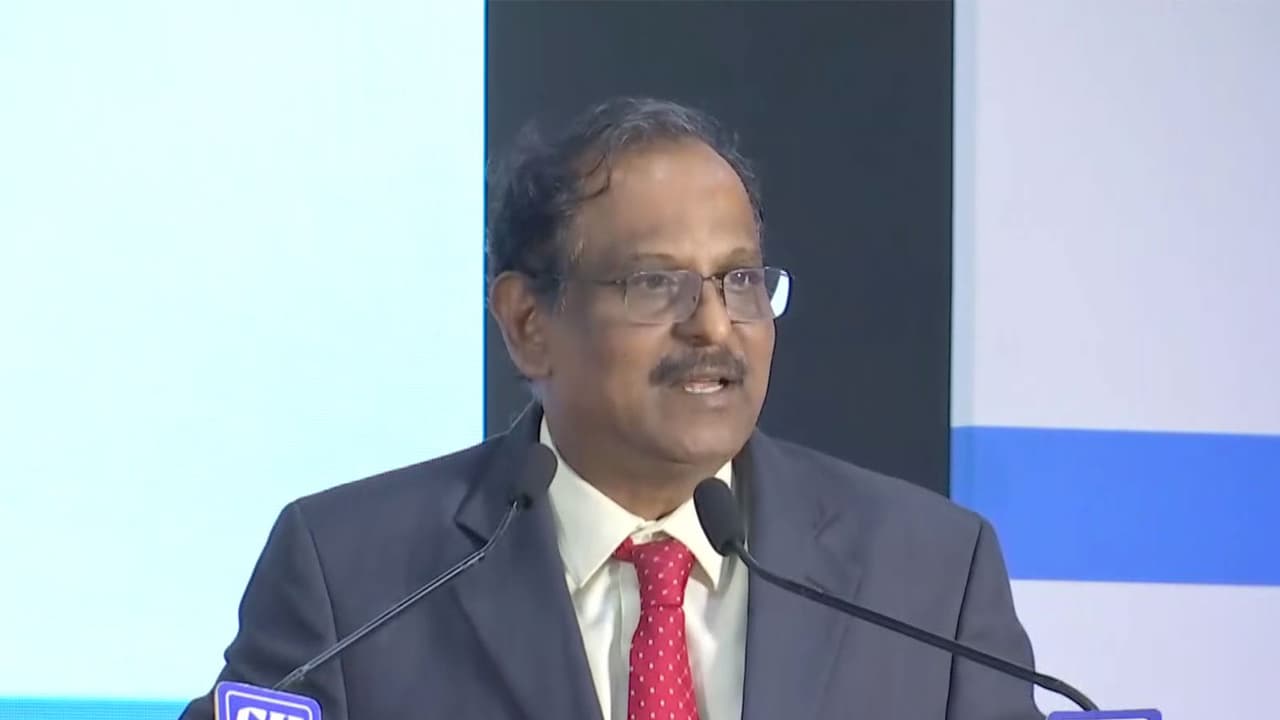
ISRO Chairman V Narayanan has urged greater participation from Indian industry and startups, stating that the demand for 200-300 new satellites in the coming years cannot be met by ISRO alone, necessitating a collaborative effort to scale up.
ISRO Calls for Greater Private Participation
ISRO Chairman V Narayanan has called for greater participation from Indian industry, startups and academia to scale up the country’s space sector, stressing that the growing demand for satellites and launches “cannot be done only by ISRO”.
Addressing the 9th edition of the Bengaluru Space Expo 2026, Narayanan said India’s space programme was entering a new phase marked by increasing private-sector participation, technological advancement, ambitious missions and international cooperation.
“Today we are having only 56 space assets serving from space. But the need is huge. At least 200 to 300 satellites have to be built and launched in maybe 6 to 7 years’ time frame. And this cannot be done only by ISRO,” Narayanan said.
He said the government had introduced reforms to enable private participation, with IN-SPACe facilitating authorisation of private space activities and NewSpace India Limited (NSIL) supporting commercialisation.
Industry’s Crucial Role
Narayanan highlighted the contribution of Indian industry to the country’s space programme, noting that around 80 per cent of the budget for a rocket launch goes to Indian industries.
“Whenever a rocket lifts off — a PSLV, GSLV or LVM3 rocket — please understand, 80% of the budget goes to Indian industries. That means the success of the Indian space program is because of the partnership with Indian industries and academia,” he said.
He also pointed to the growth of India’s startup ecosystem, saying around 450 startup companies are currently working in the space sector. Narayanan said India would need to significantly increase its launch frequency to meet its ambitions.
“When I joined ISRO in 1984, we used to have a launch once in three years, then once in two years. Today we are launching once in a month. But the need is around 50 launches per year. So we all have to work together,” he said.
IN-SPACe on Private Sector Growth
Pawan Goenka, Chairman of IN-SPACe, also highlighted the rapid expansion of India’s private space sector, saying the country had moved from a single space startup in 2014 to more than 450 today.
“From a single space startup in 2014, we now have over 450. This year alone, more than $160 million of private capital has already come in,” Goenka said.
He cited the progress of Skyroot Aerospace, which developed India’s first privately built rocket and subsequently achieved orbital launch capability, as an example of the growing partnership between private industry, ISRO and IN-SPACe.
“The partnership is India’s real strength. The depth of a national space agency built over six decades, now working hand in hand with a young and ambitious private industry. ISRO and industry are rising together,” he said.
Vision for a Global Space Economy
Goenka said India was building a full-spectrum space economy involving ISRO, IN-SPACe, NSIL, private companies, MSMEs, academia and investors.
He urged Indian companies to move up the value chain and cater to global markets, while calling on international companies to view India as a base for manufacturing, technology development and space-sector partnerships.
The Bengaluru Space Expo has brought together government representatives, space agencies, international partners, industry leaders, startups and academia to discuss innovation, policy and growth in the global space sector.
(Except for the headline, this story has not been edited by Asianetnews Editorial staff and is published from a syndicated feed.)