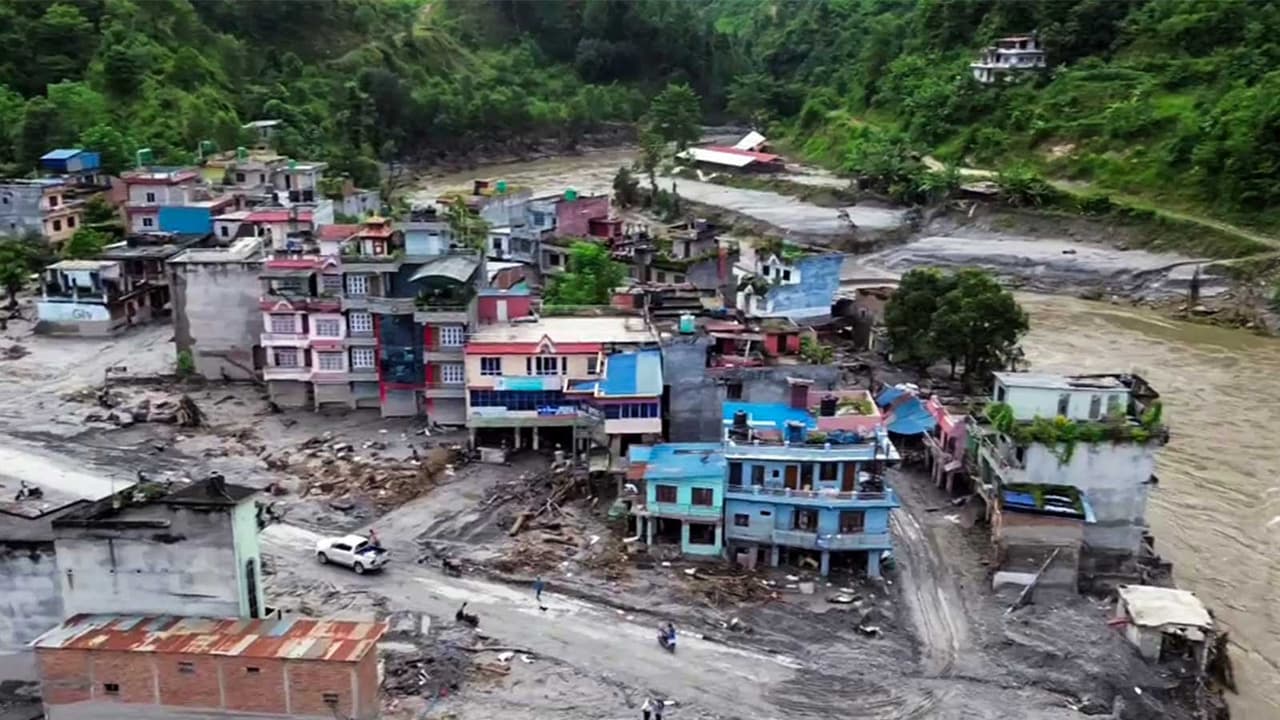
Nepal observes a national day of mourning for victims of the August 26 Bhotekoshi flood. The disaster caused widespread damage and loss of life in Rasuwa and other areas, prompting a massive response from Nepal’s security forces.
Nepal is observing a day of national mourning on Monday in memory of lives lost in devastating floods which struck on August 26. A Cabinet meeting held on September 3 at the Office of the Prime Minister and Council of Ministers had decided to observe national mourning in honour of the flood victims.
Accordingly, the national flag is being flown at half-mast at government offices across the country, as well as at Nepali embassies and diplomatic missions abroad. The Bhotekoshi flood struck Rasuwa, causing widespread loss of life and extensive damage to homes, roads, bridges, hydropower facilities and other critical infrastructure. The disaster also affected downstream areas along the Trishuli River, including parts of Nuwakot and Dhading, leaving communities displaced and disrupting transport, electricity, water supply and other essential services.
Search, Rescue and Relief Operations
Search and rescue operations, relief distribution and infrastructure restoration have continued in the affected areas, with national security agencies, government authorities, local communities and international partners involved in the response.
PM’s Statement on Security Operations
On the eve of the national mourning, Prime Minister Balendra (Balen) Shah issued a public statement acknowledging the ongoing work of Nepal’s security personnel involved in search, rescue and management operations following flood damage caused by the Bhote Koshi and Trishuli rivers. The statement highlighted a recent incident at the Central Jail at Khampa Camp in Bidur-6, Nuwakot, where floodwaters damaged administrative structures and reached lower levels of housing facilities.
According to the Prime Minister, 52 personnel from the Nepal Police and the Armed Police Force (APF) transferred all 923 inmates to higher ground within the complex while re-apprehending 50 inmates who attempted to escape through damaged perimeter structures, with several officers sustaining injuries during the process.
Despite damage to nearby barracks, loss of road access and disrupted water supplies, security personnel have continued maintaining operations and supplying necessities at the facility.
Nationwide Deployment and Rescue Statistics
Nationwide, joint operations involving the Nepali Army, Nepal Police and APF have resulted in the rescue of 13,391 individuals via air and ground transport. Current deployments across affected regions include 9,287 personnel from the Nepali Army managing operations in Battar and Dhunche and assembling temporary bridges in Devighat. Similarly, 7,975 Nepal Police officers are handling frontline search operations, body retrieval and canine unit deployments. Moreover, 4,203 APF personnel are operating across 13 response bases, utilising diving units, rope rescue teams and drone surveillance.
82 Security Personnel Unaccounted For
The Prime Minister also noted that 82 security personnel remain unaccounted for following the floods, including 45 from the Nepali Army, 25 from the Nepal Police and 12 from the APF.
Shah expressed appreciation for the continued efforts of the security forces, their families and assisting experts, reaffirming the government’s commitment to supporting security personnel deployed in the field.
(Except for the headline, this story has not been edited by Asianet Newsable English staff and is published from a syndicated feed.)