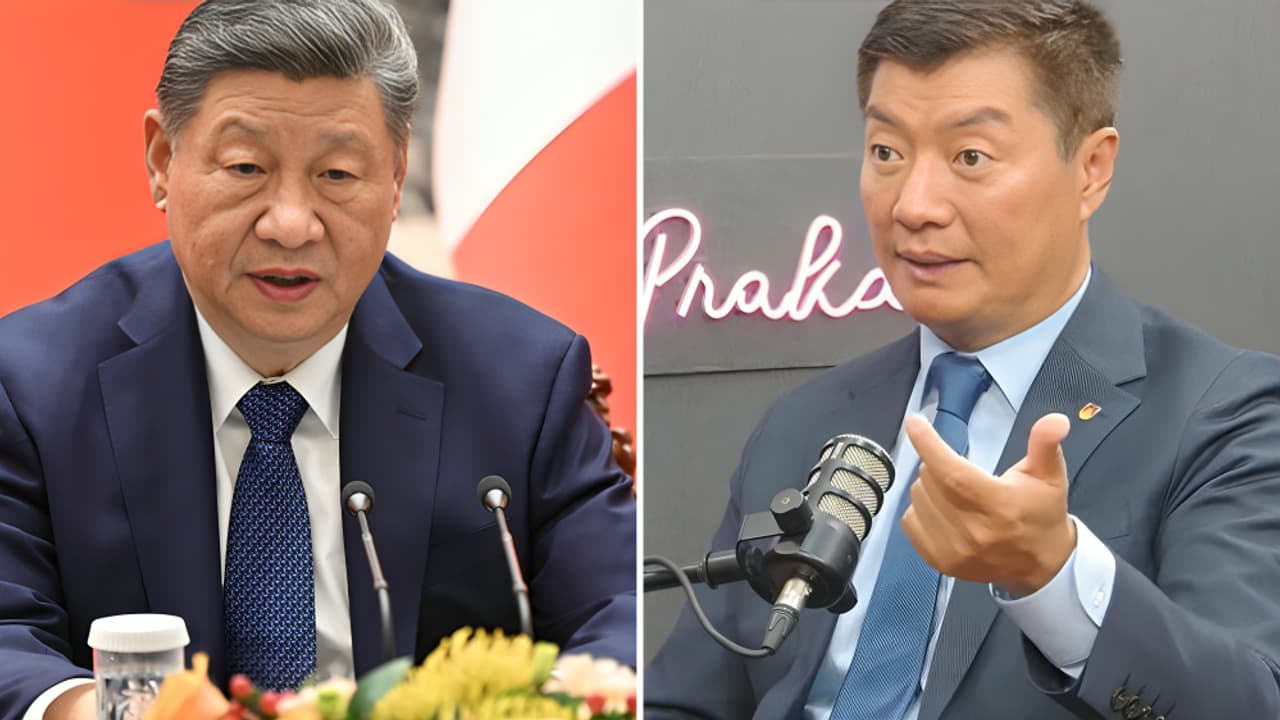
Former Tibetan government-in-exile leader Lobsang Sangay has claimed that Chinese President Xi Jinping suffered at least two heart strokes, citing an unnamed senior Chinese official. Sangay also linked Xi’s alleged health problems to his recent actions and questioned China’s succession plans. The claims remain unverified.
A fresh claim about Chinese President Xi Jinping’s health has triggered questions about the country’s leadership and succession plans. Former Tibetan government-in-exile leader Lobsang Sangay has claimed that Xi Jinping suffered at least two heart attacks, and possibly three. Sangay said he was told this by a senior former Chinese official whom he met during a conversation lasting more than an hour.
The claim was made during an ANI Podcast with Smita Prakash published on September 3. Sangay also spoke about Xi’s grip over the Chinese Communist Party, the removal of senior military officials and what he described as China’s growing succession dilemma. However, there is no independent evidence in the available reporting confirming that Xi has suffered heart attacks. This distinction is important because Sangay’s comments are an allegation based on an unnamed source, rather than a confirmed medical report.
What did Lobsang Sangay claim about Xi’s health?
Speaking about Xi’s recent public appearances and mannerisms, Sangay claimed that a senior former Chinese official had told him that Xi had suffered two heart attacks.
Sangay suggested that the Chinese President was under considerable pressure and claimed that this could be affecting his health and decision-making.
He also referred to what he described as changes in Xi’s appearance and walking style. Sangay went further, alleging that Xi was experiencing “mental fog” and connecting this to the removal of senior military figures.
These claims, however, should not be treated as established facts. No medical records or independent confirmation were cited for the alleged heart attacks.
Why did Sangay link Xi’s health to military purges?
Sangay also discussed the continuing shake-up within China’s military leadership.
He claimed that several senior generals appointed under Xi had subsequently been removed or disappeared from public view. His comments come against the backdrop of an extensive campaign against senior PLA figures.
The broader military purge is independently documented. In January 2026, China’s Ministry of National Defense announced investigations into two of its most senior military figures, Zhang Youxia and Liu Zhenli. Analysts at the Center for Strategic and International Studies described their downfall as an exceptionally significant development in Xi’s effort to reshape the People’s Liberation Army.
That does not, however, establish Sangay’s claim that Xi’s alleged health problems caused these actions.
What is Xi Jinping’s succession dilemma?
One of the most significant parts of Sangay’s interview concerned who could eventually succeed Xi Jinping.
Sangay argued that Xi faces what he called an “Emperor’s dilemma”.
His argument is based on a historical problem: a powerful ruler can formally name a successor, but doing so can create a rival who eventually challenges the ruler’s authority. On the other hand, refusing to name a successor can create uncertainty and a struggle for power when the leader eventually leaves office.
Sangay therefore argued that Xi may be reluctant to publicly designate a successor.
The succession question is not new. Analysts have previously pointed to the weakening of China’s established leadership-transition norms under Xi. The Lowy Institute and CSIS have both examined scenarios involving a future succession struggle, including the possibility of elite conflict if a transition is not clearly managed.
Could naming a successor trigger a coup?
Sangay went further by claiming that announcing a successor could potentially create the conditions for a power struggle or even a coup.
This is Sangay’s political assessment, not a confirmed prediction.
China’s political system is highly centralised around the Communist Party, with Xi holding the country’s top party, state and military positions. Analysts have noted that his concentration of power has made the question of eventual succession particularly important.
There is currently no verified evidence that a coup is imminent in China.
Is Xi Jinping actually missing or unwell?
Claims about Xi’s health have circulated periodically, often following periods when he has had fewer public appearances.
But his recent public activity provides important context.
Chinese official sources reported that Xi returned to Beijing on September 3, 2026, after attending the Shanghai Cooperation Organisation summit in Kyrgyzstan and making a state visit to Egypt.
That does not prove anything about his underlying health, but it does show that he has remained publicly active at the highest level.
Therefore, claims that Xi has suffered multiple heart attacks should be presented as unverified allegations, rather than as established medical facts.
Who is Lobsang Sangay?
Lobsang Sangay served as the elected Sikyong, or political head, of the Central Tibetan Administration from 2011 to 2021. The Central Tibetan Administration is based in Dharamshala, India, and represents Tibetans living in exile.
Sangay is now a senior visiting fellow at Harvard Law School’s East Asian Legal Studies programme.
His political background is relevant when assessing his comments because he is a long-standing critic of China’s policies towards Tibet.
Why is Tibetan government in exile?
China incorporated Tibet into the People’s Republic of China after the Chinese takeover of Tibet in the early 1950s. Following the 1959 uprising in Lhasa, the Dalai Lama fled to India along with thousands of Tibetans.
The Central Tibetan Administration subsequently operated from India as a government-in-exile. China does not recognise the administration as a government and considers Tibet part of its territory.
Sangay led this administration for a decade before Penpa Tsering succeeded him as Sikyong in 2021.
What does Sangay’s claim mean for China?
Sangay’s remarks bring three separate issues into focus: Xi Jinping’s health, the purge of China’s military leadership and the unresolved question of succession.
The first remains unverified. The second is supported by China’s own announcements and independent analysis. The third is a long-running question surrounding China’s increasingly personalised political system.
There is no confirmed evidence that Xi Jinping has suffered two or three heart attacks, nor is there verified evidence of an impending leadership coup.
What is clear is that Xi remains China’s dominant political figure and continues to carry out high-level diplomatic and political duties.