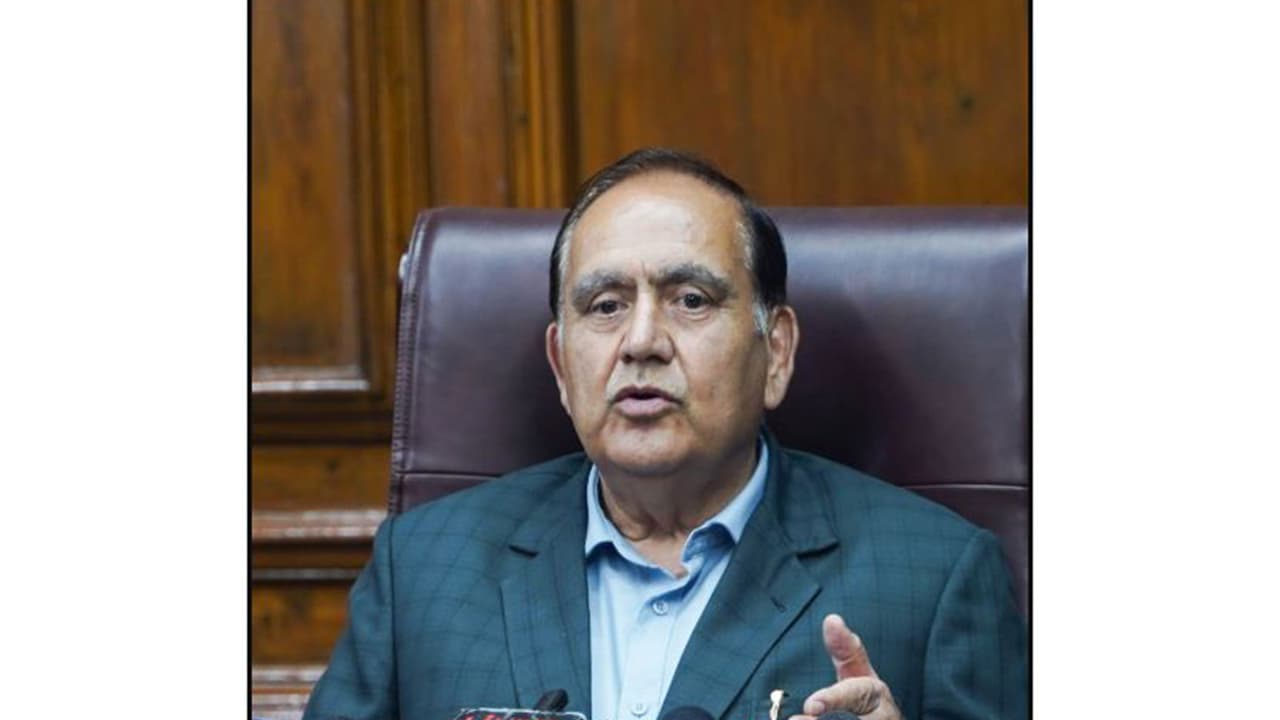
The Himachal Pradesh Assembly’s monsoon session concluded with 91% productivity after functioning for around 45 hours and 30 minutes over 10 sittings, Assembly Speaker Pathania announced. The session saw 7 bills passed and 786 questions answered.
Himachal Assembly Concludes with 91% Productivity
Himachal Assembly monsoon session concluded with 91% productivity, said Assembly Speaker Pathania. Addressing reporters in Shimla after the conclusion of the session, Pathania said the session began on August 21 and concluded on September 3, with all 10 scheduled sittings held. He said the House functioned for around 45 hours and 30 minutes during the session, with proceedings extended on several occasions to ensure that important issues raised by legislators could be discussed.
“The Monsoon Session began on August 21 and concluded today. All 10 scheduled sittings were held, and the Assembly worked for around 45 hours and 30 minutes. The productivity of the House was 91 per cent,” Pathania said.
He said the normal working hours of the House were extended from 5 pm to 7 pm and, on some occasions, proceedings continued until 8 pm, including on Wednesday. “My effort was to ensure that the issues brought by the honourable members were discussed in detail and that action was taken in accordance with the subjects they raised,” he said.
Legislative Business and Discussions
Pathania said the government provided replies to 786 questions during the session, including 514 starred and 272 unstarred questions. He added that information relating to nearly 5,500 unstarred questions had also been made available to members.
Under Rule 62, 14 subjects were taken up for discussion, while five subjects were listed under Rule 101. Two of the subjects listed under Rule 101 were discussed, one was deferred, and two subjects moved by the Opposition were adopted by the House, he said. “Since those two subjects were in the interest of Himachal Pradesh, they were adopted for discussion,” Pathania said.
He said two major issues were discussed under Rule 130 – healthcare services and employment. “Detailed discussions were held on healthcare services and employment. These were important issues, and members from both sides participated in the discussions,” he said.
Pathania said 11 subjects were raised under Rule 324, while 34 issues were taken up during Zero Hour, a practice introduced in the Himachal Pradesh Assembly during his tenure. He said the repeated raising of some Zero Hour issues indicated that members were seeking solutions to problems in their constituencies. “I felt that the issues being raised during Zero Hour were getting resolved in the constituencies, which is why members repeatedly brought such matters before the House,” he said.
Acknowledgements and Public Engagement
The Speaker thanked members of both the ruling party and Opposition for cooperating in the conduct of the session, as well as Assembly officials, government officers and district administration officials for their work. He also thanked print and electronic media for bringing the proceedings and debates of the Assembly to the people of Himachal Pradesh.
The session also saw seven government Bills being introduced and passed after discussion, while 44 committee reports were presented before the House. Around 1,908 students from government and private educational institutions witnessed the proceedings during the session, which Pathania said reflected the interest of young people in the democratic system.
He noted that the previous session had 16 sittings, lasted around 84 hours and 49 minutes and recorded 103 per cent productivity, with 617 questions received from members.
New Conventions and Speaker’s Decisions
Responding to questions on the controversy surrounding the National Anthem and National Song, Pathania said the Assembly had traditionally begun its proceedings with the National Anthem. He said the National Song was generally sung at the conclusion of the session and that, in the larger public interest and in view of changes in the duration of its rendition, the full National Song was sung at the conclusion of the Monsoon Session. “We began with the National Anthem and we concluded the session with the National Song. This will remain the convention,” Pathania said. He said the decision was taken keeping in mind the larger interest of the public, the state and the country.
Pathania also said the decision to provide distinctive flags to MLAs had already been taken during the 13th Assembly but could not be implemented at that time. “As Speaker, I have implemented that decision,” he said. He explained that every MLA would receive a distinctive flag that could be displayed on their vehicle to help establish their identity, particularly when travelling within or outside Himachal Pradesh. He compared it with the distinctive flags used by senior constitutional and administrative officials, saying the measure would help avoid difficulties in identifying elected representatives.
Procedural Clarifications
About instances where questions were disposed of quickly without extensive discussion, Pathania said important questions should certainly receive adequate discussion. He said that because discussions under Rule 61 were placed towards the end of the agenda, members sometimes did not get an opportunity to discuss all issues if earlier discussions continued for longer. “Where the issue is important, there should certainly be discussion. Our effort is that questions raised in the House should be discussed fully and that the government should give open and complete replies,” he said.
Pathania said replies to around 545 questions listed for discussion had been provided to members, while some questions could not be taken up for discussion during the session. He said such questions could be referred to in future proceedings. He stressed that providing information to members was the responsibility of the Assembly Secretariat and said that responsibility had been fulfilled.
Asked about a new trend of ruling-party members staging protests and raising slogans outside the House, Pathania said the matter fell within the rights of individual legislators. “It is for the ruling party to answer. Every member, whether from the ruling side or the Opposition, has the right to express their views in their own manner,” he said. Pathania said political circumstances and conventions could change over time and noted that the Assembly campus was a place where elected members had the right to protest and hold press conferences. “Members are elected representatives of the people, and they can resort to such activities within the Assembly premises,” he said.
Pathania concluded by congratulating and thanking all members and officials for their cooperation. He also extended advance greetings to the people on Janmashtami and the forthcoming Sharad Navratras. He said the next Assembly session would be held in Dharamshala during the winter session. (ANI)
(Except for the headline, this story has not been edited by Asianet Newsable English staff and is published from a syndicated feed.)