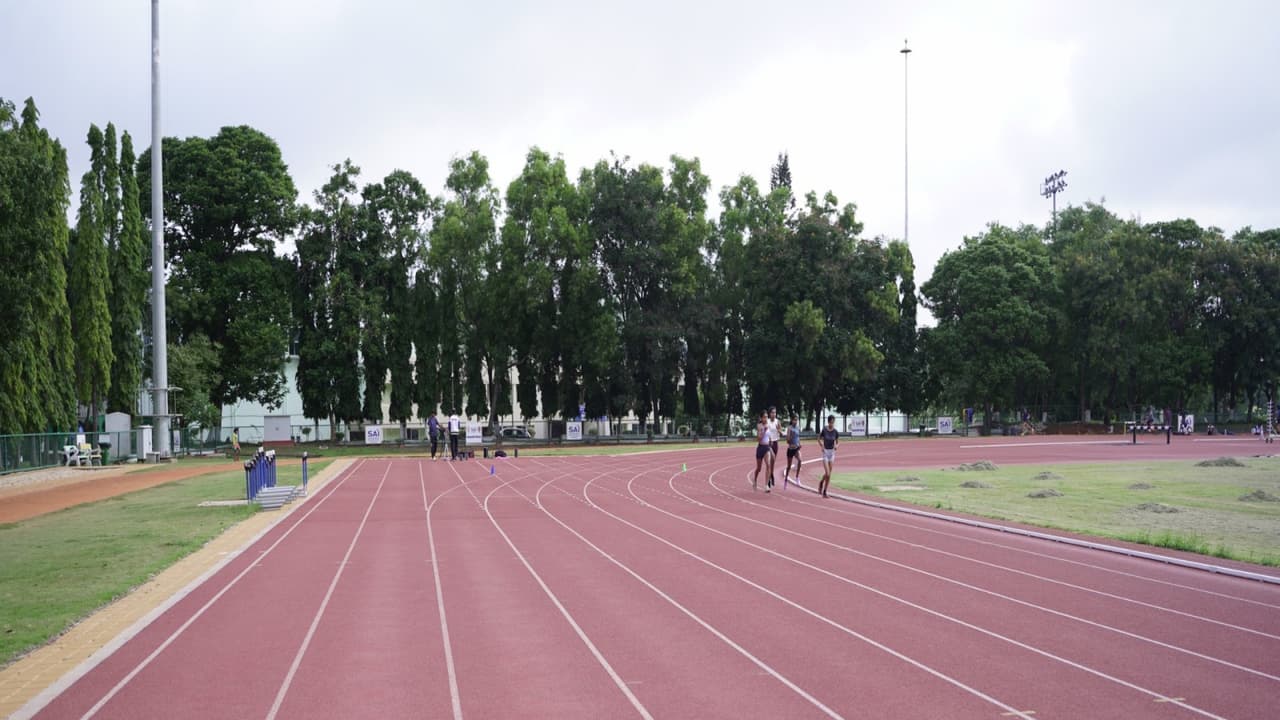
SAI’s NCOE in Bengaluru is hosting a national coaching camp for India’s Asian Games 2026-bound athletes. Stars like Avinash Sable are using a unique smart track that provides real-time performance data to enhance their training.
The Sports Authority of India’s National Centre of Excellence (NCOE) in Bengaluru has become an important preparation base for India’s middle- and long-distance track athletes, preparing for the Asian Games 2026. A national coaching camp is currently underway at the SAI centre, scheduled until September 8. The camp, sanctioned by the Target Olympic Podium Scheme (TOPS), features 800m runner Krishan Kumar, steeplechase star Avinash Sable, high jumpers Aadarsh Ram and Supriya B, decathlete Thowfeeq N, middle- and long-distance runner Parul Chaudhary, and race walkers Manju Rani and Priyanka, as per a press release.
All eight are part of the approved 73-member (35 men, 38 women) Indian athletics contingent for the Asian Games; the competition is scheduled in Aichi-Nagoya from September 19 to October 4. Beyond the conventional camp infrastructure, the athletes in Bengaluru have another advantage: a specialised smart track, which allows coaches to capture real-time performance data during training.
A Smart Track for a Competitive Edge
“This is one of its kind in India,” said Suresh Kumar, Coach (Athletics) at SAI NCOE Bengaluru, explaining the technology embedded into the track. “So what happens is when the athlete runs, we get the real-time speed data. We get the split timings wherever the gates are placed, then the total timing we get, as well as the stride length and the stride frequency. All this data is captured in real time. This helps a lot for the athletes in the training,” Kumar added to SAI Media.
The track was used extensively for training by Commonwealth Games 2026 para-athletics medalists – Dilip Mahadu Gavit and Mohammed Basil – ahead of the Glasgow games. The duo finished in the top two positions in the men’s 100m T47 category to win gold and silver medals respectively in CWG 2026.
For athletes, the ability to replicate electronic timing during training is another advantage, Kumar explained. The technology also helps athletes get a more accurate understanding of their performances. “The athletes are very happy because they get to understand and find out the real data based on the electronic timing, not just during training but in any competitions that take place here,” Kumar said.
The smart track was installed in 2024 and has since been used by elite athletes training at the centre. Its timing gates are positioned both on the straight and around the curve, allowing coaches to analyse different phases of a run. An accompanying app also enables the data to be accessed immediately for subsequent analysis.
The technology has been designed to work alongside existing athletics infrastructure rather than requiring a completely new track. According to Kumar, the system can be installed on any existing synthetic track by embedding the magnetic gates beneath the surface, with installation possible within a day.
Integrated Support with Expert Staff
The SAI Bengaluru centre is therefore combining high-level coaching, sports science and technology in the pre-Asian Games camp, which includes specialised coaches such as race-walking coach Ronald Gerd Weigel, jumps coach Sahana Kumari Nagaraj Gobbargumpi, besides coach Kalyan Chaudhary and masseuse Meena Sagar Ugale.
Key Technological Benefits
The system also gives coaches information that is difficult to capture manually during a sprint. “You even get the split timing because, for a sprint coach, if I’m at the finish line or like 40m or 50m away from when the athlete is starting, we will be able to get the electronic split time,” Kumar explained to SAI Media.
The track’s embedded magnetic timing gates also ensure that training does not have to stop because of any unpredictable weather. Unlike conventional portable timing equipment, the system remains embedded in the track and can be used in rain or dusty conditions. “So with this, we don’t have to worry about the weather. We don’t have to worry about the wear and tear, nothing. It’s just like it’s already there. You just need to run over in between that. The real-time data is always available,” Kumar added. (ANI)
(Except for the headline, this story has not been edited by Asianet Newsable English staff and is published from a syndicated feed.)