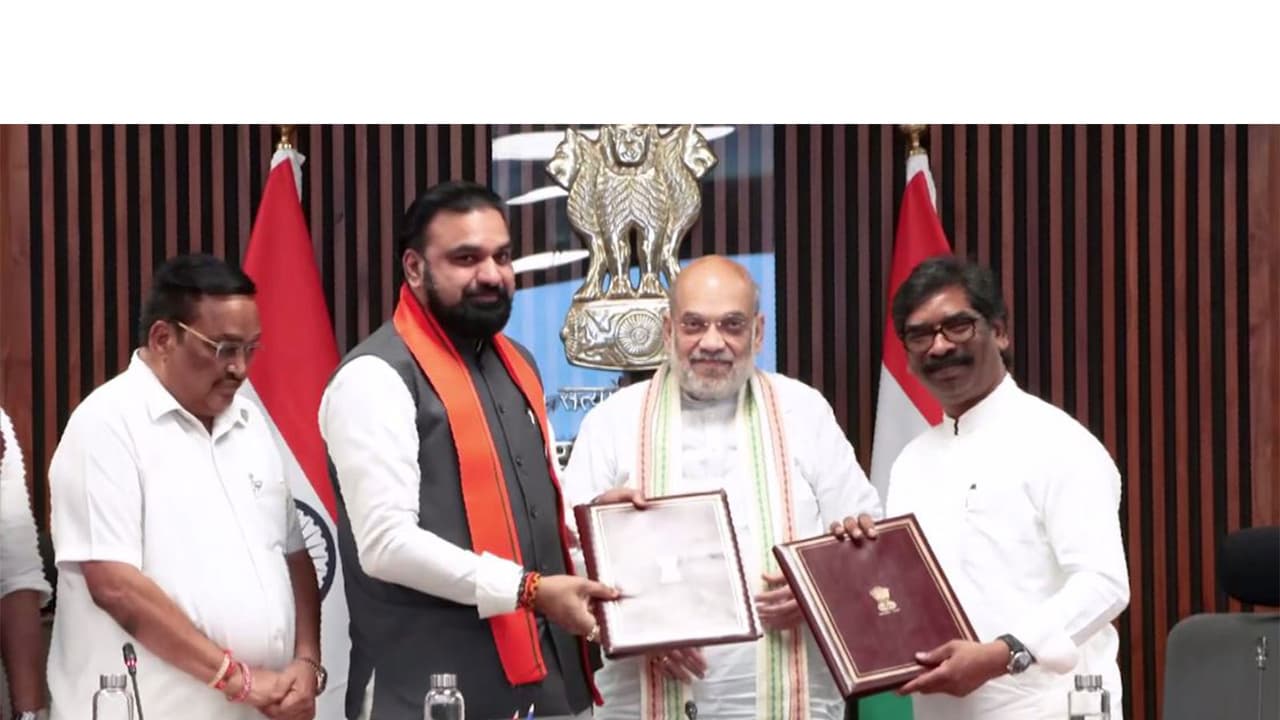
Bihar and Jharkhand have signed an MoU to resolve a 25-year-old dispute over Sone River water sharing. The agreement, signed in Amit Shah’s presence, will provide irrigation and drinking water to ten key districts across both states.
Background of the Dispute
The Sone River water dispute was a 25-year-long sharing disagreement between Bihar and Jharkhand over the allocation of Sone River water originating from the 1973 Bansagar Agreement. When Jharkhand was carved out of Bihar in 2000, Jharkhand demanded a formal, defined share of that water.The Sone is a perennial river that rises in the Amarkantak hills of Madhya Pradesh and traverses around 784 km across Madhya Pradesh, Chhattisgarh, Uttar Pradesh, Jharkhand and Bihar before merging with the Ganga at Koilwar near Patna.The river plays a crucial role in Bihar’s irrigation network through the Sone canal system and supports agriculture across several districts in the state’s southern and central regions.The distribution of Sone waters has been governed since 1973 by the tripartite Bansagar Accord involving Madhya Pradesh, Uttar Pradesh and undivided Bihar. Under the agreement, undivided Bihar was allocated 7.75 million-acre-feet (MAF) of water.The issue gained prominence after Jharkhand was created out of Bihar in November 2000, with a portion of the Sone basin falling within the newly formed state. However, the water entitlement originally assigned to “Bihar” under the Bansagar Accord was never formally apportioned between Bihar and Jharkhand. Jharkhand subsequently began seeking a clearly defined share of the allocation soon after its formation.
‘Team Bharat’ and Cooperative Federalism
“Today’s agreement between Bihar and Jharkhand has resolved a long-awaited water dispute in eastern India. The agreement reached today regarding the sharing of the Sone River’s waters is an excellent example of the ‘Team Bharat’ vision and cooperative federalism championed by Prime Minister Narendra Modi,” Shah said after the signing of the MoU.He said that while all states possess their own distinct identities, if they move forward as ‘Team Bharat’ within the national context, there is no problem which cannot be resolved.Union Home Minister said the MoU marks the fourth water agreement between states this year, which will enhance water availability for irrigation, rural development, and drinking purposes. He added that “the agreement reached today to resolve the nearly 25-year-old water dispute between Bihar and Jharkhand exemplifies that any problem can be solved through dialogue conducted with the spirit of cooperative federalism.”As per the MHA, Jharkhand and Bihar chief ministers expressed their gratitude to Prime Minister Modi and Home Minister Shah for resolving the issue of Sone River water sharing.
Other Inter-State Water Agreements
On the initiative of the Home Minister, long-pending water disputes between various states that had been unresolved for several decades are being resolved through the Inter-State Council; so far this year, four historic agreements have been reached.
Narmada Award Settlement
On July 7, 2026, a historic agreement regarding the settlement of outstanding payments was signed among the ‘Narmada Award’ beneficiary states Maharashtra, Gujarat, Rajasthan, and Madhya Pradesh in the presence of the Union Home Minister. This agreement marks a milestone in resolving long-standing disputes among these states concerning cost-sharing for the construction of the Sardar Sarovar Project, with the outstanding dues being resolved through a one-time settlement.
Rajasthan-Haryana Yamuna Water Project
On June 29, 2026, a significant agreement was signed between the governments of Rajasthan and Haryana regarding the construction and implementation of the Yamuna Water Project. Under this agreement, approximately 580 MCM of water will be conveyed from the Yamuna Canal to Rajasthan via three underground pipelines. The project aims to deliver Rajasthan’s share of Yamuna water from the Western Yamuna Canal through these underground pipelines. This will enable Rajasthan to effectively utilise the water allocated to it under the 1994 agreement regarding the sharing of usable surface water in the Upper Yamuna Basin. The project will ensure a continuous supply of drinking water to the arid and low-rainfall regions of Rajasthan and foster socio-economic development, thereby benefiting millions of people.
Kishau Multipurpose Dam Project
On June 16, 2026, a consensus was reached among the concerned states regarding the long-pending ‘Kishau Multipurpose Dam Project’ during a crucial meeting held in New Delhi under the chairmanship of Union Home Minister Amit Shah. During the meeting, Himachal Pradesh, Uttarakhand, Delhi, Uttar Pradesh, Haryana, and Rajasthan agreed to an MoU for the implementation of the ‘Kishau Multipurpose Project.’ Regarding the project, the Central government will provide 90 per cent of the funding for the water component as central assistance, while the six states will bear the financial burden of the remaining 10 per cent. An agreement was reached to allocate the water assigned to Himachal Pradesh to Delhi and Rajasthan in exchange for sharing the cost of the project’s power component.Union Minister for Jal Shakti CR Patil, Deputy Chief Minister of Bihar, Union Home Secretary, and senior officials from the Central government and both states were present during the signing of the MoU on Monday. (ANI)(Except for the headline, this story has not been edited by Asianet Newsable English staff and is published from a syndicated feed.)