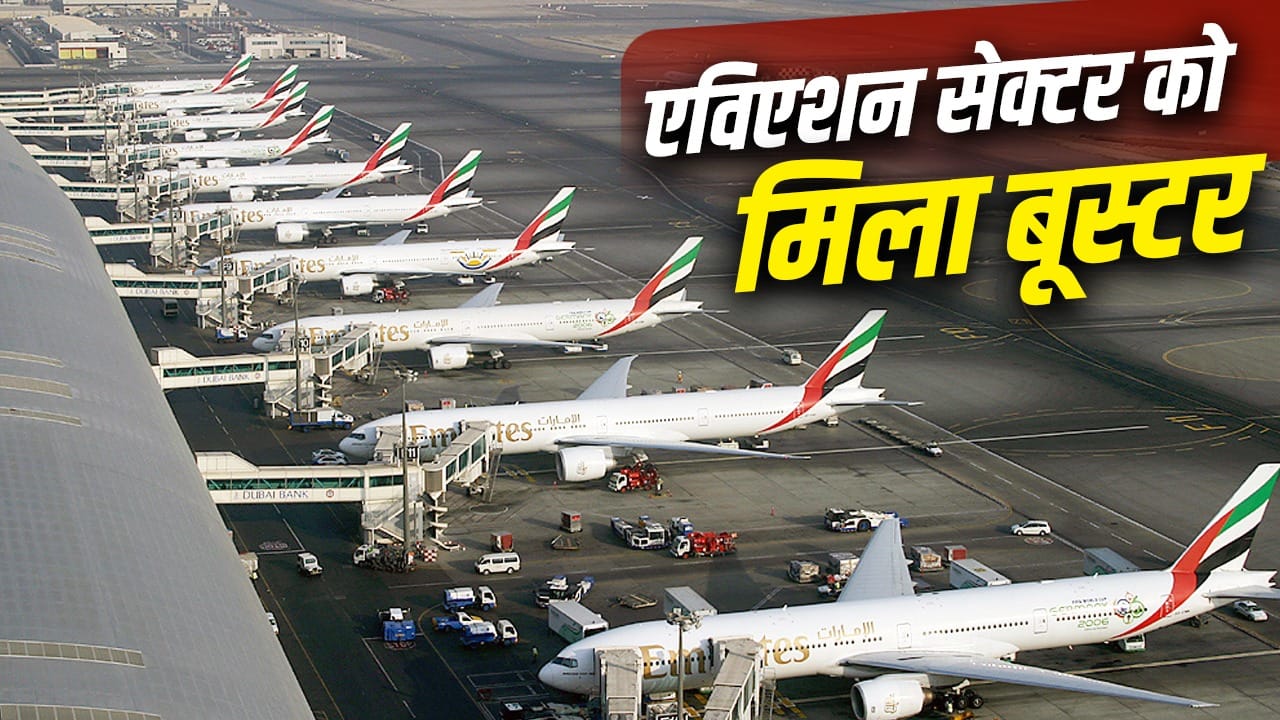
aviation sector
To provide relief to the aviation sector which is facing the challenges of expensive fuel due to Iran-US war, the Central Government has approved ATF (Aviation Turbine Fuel) fund of Rs 10,000 crore. The purpose of this help is to control the rising prices of ATF and to provide relief to Indian airlines.
Through this fund, one-time financial assistance of Rs 10,000 crore will be given to oil companies (OMCs), so that the prices of aviation fuel can be kept under control. Now the question is how will the fund of Rs 10,000 crore be used? Will this step of the Central Government be able to remove the challenges of the aviation sector? What benefit will the public get from this decision of the government?
Why did the government give a fund of Rs 10,000 crore?
Union Minister Ashwini Vaishnav said that due to the ongoing conflict in West Asia, there has been a huge increase in the prices of aviation fuel. Due to this, the financial burden on airlines and passengers was increasing. According to reports, the international price of ATF was around Rs 60.5 per liter in March 2026, which increased to Rs 142 per liter in May 2026. That means the price increased almost two and a half times. It is worth noting that ATF i.e. aviation fuel accounts for about 40 percent of the expenses incurred in running any airline. If prices go higher, this share reaches 60 percent. In such a situation, due to cost of fuel, the pressure on both airlines and oil companies increases. As is happening now.
How will the Rs 10,000 crore fund be used?
Even though the government has announced a fund of Rs 10,000 crore to provide relief to the aviation sector, this money will not be given directly to the airlines companies. The government will provide this assistance to oil companies. The government is giving this amount to oil companies as interest-free advance. With this amount the prices of aviation fuel will be kept under control. All Indian airlines operating domestic and international flights will benefit from this. Under the new system, airlines will be able to buy fuel at a fixed price, which will limit their expenses.
Oil companies will have to return the money
The big thing is that the government is giving this money to oil companies only in the form of interest. When the prices of ATF will reduce in the international market in future, then this difference amount will be taken back from the oil companies and deposited in the treasury of the Government of India. With this, this scheme will remain sustainable for a long time. However, the condition is that airlines will have to purchase ATF only from oil companies for a maximum of three years. However, it will be reviewed every year or this system will remain in force until the advance amount is fully recovered. The scheme will be monitored by a committee comprising officials from the Ministry of Civil Aviation, Ministry of Petroleum and Natural Gas and Department of Expenditure.
What benefit will the public get from this decision of the government?
The question arises that when this fund has been used to save the aviation sector from possible losses, then how will it benefit the common people? The government believes that this step will not affect the services of airlines and passengers will also get relief from the sudden increase in air fares. Also, due to closure of Pakistan’s airspace, Indian airlines have to fly on long routes, due to which fuel expenses have increased. This package will also help in reducing that additional burden. According to the government, about 77 lakh jobs related to the aviation sector will be protected by this decision. Apart from this, connectivity of airports of small cities and towns started under the UDAN Scheme will also be maintained.
Airlines got a triple blow
- Crude oil prices increased rapidly, making aircraft fuel expensive. Fuel usually accounts for 40% of the total expenses of airlines.
- The rupee further weakened against the dollar, making dollar-denominated expenses such as aircraft lease fares and other payments expensive.
- The international flight network became smaller, due to which the earnings in foreign exchange also decreased.
What are the challenges facing airlines?
Indian airlines are facing a major impact of the new crisis arising in the Middle East. Most of the international flights of Indian Airlines are connected to Gulf countries, hence any problem there has a direct impact on Indian Airlines. This crisis had a big impact on international flights. According to data from the Directorate General of Civil Aviation (DGCA), the number of international flights declined by 40% in March 2026. The available seat capacity (ASK) declined by 30% and the number of passengers was down by 36.5%. A huge decline of 42% was seen in the number of passengers compared to February 2026.