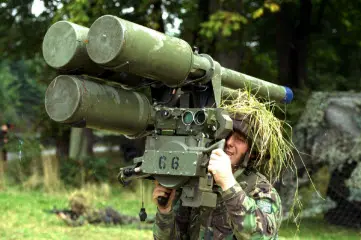
India’s decision to acquire the American FGM-148 Javelin anti-tank missile is more significant than the size of the immediate purchase suggests.
It gives the Indian Army a highly mobile, infantry-carried weapon designed to destroy modern armoured vehicles while allowing the soldier who fires it to move away almost immediately.
More importantly, Washington and New Delhi are now discussing a path towards industrial cooperation that could eventually bring Javelin production into India.
There is, however, an important distinction. The August 28 agreement is a procurement agreement, not yet a signed agreement to indigenously manufacture or co-develop the Javelin in India. The US Embassy said the Letter of Offer and Acceptance opens the door to future cooperation between American and Indian defence industries. That is consistent with the earlier Javelin Joint Venture initiative with Bharat Dynamics Ltd to explore co-assembly and co-production in India.
Why Javelin anti-tank missile matters for India?
India has signed a government-to-government agreement with the United States to acquire the Javelin system through Washington’s Foreign Military Sales programme. The US had already approved a possible $45.7 million sale in November 2025 covering 100 Javelin rounds, one fly-to-buy missile and 25 Lightweight Command Launch Units or Block 1 launchers, along with training, spares, support and related equipment.
Indian reports put the current emergency procurement at about Rs 292 crore. The precise number of missiles and launchers covered by the signed agreement has not been publicly disclosed.
The timing is revealing.
India is simultaneously dealing with the continuing threat of cross-border terrorism from Pakistan and the much larger strategic challenge posed by China along the Himalayan frontier. Arunachal Pradesh remains a particular flashpoint. Beijing continues to call the Indian state “Zangnan” and claims it as Chinese territory. New Delhi has repeatedly rejected this, and in August 2026 formally incorporated 27 locations in Arunachal Pradesh into official Indian maps after repeated Chinese attempts to rename places there.
The Javelin therefore belongs to a larger Indian effort to make frontline formations more lethal, mobile and self-reliant.
How is Javelin different from conventional RPGs? The easiest comparison is with the ubiquitous RPG-7.
An RPG is essentially a relatively simple, unguided rocket-propelled anti-armour weapon. A soldier aims it, fires it and hopes that the projectile reaches the target. It remains extremely useful because it is inexpensive, rugged, easy to operate and widely available.
Javelin is in another technological league. It is a guided missile with an imaging-infrared seeker. The operator identifies the target, locks on before launch and fires. The missile then guides itself. The soldier does not have to continue pointing the weapon at the tank.
That is the crucial difference: “fire and forget.” The US Army describes Javelin as using an imaging-infrared seeker, tandem warhead, lock-on-before-launch guidance and a soft-launch system.
The missile normally follows a top-attack trajectory. Instead of hitting the heavily protected front of a tank, it climbs and dives onto the vehicle’s roof, where armour is generally thinner.
It can also be fired in direct-attack mode against buildings, targets under cover and other situations in which top attack is unsuitable.
The tandem warhead is another advantage. The first charge is designed to defeat explosive reactive armour; the second attacks the underlying armour. That gives Javelin a considerably more sophisticated anti-armour capability than a conventional unguided rocket.
And then comes survivability. Once an RPG gunner fires, the enemy can often locate the firing position and return fire. With Javelin, the soldier can fire and immediately move. Lockheed Martin says the missile automatically guides itself after launch, allowing the gunner to take cover or reposition.
The system’s soft-launch arrangement also allows it to be fired from enclosed or covered positions-an important advantage for infantry operating from bunkers or buildings.
The Javelin missile is therefore not simply a “better RPG”. It represents a different generation of infantry anti-armour warfare.
How battle tested is the Javelin? Very. Lockheed Martin says Javelin had already recorded more than 5,000 combat firings before the Ukraine war. Its engagement envelope is normally about 65 metres to 4 kilometres, depending on conditions and configuration.
Ukraine transformed its reputation. Javelins became one of the symbols of the Ukrainian defence against the Russian invasion in 2022. The United States subsequently supplied large numbers, and American procurement contracts have explicitly included thousands of replacement missiles for rounds sent to Ukraine. A 2024 US Army contract, for example, included more than 4,000 Javelins to replenish stocks transferred to Ukraine.
The weapon’s importance goes beyond the number of Russian tanks it destroyed. It demonstrated the psychological and tactical value of giving relatively small infantry teams a credible ability to threaten expensive armoured formations. That lesson has been absorbed across NATO.
What are the countries using the Javelin missies now? The system has become a genuinely global Western anti-armour weapon.
The CSIS Missile Threat database lists more than 20 operators, including the United States, Britain, Australia, France, Norway, Poland, Estonia, Lithuania, the Czech Republic, Georgia, Ukraine, Indonesia, Ireland, Jordan, Oman, Qatar, Saudi Arabia, the UAE, Taiwan and Bahrain.
The customer list has subsequently expanded. The 2025 US production contract specifically identified Brazil and Tunisia as new Javelin users, while other countries including Kosovo have been moving into the system.
Taiwan was approved for a possible $375 million Javelin sale in December 2025-a particularly revealing customer because its principal military concern is China.
India consequently joins a club whose members include several countries preparing specifically for possible high-intensity warfare against heavily armed adversaries.
Do Russia and China make the equivalent of Javelin missiles and sell to third parties? Is an American proprietary weapon produced by the Javelin Joint Venture between Raytheon, an RTX company, and Lockheed Martin.
But Russia, China and European countries produce weapons designed to perform similar missions.
China’s most obvious counterpart is the HJ-12, or Red Arrow-12, developed by Norinco. It is a man-portable, fire-and-forget anti-tank weapon with capabilities broadly comparable to Javelin. China has developed an export version, the HJ-12E, and Norinco announced delivery of the system to its first foreign customer.
Russia’s principal families are different. The Kornet is a powerful long-range anti-tank guided missile, but it is not a Javelin copy and generally uses a different guidance philosophy. Russia also fields other guided anti-armour systems such as Konkurs and Metis families.
Europe has gone down several different paths. Britain’s NLAW, developed with Sweden’s Saab, became another celebrated Ukrainian weapon. France has the MBDA MMP. Germany and other European forces use or procure Israel’s Rafael Spike family.
So, the global competition is not really “Javelin versus Russian Javelin”. It is a contest between increasingly sophisticated fire-and-forget, top-attack and multi-mode anti-armour systems.
How much do you pay to buy a Javelin missile? This is where the weapon becomes controversial from a procurement perspective.
A Javelin is dramatically more expensive than an RPG. Public US Army figures have put individual missile costs broadly in the $80,000-$120,000-plus range, depending on variant, procurement lot and what is included. The launcher is a separate and considerably more expensive component.
The US Army’s FY2025 budget provides an illustration of the scale: $70.8 million was associated with replenishing 300 missiles, before final contract pricing. There is no authoritative public figure for a standalone “global Javelin market” because procurement contracts bundle missiles, launchers, training, spares, support and upgrades.
The broader global anti-tank guided missile market is estimated by commercial researchers at roughly $6-7 billion annually, although estimates vary considerably by methodology and what systems are included.
The better indicator of Javelin’s commercial importance is production. Lockheed Martin says the programme is increasing annual production capacity from about 2,400 to 3,960 missiles by late 2026, driven by worldwide demand.
That is an extraordinary change from the pre-Ukraine-war environment.
What about Gaza and Iran?
The Ukraine war is the clearest recent combat story for Javelin.
There is no comparable public evidence establishing Javelin as a major weapon in the Gaza war, and it would be misleading to suggest that Israel’s principal anti-armour arsenal there is based on Javelin. Israel has its own extensive family of anti-tank weapons, including Spike systems.
Likewise, the current US-Israel-Iran conflict has involved enormous quantities of American precision munitions, air-defence interceptors, cruise missiles and other weapons, but publicly available reporting does not establish Javelin as a significant weapon in the Iran campaign. Recent reporting instead highlights the consumption of Patriot PAC-3, THAAD and other high-end US munitions.
That distinction matters: Javelin is fundamentally an infantry anti-armour weapon, whereas the Iran conflict is dominated by air, missile and naval warfare.
India’s bigger calculation
For India, however, the Javelin purchase is about more than acquiring another missile.
The Army needs weapons that can be carried by small infantry units operating in difficult terrain. Along the Pakistan border, the immediate concern is armour and fortified positions. Along the Chinese frontier, the problem is different: altitude, mountains, narrow approaches, roads and the possibility of rapidly deployed mechanised forces.
A portable weapon that allows an infantry team to destroy an armoured vehicle without remaining exposed after firing fits that battlefield.
But the really consequential part of the agreement may come later.
In February 2025, the Javelin Joint Venture signed an MoU with Bharat Dynamics Ltd and began exploring co-assembly and co-production in India.
If that evolves into actual Indian production, New Delhi gets three things: supply security, industrial capability and the possibility of exports.
That is where the Javelin deal intersects with India’s “Atmanirbhar” defence strategy. The immediate purchase fills an operational gap. Local production could eventually turn the weapon into an industrial capability.
And there is a larger strategic message.
India is not abandoning its traditional Russian defence relationship. Nor is it becoming a formal American ally. Instead, it is diversifying its weapons ecosystem-buying French aircraft, American drones and missiles, Israeli systems and continuing to develop indigenous weapons.
The Javelin fits neatly into that strategy.
For an army facing two nuclear-armed neighbours, the objective is not merely to own more weapons. It is to ensure that a soldier at the sharp end has the technology to survive, shoot first and destroy an armoured threat-and that India can eventually make the weapon at home.
That is what makes the Javelin agreement strategically larger than its initial price tag. (IPA Service)