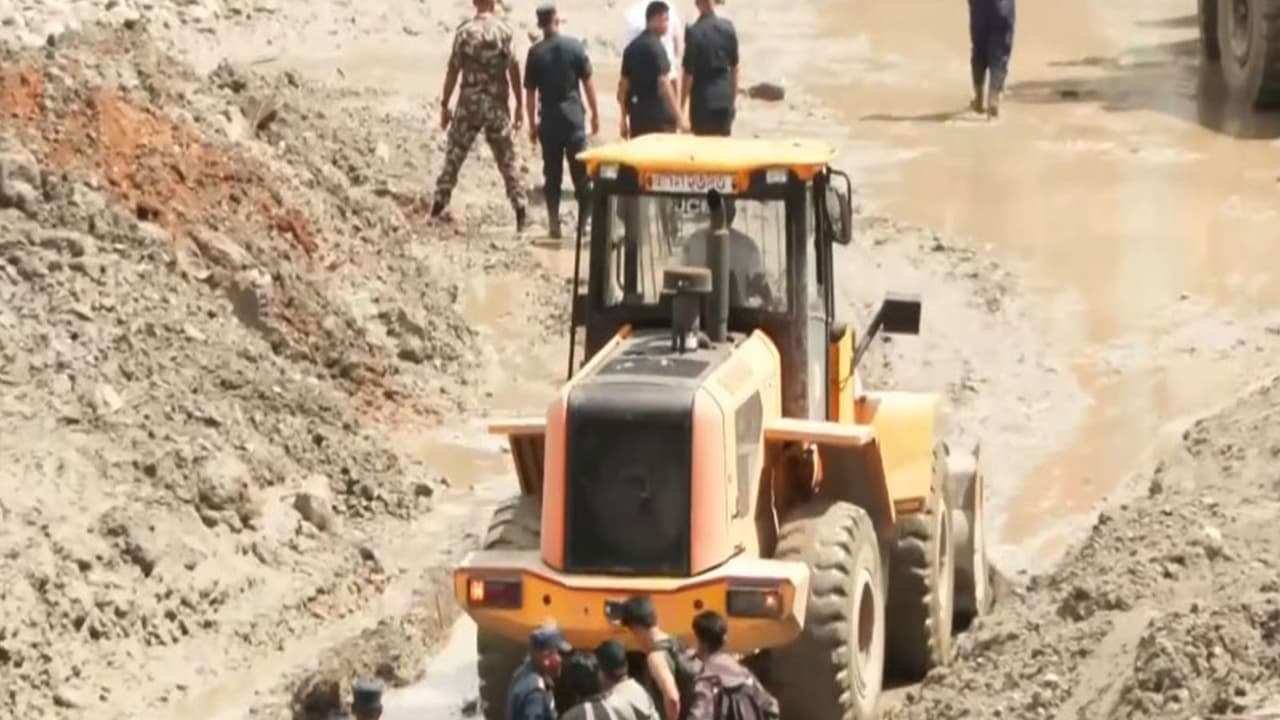
A damaged 500-metre road stretch in Nepal’s flood-hit Rasuwa district has become a critical bottleneck, halting rescue and relief operations. Repair work is suspended amid heavy rain, hampering access for teams carrying essential aid.
Damaged Road Halts Relief Efforts
Trishul [Nepal], August 29 (ANI): Road connectivity to Nepal’s flood-hit Rasuwa district continues to pose a major challenge to rescue and relief operations, with around 500 metres of a damaged stretch near the Trishuli River still awaiting reconstruction.
Repair work on the damaged road is underway to restore connectivity and facilitate the movement of rescue teams and vehicles carrying food, medicines and other essential relief material. However, the work was halted amid heavy rainfall and the threat of further flooding.
The damaged stretch has emerged as a critical bottleneck for sustained relief operations in Rasuwa, one of the worst-affected areas following the flash floods on August 26. The Trishuli River showed the extent of damage to the road, with a significant portion yet to be restored. Once the remaining stretch is repaired and made operational, it could improve access to the affected areas and allow rescue teams and relief vehicles to move more easily. The immediate challenge, therefore, is not limited to rescuing those stranded in the flood-hit areas but also restoring the road network needed to sustain relief operations.
Curious Onlookers Visit Disaster Zone
Meanwhile, the impact of the disaster has prompted people from nearby areas to visit the affected sites to assess the situation themselves. Sabina Sunar, who travelled from Kathmandu with her one-year-old child, said she came to see the situation as her village is located across the affected area. “It’s sad; that’s why I came to see,” Sunar said when asked why she had travelled to the dangerous zone with her young child. She said people in her village were safe.
Another visitor, Saksham, said he came to the area with his parents to see the situation after hearing about the floods.
Rajendra Sunar, who travelled to the area with his family, said he wanted to see the situation on the ground after seeing reports on mobile phones and television. “We came to see how things are here, what’s happening. Various things are coming on mobile and TV, so since it’s a holiday today, we came to see properly what’s going on,” Sunar told ANI.
He said he had contributed NPR 5,100 to the Prime Minister’s Relief Fund and that other members of his family had also contributed. Sunar said his village, located around 26 km away towards Dhading, was currently cut off due to the damaged road. He said he had been unable to speak to his family because there was no electricity to charge phones, though they were safe. “Once the road is clear, I will go,” he said.
Rescue Operations Suspended Amid Heavy Rain
According to Nepal Police, authorities have recovered 616 bodies following the August 26 flash floods in Rasuwa district, while 2,301 people have been injured and rescued. Earlier in the day, rescue operations in Nepal’s Trishuli region have been temporarily suspended as heavy rain intensified, raising the river level and forcing authorities to halt helicopter operations due to adverse weather conditions.
The worsening weather conditions have also prompted authorities to evacuate people from areas surrounding the rising river as a precautionary measure, officials said. Nepal Police said on X that the road section between Kathmandu and Mugling is fully operational, with only a one-kilometre stretch at Baireni Bazar in Dhading operating under one-way traffic. The suspension of rescue operations comes amid a large-scale response to the flash floods in the Bhotekoshi-Trishuli corridor and surrounding areas, where security agencies and local authorities have been conducting search and rescue operations.
Government Details Massive Rescue and Relief Response
Prime Minister Balen Shah, in a Facebook post while addressing the nation on Raksha Bandhan, said 15,431 security personnel had been deployed for search and rescue operations in affected areas, including Rasuwa and the Bhote Koshi-Trishuli corridor. The deployment includes 6,755 personnel from the Nepali Army, 4,473 from Nepal Police and 4,203 from the Armed Police Force Nepal.
According to Shah, a total of 4,451 people have been rescued so far, including 191 workers rescued from trapped hydropower tunnels and 517 people rescued through helicopter shuttle operations. Sixteen helicopters from the Nepali Army and private sector had conducted 99 shuttle flights across Dhunche, Trishuli, Timure and Syabrubesi before the latest deterioration in weather conditions.
Specialised teams have been focusing on rescuing workers trapped at the Upper Trishuli Hydropower Project, Rasuwagadhi Hydropower Station and other vulnerable tunnel sites. Authorities have also rescued and identified 129 foreign tourists and citizens, with Nepal’s Ministry of Foreign Affairs operating an Emergency Control Room to coordinate with embassies and families.
Shah said more than NPR 67.5 million had been disbursed across 15 affected local levels, while more than NPR 1.9 billion was collected in the Prime Minister’s Disaster Relief Fund within 36 hours. He said early warnings and relocation preparations were active in high-risk areas, with more than 200,000 SMS alerts issued to citizens.
The flash floods in the Bhotekoshi River area of Rasuwa have caused widespread destruction, leaving several people dead or missing and disrupting key roads and communication links. Authorities continue to coordinate with India, China and other international partners for rescue and relief support, while efforts are underway to restore roads, telecommunications, electricity and other essential services in the affected areas.
Impact on Neighbouring Bihar
Meanwhile, in Bihar, following the flood situation in Nepal, the water level in the Gandak Barrage on the India-Nepal border in West Champaran district continues to fluctuate. The river level currently stands at 97,500 cusecs, which is considered within the normal range. (ANI)
(Except for the headline, this story has not been edited by Asianet Newsable English staff and is published from a syndicated feed.)