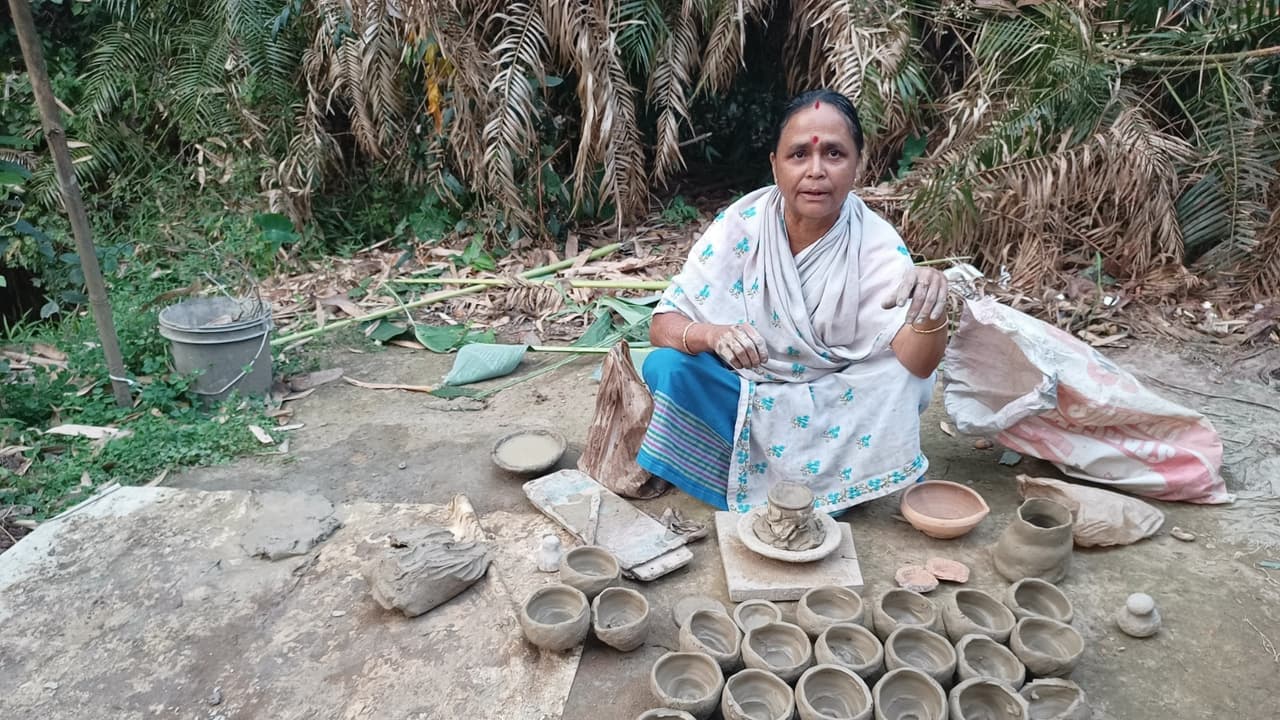
In Assam, families facing crop raids by elephants find new hope in traditional pottery. With support from Aaranyak providing raw clay, potters have doubled their income, creating a sustainable livelihood and reducing human-elephant conflict.
A Turn to Traditional Pottery
For the Bharali family, repeated crop depredation eventually made cultivation untenable. Their search for an alternative did not lead them to an unfamiliar occupation. Instead, Aaranyak helped the family return more securely to a skill they already possessed, traditional pottery. Radha Bharali, 65, is a traditional potter with a physical mobility disability. Pottery had long supplemented the household’s livelihood, but production remained small and irregular. Radha’s disability made one of the most physically demanding parts of the craft — extracting and transporting clay, particularly difficult, leaving his wife, Putul Bharali, to shoulder much of the production and market-related work.The problem was neither a lack of skill nor a lack of demand. It was access to the basic raw material that kept their craft alive. With limited capital, the Bharalis could not purchase sufficient quantities of clay or regularly hire labour to collect and transport it. As a result, production remained restricted to around 200-300 pots a month, generating a gross monthly income of approximately Rs 4,000-6,000. Recognising this specific constraint, Aaranyak, with support from the British Asian Trust, Elephant Family and the Darwin Initiative, designed a simple but targeted livelihood intervention. Aaranyak provided the family with raw clay, removing the immediate financial and logistical barrier limiting an existing livelihood. The effect was striking. With reliable access to clay, the Bharalis increased production to around 500-600 pots a month. At a local selling price of approximately Rs 20 per pot, their monthly gross income from pottery rose to about Rs 10,000-12,000.
Towards Self-Reliance and New Opportunities
Traditional festivals have opened further opportunities. During Bihu, demand for earthenware increases, allowing the family to benefit from seasonal sales. During Diwali, they also produce hand-moulded diyas, selling them for around Rs 4-5 each and adding another stream of seasonal income. More importantly, the initial support has helped the family move towards self-reliance. With their increased earnings, Radha and Putul are now able to hire local wage labourers to collect and transport clay themselves. What began as a modest input intervention has therefore enabled the household to sustain the livelihood without remaining dependent on continued material support.
Empowering the Community
Aaranyak extended the initiative to five other families in Charaguwa Grant Gaon who already possessed traditional pottery-making skills. These households have similarly been able to strengthen their pottery livelihoods, increase production and generate local income. The revival of pottery has also created an opportunity to connect the village’s traditional knowledge with visitors. Some families now welcome tourists to observe and participate in handmade pottery sessions, giving the craft a cultural as well as economic dimension.
A Model for Community-Based Conservation
What makes Charaguwa’s pottery especially distinctive is its simplicity. There is little reliance on machinery or sophisticated equipment. Clay is beaten, moulded and shaped largely by hand, with knowledge passed through generations guiding the process. For Aaranyak, the intervention demonstrates an important principle of community-based conservation: livelihood resilience does not always require introducing something new. Sometimes it requires recognising what already exists and removing the barrier preventing it from succeeding. In the Bharalis’ case, the missing piece was simply clay.That distinction becomes particularly important in landscapes affected by human-elephant conflict. Introducing an unfamiliar livelihood can demand extensive training, new infrastructure, market creation and long-term institutional support. Strengthening a livelihood already rooted in local knowledge can often be more practical and sustainable, while allowing communities to retain their skills, traditions and identity.The experience at Charaguwa Grant Gaon therefore represents more than a pottery-support initiative. For families whose agricultural security is increasingly vulnerable to elephant conflict, such interventions can provide meaningful economic alternatives without severing their connection to traditional knowledge. Sometimes conservation solutions do not have to arrive from outside a community. They may already be sitting quietly within it, in an inherited skill, a familiar resource or a tradition waiting for the right support to become viable again. For the Bharalis, that possibility began with a lump of clay. (ANI)(Except for the headline, this story has not been edited by Asianet Newsable English staff and is published from a syndicated feed.)