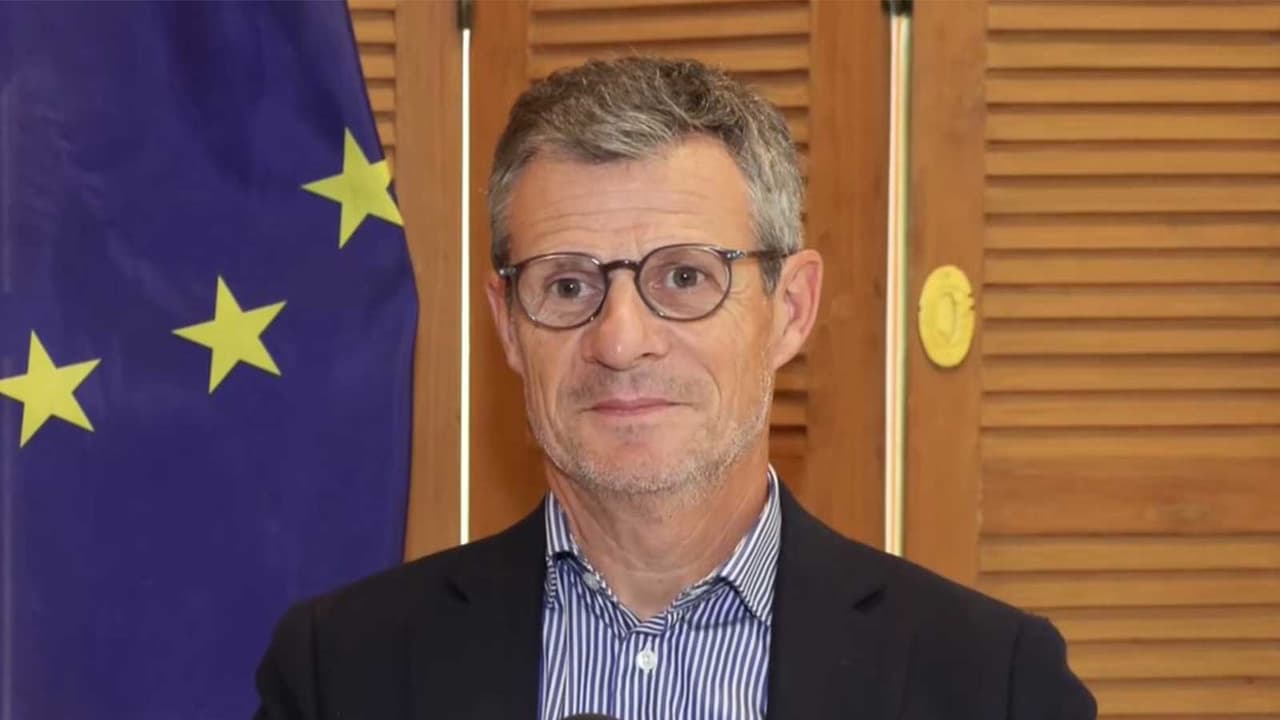
As his tenure ends, EU Ambassador Herve Delphin lauds India-EU relations as stronger than ever due to ‘strategic comfort’. He details the new ‘FTA-2’ talks, clarifies the CBAM’s impact, and highlights cooperation in building resilient supply chains.
As he prepares to conclude his tenure in India, EU Ambassador to India, Herve Delphin, has described India-EU relations as stronger than they have been in years, attributing the deepening partnership to greater “strategic understanding” and “strategic comfort” between the two sides.
Speaking to ANI, the Ambassador said his tenure focused on developing a comprehensive understanding of India and strengthening cooperation across a wide range of sectors. “The role of a diplomat is first and foremost to present and represent the views of his own country and to promote the interest. But at the same time, our job is also about listening, observing and building a greater understanding on the opportunities and challenges in the country of posting,” he said.
The Ambassador said the India-EU relationship is not limited to one particular area but encompasses a broad range of sectors, which he identified as one of the key achievements of his tenure.
India-EU Free Trade Agreement
On the India-EU Free Trade Agreement, which took nearly two decades to conclude, the Ambassador said the latest negotiations should not necessarily be viewed as a continuation of the earlier talks. “It is one and the same FTA that’s been negotiated over 20 years. I think what we have been negotiating in the last three years was FTA-2. So it has nothing to do with the previous one. And what has been, really, the, I would say, the driving force, I think, realism in the way both sides quickly identified what they were really keen to engage on, but also identified their so-called red lines”, he said.
He attributed the breakthrough to greater realism and pragmatism on both sides, saying India and the EU identified their priorities as well as their respective “red lines”. “We didn’t lose time and energy in trying to negotiate on issues that we knew were considered as red lines by the other side,” he said.
The Ambassador also highlighted the strong political push behind the agreement, particularly amid a period of increased global volatility and uncertainty. He said the complementary nature of the Indian and European markets also helped facilitate the negotiations. “India and the EU offer each other complementarity in scale in terms of access to each other’s market,” he said, adding that the two sides were not competing head-on in the same sectors.
The Ambassador said the negotiations gained momentum from 2025 and were concluded in a little over a year, expressing hope that the agreement would be signed within less than a year.
Concerns over Carbon Border Adjustment Mechanism (CBAM)
Addressing concerns among Indian exporters over the EU’s Carbon Border Adjustment Mechanism (CBAM), the Ambassador said the measure was designed to prevent “carbon leakage” and incentivise lower emissions. He explained that European companies operating in the EU single market are subject to the EU Emissions Trading System, and CBAM seeks to address the competitive disadvantage that could arise from imports with high carbon content.
The Ambassador stressed that CBAM would not affect all Indian exporters equally. “As far as India is concerned, I think 80 per cent or more of India’s exports to Europe which have a high carbon content refers to steel and iron. So it’s not all exporters in all sectors. It is a very specific sector,” he said.
He said the EU had been engaging with Indian authorities and affected industries during the consultation process, adding that the Indian steel industry was increasingly looking towards reducing its carbon footprint.
According to the Ambassador, Indian steelmakers producing low-emission steel could ultimately benefit from CBAM as Europe is expected to remain a net importer of steel. “I think you have to right-size the issues, and I think we are confident through conversation, exchanges and mutual understanding that this problem will be addressed in a fair way,” he said.
De-risking and Resilient Supply Chains
On efforts by both India and the EU to reduce dependence on a single market and build resilient supply chains, the Ambassador said the two sides shared the strategic objective of “de-risking” and increasing the resilience and reliability of supply chains. He said the FTA would act as an important enabler, while cooperation would also be strengthened through an Investment Protection Agreement and the India-EU Trade and Technology Council (TTC).
The Ambassador said the two sides were examining strategic sectors including semiconductors, clean technology, pharmaceuticals and agri-food. “We are looking at specific global value chains where we both stand to benefit from our cooperation and our integration,” he said.
He also highlighted the concept of “blue valleys”, industrial cooperation parks or corridors where European and Indian companies could work together across research, innovation, startups, investment, skilling and joint manufacturing. “We’re really making a qualitative change and a qualitative step in the way we work together, and in a way we will mutually increase our resilience,” he said.
(Except for the headline, this story has not been edited by Asianetnews Editorial staff and is published from a syndicated feed.)