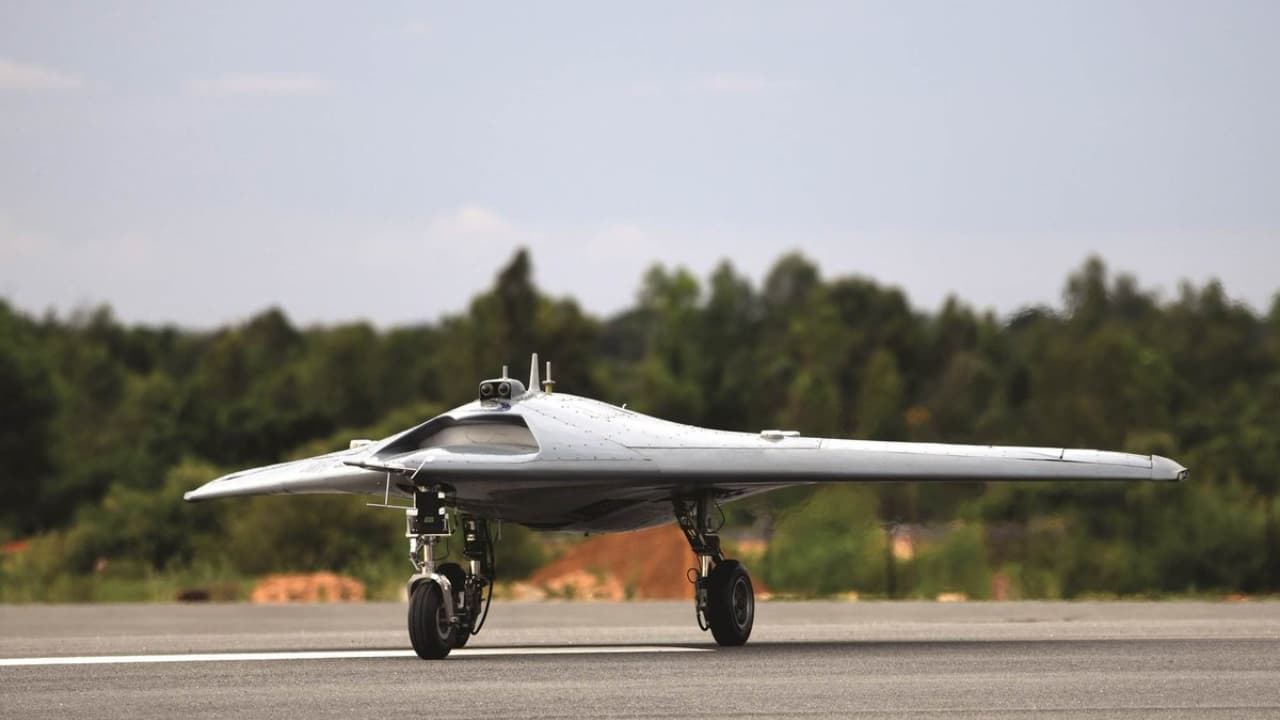
India’s Ghatak UCAV is a stealth unmanned combat drone being developed by DRDO for deep-strike missions. Designed for manned-unmanned teaming, it aims to counter advanced Chinese and Pakistani military capabilities with long-range precision attacks.
New Delhi: Ghatak stealth unmanned combat aerial vehicle (UCAV) is moving slowly from technology demonstrator toward a weapon system the Indian Air Force wants in four squadrons. How it stacks up against what China and Pakistan already field is the sharper question.
What Ghatak Is?
Developed by DRDO’s Aeronautical Development Establishment in Bengaluru, Ghatak UCAV is a tailless flying-wing weighing roughly 13 tonnes, powered by a jet engine with concealed air intakes and an airframe built predominantly from carbon-fibre composites.
Weapons are carried internally around one tonne of precision munitions, avoiding the radar signature of external pylons. The operational specification calls for a combat radius exceeding 1,000 km and eight hours of endurance.
The design concept is manned-unmanned teaming (MUM-T): operating alongside Su-30MKIs, and eventually Tejas Mk2 and the AMCA, as a forward sensor and shooter that absorbs risk in the most lethal segments of a mission.
Against China
China’s GJ-11 “Sharp Sword” is the direct comparator, a flying-wing UCAV of similar configuration and apparently similar intent. Beijing has been opaque about operational numbers, but the GJ-11 is clearly further along than Ghatak: it has been seen in formation flights and in public military displays suggesting at least limited production.
Behind it sits a formidable air-defence architecture – HQ-9 batteries underpinned by Russian S-400 technology, and the longer-range HQ-19 in development – layered across a Tibetan plateau that sits above 4,000 metres.
The PLAAF also fields over 300 J-20 stealth fighters. Ghatak’s long combat radius and low-observable profile are specifically intended to strike radar installations, logistics nodes, and command facilities sustaining PLAAF operations near the LAC without committing crewed jets to those corridors. In raw capability terms, China is ahead on every metric that matters – numbers, air-defence depth, and programme maturity.
Against Pakistan
Pakistan’s threat calculus is different. Its frontline fighter mix – upgraded F-16 Block 52s and the JF-17 Block III with an AESA radar – is capable but lacks a stealth dimension. Its armed drones, mostly Chinese-supplied CH-4 and CH-3 systems alongside indigenous Burraq and Shahpar platforms, are non-stealthy, medium-altitude designs suited to counter-insurgency, not contested airspace penetration.
A mature Ghatak fleet would hold Pakistani air-defence batteries, missile infrastructure, and command nodes at risk without the attrition of manned deep-strike missions.