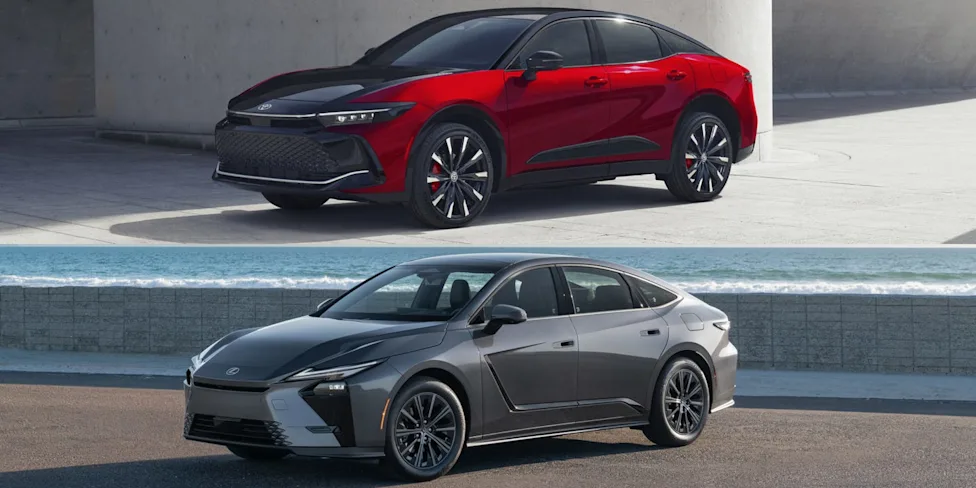
There’s this one weird trick Big Auto doesn’t want you to know: Luxury and mainstream models often share platforms, powertrains, and other components. That’s the case with the latest sedan and the n four-door. So if they’re similar underneath, which is the better deal?
You can think of the Crown as a sort of super-Camry. It’s bigger and roomier than Toyota’s mainstream mid-size sedan, it’s more luxurious, and it’s available with two hybrid systems. The base setup is similar to the Camry’s, and the optional powertrain is significantly more powerful. If you’re wondering where the Crown came from, it replaced the Toyota Avalon and borrows its name from a line of upscale Japanese-market Toyota products.
The ES, long perceived as a Camry in nicer clothes, is now closer in size to today’s Crown and the Avalon before it. With the LS sedan bowing out after 2026, the ES is the largest remaining four-door in the Lexus lineup and by far the most modern, having just been redesigned. That 2026 redo brought wrapped in the same body; for the purposes of this comparison, we’re focusing on the ES Hybrid.
Design and Dimensions
Toyota apparently couldn’t quite decide if the Crown should be a classic three-box sedan or some type of crossover SUV. So why not a little of both? What you get is a tall, slightly lifted sedan with sloping rear glass that ends above a traditional trunk. Despite being a few inches taller than a Camry, the Crown is 4.3 inches shorter in height than the ES.
The Crown rides on a 111.2-inch wheelbase, while the ES’ wheelbase measures 116.1 inches, almost three inches longer than the previous ES. The Lexus is also longer overall, 202.4 inches to the Toyota’s 196.1. If you adopt the more-is-better ethos of car buying, the ES takes an early lead.
Interior and Cargo
But it’s not the size of the vehicle that matters, it’s how the engineers use it (in terms of packaging). The ES’s extra height translates only translates to a small amount of extra vertical room inside: the ES has 38.3 inches of headroom up front and 37.8 in the rear, advantages of just 0.1 and 0.3 inch compared to the Crown. The Toyota is the winner in front legroom, at 42.1 inches to the Lexus’s 41.9, whereas in back the ES wins with 40.7 inches, 0.8 inch better than the Crown.
Feature and materials differences are similarly unexpected. It’s Toyota that includes leather upholstery on all of its contender’s trims, while every ES Hybrid features faux-leather seating surfaces (the EV version offers the real stuff in its higher trim levels). Both the Toyota and the Lexus come with heated and ventilated front seats, but heated rear seats are standard on the Crown yet missing from the ES’s spec list.
There’s a 12.3-inch digital gauge display in front of both driver seats, but Lexus has the larger center touchscreen, at 14.0 inches to the Crown’s 12.3-incher. And in our humble opinion, the ES has a cleaner and more attractive interior design.
Pop the trunk with a Toyota badge on it, and you’ll have 15 cubic feet to play with. The ES has a 13 cubic foot trunk. At this point we’re wondering where all that extra length and wheelbase went. One more oddity: The Toyota’s rear seat splits 60/40 and folds down, while the Lexus’s second-row setback is fixed.
Powertrains and Fuel Economy
The gas-electric ES350h comes one of two ways: with front- or all-wheel drive. Both versions make a total of 244 horsepower despite the AWD powertrain’s addition of an extra electric motor to drive the rear axle.
Crown buyers choose from two different powertrains, both with standard all-wheel drive. The base hybrid system is new to the Crown for 2027 and matches the setup in the ES but makes a bit less power, at 236 horsepower. Toyota’s Hybrid Max setup comes exclusively on the top Platinum trim and makes a healthy 340 horsepower. At our test track, the Hybrid Max managed a 5.1-second 60-mph time, while the previous base Crown hybrid needed 7.2 seconds. We haven’t tested the updated base Crown or the ES350h, but both should reach 60 mph in about 7.2 seconds as well.
Toyota’s fuel-economy estimates for the base Crown are 42/38 mpg city/highway and the Hybrid Max’s 29/32 mpg EPA ratings should carry over for 2027. Strangely, the standard 2027 Crown is expected to lose a few highway miles per gallon compared to the 2026’s 41-mpg rating. In our 75-mph real-world highway fuel-economy test, we saw 42 mpg with the outgoing powertrain and 32 mpg for the Hybrid Max.
The ES fares a lot better on the government’s test cycle, with ratings of 48/44 mpg city/highway for the front-drive model and 47/42 mpg with AWD.
Trims and Price
Toyota asks $42,935 for the 2027 Crown XLE. Step up to the $50,260 Nightshade, and you get some more equipment—a JBL stereo, 21-inch wheels, rain-sensing wipers, a panoramic glass roof, driver’s seat memory, front and rear parking sensors with automatic braking, and black aesthetic touches. Beyond that is the Limited, for $51,015, which uses the same base powertrain but adds a 360-degree camera system, lane-change assist and traffic-jam assist, as well as digital key capability. The top-dog Platinum with the Hybrid Max powertrain runs $56,485 and also nets you adaptive dampers, a hands-free power trunk, and a head-up display. It also opens up the option for a two-tone exterior with a black hood and roof.

2027 Toyota Crown Nightshadetoyota
The base 2027 ES350h trim, Premium, starts at $51,200. To get the same basic powertrain as the least-expensive Crown, you have to spend an extra $1400—$52,600, or nearly $10k more than the Crown XLE—for the Premium AWD. Stepping up to the Premium+ trim—$56,000 with front-wheel drive or $57,400 for the AWD version—adds a 17-speaker Mark Levinson audio system, remote parking, a rear-camera mirror, digital key functionality, and, hey, a head-up display.
There are other differences between these intra-corporate rivals, including a more advanced and feature-rich suite of active driver assists for the Lexus. And they ride and drive differently, so don’t make your decision based solely on these specs.
But it’s hard to ignore the price advantage of the Crown here, especially considering its standard equipment and larger trunk. Even after paying the premium for the Crown Platinum and its more powerful hybrid setup, the total still comes in under the price for the ES350h Premium+ AWD. The money you save can go toward the Hybrid Max’s bigger gas bill.