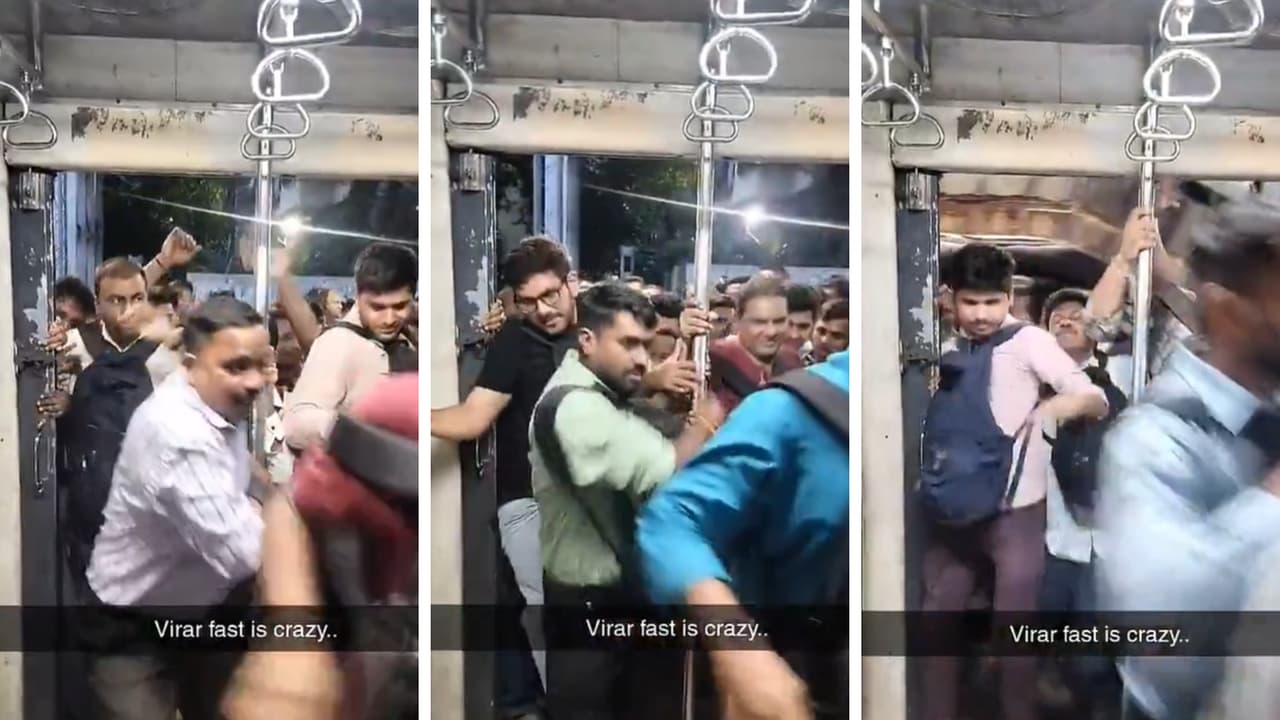
Billionaire Harsh Goenka has sparked a debate after sharing a video showing commuters boarding a moving train one by one before it stops at a station. Calling the situation ‘risky, dangerous and unacceptable’, Goenka questioned why such travel has become normal. Netizens blamed overcrowding, poor infrastructure, urban migration and lack of empathy.
Billionaire industrialist Harsh Goenka has triggered a wide-ranging debate on India’s overcrowded public transport after sharing a disturbing video showing commuters boarding a train while it was still moving. In the viral video, passengers can be seen getting onto the train one after another before it comes to a complete halt at the station. The risky scenes prompted Goenka to question why millions of Indians continue to accept such dangerous travel conditions as part of everyday life.
“We send missions into space, build world-class airports and run sleek Vande Bharat trains. And then millions of Indians commute like this every day,” he wrote on X.
Calling the situation ‘risky, dangerous and unacceptable’, Goenka added that India could not aspire to first-world infrastructure while treating such conditions as normal.
Scroll to load tweet…
Social media users back Goenka’s concerns
The video quickly drew strong reactions, with many users agreeing that overcrowded train travel has been normalised for far too long.
Several commenters said the issue reflected a wider gap between major infrastructure projects and the everyday experience of ordinary commuters. One user argued that India needed to focus on ‘basic dignity and standard of living’ if it truly wanted to become a developed nation.
Another said the problem was often brushed aside as the ‘spirit of Mumbai’, arguing that dangerous commuting conditions should not be celebrated or romanticised.
Others questioned whether policymakers fully understood the hardship faced by daily passengers, with one user saying that empathy was missing because decision-makers did not travel in such conditions.
Calls for AC trains, metro expansion and decentralisation
The viral post also led to several suggestions on how overcrowding could be reduced.
Some users called for more air-conditioned local trains, stricter ticket checks and better crowd management on platforms. Others suggested expanding metro networks or increasing the frequency of trains on heavily used routes.
A number of users, however, pointed to a larger urban planning problem. They argued that the concentration of offices, industries and jobs in major cities such as Mumbai had placed enormous pressure on existing transport systems.
Several suggested decentralising economic activity and encouraging businesses to move towards satellite towns and smaller cities. Others called for more flexible work arrangements, including remote or hybrid working, to reduce peak-hour pressure.
Debate shifts to infrastructure and population pressure
Not everyone agreed on the cause of the problem. Some blamed rapid population growth and migration to major cities, while others pointed towards corruption, poor planning and delays in upgrading public transport.
One recurring argument was that India often treats problems that should be unacceptable as part of normal daily life.
Goenka’s has simply struck a chord because the video captured a familiar reality for many commuters – a daily journey where reaching work or home can sometimes involve risks that passengers have simply learned to live with.