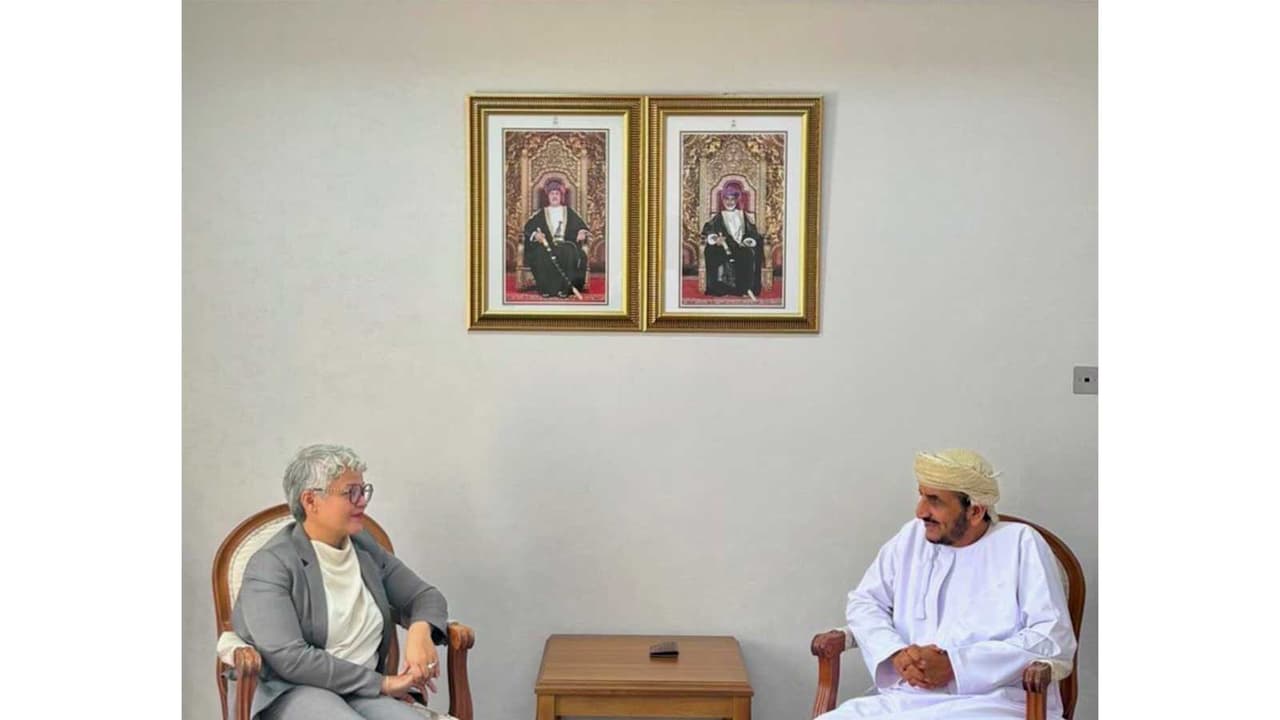
US Ambassador Ana Escrogima met Omani Undersecretary Khalifa bin Ali Al Harthy to discuss collaboration and regional stability. The talks come amid Oman’s diplomacy with Iran over the Strait of Hormuz, a warning from Trump, and new transit fees by Iran.
US Ambassador to Oman Ana Escrogima held a “fruitful conversation” with Khalifa bin Ali Al Harthy, Undersecretary of the Omani Foreign Ministry for Political Affairs, in Muscat, the US Embassy in Oman said on Sunday.
In a post on X, the US Embassy said, “Fruitful conversation between Ambassador Escrogima and Sheikh Khalifa bin Ali Al Harthy, Undersecretary of the Foreign Ministry for Political Affairs, on advancing U.S.-Oman collaboration and our joint efforts toward regional stability.”
Fruitful conversation between Ambassador Escrogima and Sheikh Khalifa bin Ali Al Harthy, Undersecretary of the Foreign Ministry for Political Affairs, on advancing U.S.-Oman collaboration and our joint efforts toward regional stability. 🇺🇸🇴🇲 — U.S. Embassy Muscat (@USEmbMuscat) August 23, 2026
US-Oman Diplomatic Engagements
The meeting comes amid Oman’s diplomatic engagement with Iran over the reopening of the Strait of Hormuz and ensuring safe commercial navigation through the strategic waterway.
The development follows US Secretary of State Marco Rubio’s meeting with Oman’s Ambassador to the United States, Talal Al Rahbi, in Washington on August 21, where they discussed issues of mutual interest, the Oman Embassy in Washington said.
In a post shared on X, the Oman Embassy said, “H.E. Ambassador Talal Al Rahbi met with U.S. Secretary of State Marco Rubio on the sidelines of an event organized by the U.S. Department of State at the Institute of Peace in Washington, D.C.”
#Washington H.E. Ambassador Talal Al Rahbi met with U.S. Secretary of State Marco Rubio on the sidelines of an event organized by the U.S. Department of State at the Institute of Peace in Washington, D.C. During their conversation, they exchanged views on a number of issues of… pic.twitter.com/mdVrdteVmg — سفارة سلطنة عُمان واشنطن | OMAN EMBASSY WASHINGTON (@OmanEmbassyUSA) August 21, 2026
“During their conversation, they exchanged views on a number of issues of mutual interest, commended the strong cooperation between the Sultanate of Oman and the United States, and underscored the importance of continued coordination and cooperation in addressing shared issues and challenges,” it added.
Trump Warns Oman Over Hormuz Talks
Earlier on August 17, US President Donald Trump warned Oman against interfering in Washington’s position on the Strait of Hormuz, amid ongoing Iran-Oman talks over safe commercial navigation through the strategic waterway.
During a phone call with Fox News correspondent Trey Yingst, Trump discussed the situation with Iran as the 60-day memorandum of understanding signed in June to open negotiations aimed at ending the conflict in West Asia approached its deadline.
Asked about parallel talks between Iran and Oman over control of the Strait of Hormuz, Trump said, “If Oman gets in the way, we’ll bomb the sh** out of them.”
Iran to Charge Fees for Hormuz Transit
Meanwhile, on Sunday, Iran said that vessels from “authorised” countries transiting the Strait of Hormuz will now be required to pay service fees to Tehran.
Detailing the scope of the decision, Iran’s National Security Commission Spokesperson Ebrahim Rezaei stated that the fees will cover a wide range of maritime, environmental, and logistical provisions.
According to state broadcaster IRIB, this comes after the approval of the Article 3 “Strategic Action to Ensure the Security and Progress of the Strait of Hormuz” plan.
Details of the New Fee Structure
“Article 3 of the ‘Strategic Action to Ensure the Security and Progress of the Strait of Hormuz’ plan was approved by the National Security Commission, according to which ships from countries authorised to pass through the Strait of Hormuz will pay for the services provided by Iran,” he said.
“Fees will be charged for services including navigation, environmental, fueling under certain conditions, insurance, safety and other services we provide,” he added.
The spokesperson further stated that the payment structures have been designed with flexible financial terms.
“These fees will be charged in Rials or any other currency desired by the Islamic Republic of Iran,” IRIB cited him as saying.
(ANI)
(Except for the headline, this story has not been edited by Asianet Newsable English staff and is published from a syndicated feed.)