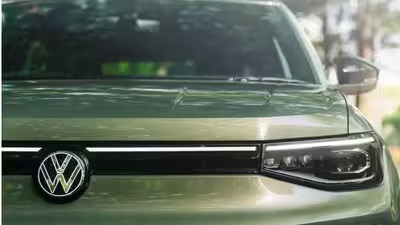
Volkswagen has officially confirmed a new sub-4 metre SUV for India built on the same MQB-A0-IN platform as the Skoda Kylaq and scheduled to arrive in 2027 as the brand’s most affordable model here. For Indian buyers, this matters because Volkswagen currently has no presence at all in the country’s highest-volume SUV segment, one dominated by the Tata Nexon, Maruti Suzuki Brezza as well as Hyundai Venue, meaning this fills a genuine gap in the brand’s lineup instead of adding another niche model. Here’s what’s confirmed and the real tension this creates within Volkswagen’s own group.
What Volkswagen Has Confirmed So Far
The SUV will be locally manufactured and positioned below the Taigun, which makes it Volkswagen’s entry point into its India SUV range once launched. Volkswagen India hasn’t revealed the car’s name or design yet but has confirmed the underlying MQB-A0-IN platform, the same architecture already underpinning the Kylaq, Kushaq, Slavia, Taigun and Virtus.
No powertrain has been officially announced though the Kylaq connection makes its 1.0-litre TSI turbo-petrol engine, offered with 6-speed manual and 6-speed torque-converter automatic options. This is a strong likely candidate given the shared platform.

The upcoming VW SUV will be based on the same platform as the Kylaq
Why This Could Cut Into Skoda’s Own Sales
The has been Skoda India’s clear volume driver, accounting for around 65% of the brand’s total domestic sales in July 2026 with 3,727 units sold that month alone. However, Kylaq’s growth has slowed sharply: sales rose just 2.32% between January and July 2026 compared to the same period last year and actually declined 5% when measured over the more recent February-July window.
Since Volkswagen’s new SUV will share the Kylaq’s platform and likely its powertrain, some overlap in buyers is difficult to avoid, meaning Volkswagen will need genuinely distinct styling and positioning to grow the Skoda-Volkswagen group’s overall share instead of simply moving existing Kylaq buyers to a different badge.
has followed a similar differentiation strategy before with the Taigun-Kushaq and Virtus-Slavia pairs where shared underpinnings didn’t stop each model from carving out its own identity. Whether that approach works a third time, in a segment as competitive as sub-4m SUVs, will depend heavily on how Volkswagen prices and styles the car once more details emerge closer to its 2027 launch.