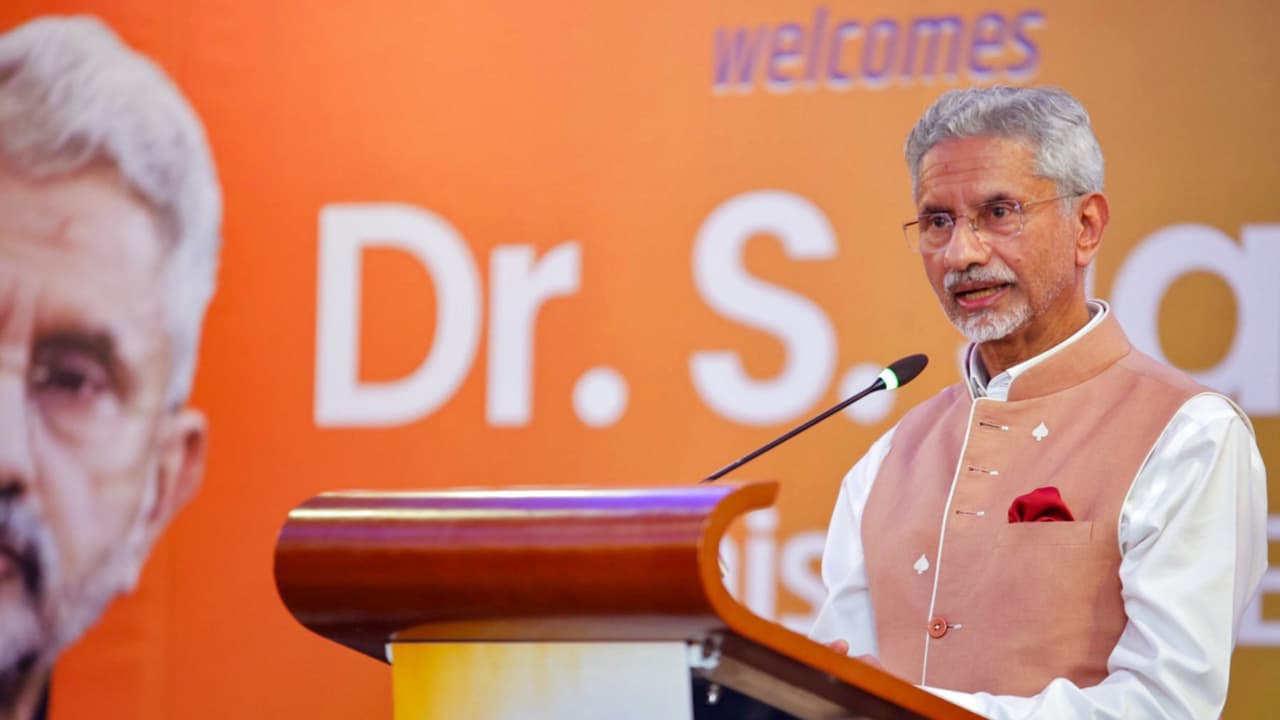
EAM S Jaishankar painted a ‘realistic picture’ of the world, describing it through three Cs: competition, conflict, and choke points. He proposed a four-D response of derisking, diversification, dealing with distortions, and building a safety margin.
External Affairs Minister S Jaishankar on Saturday painted a “realistic picture” of the current global situation, describing it through three Cs — competition, conflict and choke points — and suggested a four-D response of derisking, diversification, dealing with distortions and building a margin of safety.
Addressing a session at the Economic Times World Leaders Forum 2026 here, Jaishankar said the world has become increasingly competitive, with countries and policymakers pushing their interests to a point where competition is, at times, turning into conflict.
The World Today: Competition, Conflict, Choke Points
“It’s not a very comforting answer I’m going to give,” Jaishankar said while describing how he sees the world today. “I think what we’ve seen particularly in the last year or so, but I would really describe it as a growing trend. It looks increasingly competitive,” he said, adding that countries and policymakers are pushing their interests “to a point where you actually have conflicts.”
He pointed to the two major conflicts currently underway, referring to the Ukraine-Russia conflict and the one in West Asia, noting that one has entered its fifth year, while there is still no clear “light at the end of the tunnel” for the other.
According to Jaishankar, competition is no longer limited to traditional geopolitical rivalry and is increasingly being expressed through the “weaponisation” of different economic and strategic tools.
“This is a world increasingly characterised by choke points,” Jaishankar said, explaining that a choke point emerges when “a country or a set of countries have established dominance” in a particular field and are willing to deploy that dominance to exert pressure.
According to Jaishankar, such choke points can “inflict pain” while countries exercising that leverage may believe they are sufficiently insulated from the consequences.
He said that while “the world chugs along” and people remain occupied with their daily lives, conflicts and choke points can create complications that affect people and businesses even in far-off societies.
The Way Forward: Derisk, Diversify, Deal, Distrust
Moving from the problems to possible responses, Jaishankar outlined his four-D approach.
“If I declare the problems in terms of Cs, maybe I move an alphabet beyond,” he said, presenting “derisking” as his first and “biggest mantra”.
“Derisking will be my biggest mantra,” Jaishankar said, stressing that it is relevant not only to businesses but also to politics and strategy.
His second D was “diversify”.
“The more partners, the more sources that you have, clearly extending that you derisk,” he said, arguing that businesses and countries should avoid excessive dependence on a limited number of partners or sources.
The third D was to “deal with distortions”, with Jaishankar pointing to what he described as distorted energy, fertiliser and shipping markets resulting from the conflict emerging around choke points.
For his fourth D, Jaishankar offered a twist on the traditional principle of “Trust and Verify”.
“Today I say ‘Distrust and Diversify’,” he said, arguing that businesses and policymakers should assume that “things may not go right” and incorporate that possibility into their plans.
He cautioned against relying solely on just-in-time supply chains or assuming that the lowest cost will always be the decisive factor.
“Don’t let your supply chain really be just in time anymore; don’t assume that your lowest cost will be the determinant,” he said, stressing the need to build a “margin of safety” into business and national strategies.
“I think this is the reality of the world. It applies to national policymakers; it applies to enterprise decisions,” Jaishankar said, concluding: “I think it is a realistic picture.”
(Except for the headline, this story has not been edited by Asianet Newsable English staff and is published from a syndicated feed.)