SpaceX could gain from fewer Starship bottlenecks and NASA’s Moon-Mars push.
- The policy seeks faster reviews, more launch sites, priority airspace and greater private infrastructure investment.
- Rocket Lab could secure greater range access for Electron and Neutron as its government business expands.
- AST SpaceMobile could deploy BlueBird faster through increased launch capacity and rideshare availability.
U.S. President Donald Trump’s push to enable more than 1,000 U.S. launches and reentries annually by 2030 could deliver a major tailwind for SpaceX (SPCX), Rocket Lab (RKLB), AST SpaceMobile (ASTS) and Intuitive Machines (LUNR).
Trump signed a National Security Presidential Memorandum on Thursday aimed at ushering in a “Golden Age of Space Transportation.” The plan calls for faster permitting and environmental reviews, additional launch and reentry sites, priority airspace for launch corridors, transparent range scheduling and private investment in infrastructure.
It also directs agencies to streamline procurement, strengthen the domestic space industrial base, expand international market access and advance commercial transportation to the Moon and Mars. The Pentagon was also directed to expand its use of in-space transportation services.
SpaceX: Starship Gets A Policy Tailwind
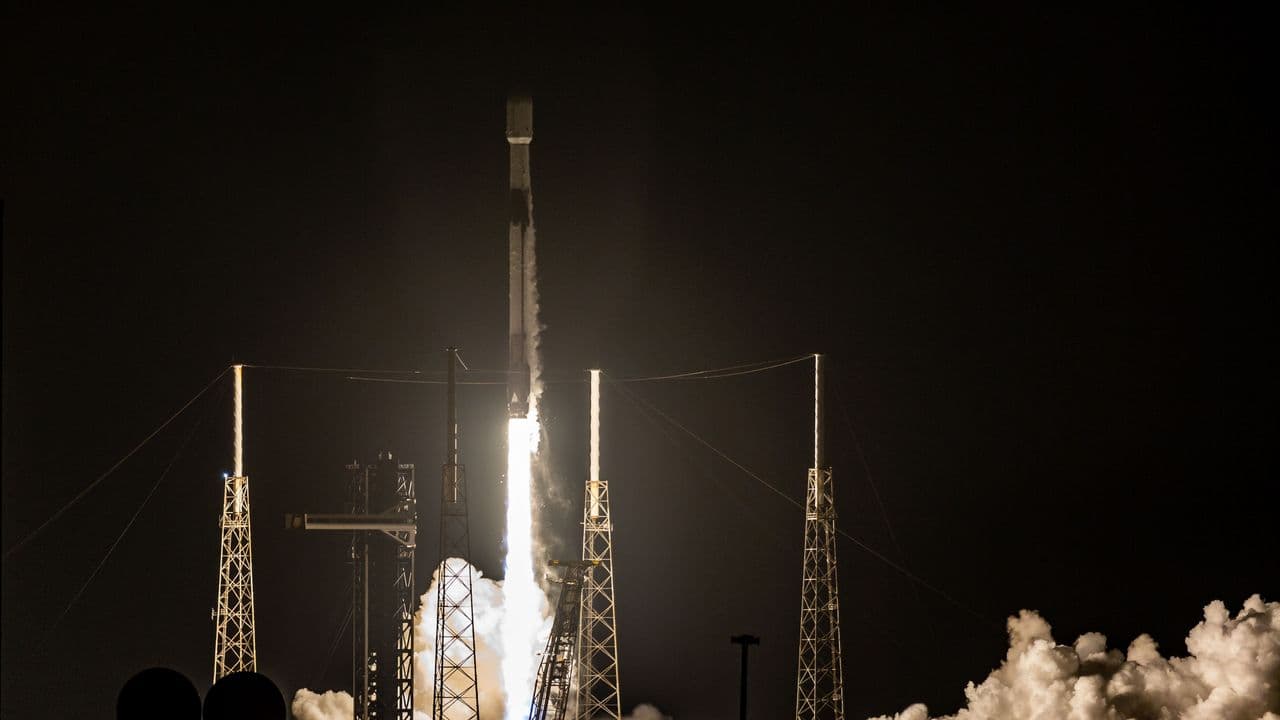
SpaceX may be a clear near-term beneficiary. More launch sites, faster reviews and priority airspace directly address constraints on Starship’s flight cadence and infrastructure expansion. Falcon 9 already dominates U.S. launch volume, recently completing missions from opposite coasts just 38.5 minutes apart. Starship’s 13th test flight in July deployed upgraded Starlink V3 satellites and ended in a controlled splashdown.
CEO Elon Musk said on Thursday that SpaceX could attempt its first tower catch of a returning Ship “in a few months,” while the first Ship reflight is expected in late 2026 or early 2027. The policy also directs NASA to facilitate commercial transportation to the Moon, robotic access to Mars and potential human transportation to Mars, which are all goals closely aligned with Starship.
Rocket Lab Eyes Faster Electron Launches
Rocket Lab could benefit from the administration’s push for a “vibrant, competitive and resilient” U.S. space industrial base. Greater range access and faster approvals could lift Electron’s launch cadence and support development of the reusable Neutron rocket. Its first-stage tank is expected at the launch site in the fourth quarter, although Neutron’s debut will likely slip into early 2027.
Rocket Lab completed its 93rd Electron launch on Thursday, deploying a satellite for Japan’s iQPS, with nine more dedicated missions booked through 2030. The company has also gained government momentum through the Space Force’s $981 million NITE-STAR program, about $12 million in Space Data Network orders, a $266 million launch contract and a $397 million satellite-building deal.
AST SpaceMobile Could Gain From More Launches
AST SpaceMobile does not launch rockets, but its cellular-broadband constellation depends on frequent and affordable access to orbit. BlueBird satellites 8 through 13 are deployed, while production continues through satellite 46. With about 45 or more satellites needed for continuous coverage, greater U.S. launch capacity and more rideshare availability could reduce deployment delays.
AST reported $31.5 million in second-quarter revenue, about $1.3 billion in contracted backlog and more than $3.7 billion in pro forma liquidity. It has nearly 60 carrier partners covering over three billion subscribers and more than $125 million in national-security awards.
LUNR Could Ride The Lunar Boom
Intuitive Machines is closely aligned with the policy’s call for commercial transportation to and from the Moon. Its third lunar mission is targeted for early 2027, with a fourth expected later that year. The company is also developing Altus lunar communications relays to support a sustained cislunar presence.
Beyond lunar exploration, Intuitive Machines recently received authorization to proceed on a multi-satellite communications program expected to exceed $600 million and was selected for NASA/JPL’s EAGLE-VSWIR Earth-science mission. The company reported $206 million in second-quarter revenue and backlog approaching $1.8 billion, supported by its expansion across lunar services, defense, communications and Earth observation.
How Do Retail Traders Feel About SPCX, ASTS, RKLB, LUNR?
On Stocktwits, retail sentiment was ‘bearish’ for ASTS and RKLB and ‘neutral’ for SPCX amid ‘low’ message volume, while LUNR drew ‘bullish’ sentiment amid ‘high’ message volume.
Over the past year, LUNR has surged 107%, RKLB has climbed 79% and ASTS has gained 44%, while SPCX has fallen 17%.
For updates and corrections, email newsroom[at]stocktwits[dot]com.<