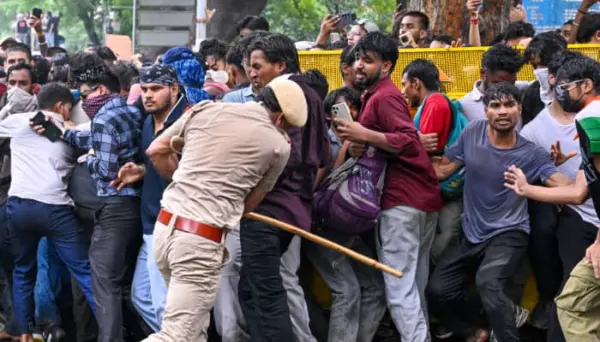
The Supreme Court of India on Thursday constituted a five-member High-Powered Enquiry Committee (HPEC), headed by former Supreme Court judge Justice R. Subhash Reddy, to examine allegations of excessive use of force by police, paramilitary forces and other security personnel against protesters.
The panel also includes former Punjab and Haryana High Court Chief Justice Ravi Shankar Jha, former Delhi High Court judge Justice Shalinder Kaur, former CBI Director Rishi Kumar Shukla and retired Meghalaya Director General of Police Dr L.R. Bishnoi.
The committee will look into allegations of excessive use of pellet guns, electric batons, lathi charges and tear gas, along with alleged violence against women protesters. It will also examine claims of police surveillance, whether crowd-control measures were proportionate, and whether victims were provided adequate medical assistance and compensation.
At the same time, the panel will consider allegations raised by the authorities regarding violence against police personnel and damage to public property during the protests.
Earlier this month on August 1, a bench headed by Chief Justice of India Surya Kant, along with Justices Joymalya Bagchi and V Mohana, said the proposed committee would also comprise a former High Court judge and a retired Director General of Police.
The Chief Justice said the consent of a former CBI Director and a former DGP, neither of whom is from any of the States involved in the matter, had been obtained.
The court was hearing a batch of petitions alleging excessive police action against students who participated in protests at Jantar Mantar and other locations across the country over alleged NEET examination paper leaks and broader concerns relating to the examination system.
This comes after weeks of student protests led by the Cockroach Janata Party (CJP) at Jantar Mantar, which included a hunger strike followed by a march towards Parliament, on July 20.
Thousands of students took part in a Parliament march organised by the CJP. The protesters demanded, among other things, the resignation of Union Education Minister Dharmendra Pradhan over alleged examination paper leaks, along with broader reforms in the examination system.
As the protesters attempted to march towards Parliament and cross police barricades in central Delhi, security personnel used tear gas and resorted to lathi-charge to disperse the crowd.
Several videos later circulated on social media, purportedly showing protesters being manhandled by police personnel. The footage led to allegations that excessive force had been used against the demonstrators.
The Delhi Police, however, defended its actions, saying force was used only after sections of the protesting crowd allegedly turned violent and resorted to stone-pelting.
The Supreme Court’s proposed high-powered committee is expected to independently examine the allegations and the circumstances surrounding the protests.