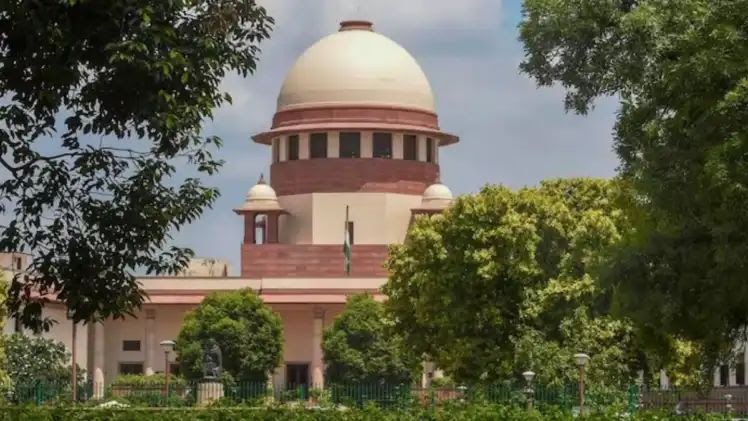
The Supreme Court has given a very sensitive and important verdict against child sexual exploitation and human trafficking.
The court has made it clear that if a minor is trafficked for commercial sexual exploitation, the culprits will be prosecuted under the stringent ‘POCSO Act’.
Justice J.B. Pardiwala and Justice R. Mahadevan’s bench, while giving this important decision on the petition of NGO ‘Prajwala’, said that every case of child sexual abuse will be considered as non-consensual by law.
The argument of consent is completely rejected.
The court clearly stated that in cases of human trafficking, the ‘consent’ of the child victim has no meaning, whether the perpetrator has used tactics like intimidation, threat or coaxing or not.
The court’s full attention should be on the actions and intentions of the criminals. Even if the victim knows that she is being forced into prostitution, she will still be a victim because she may be deceived about the working conditions.
The court said that Article 23 of the Constitution completely prohibits human trafficking and this right applies against the government as well as private individuals.
Rehabilitation is real empowerment
The Supreme Court directed the investigating officers not to look at such sensitive cases from the prism of any one law, but to use the POCSO Act in its entirety along with the Indian Justice Code and the Immoral Traffic (Prevention) Act.
With the implementation of POCSO, the process of recording statements and medical examination of victimized children becomes more sensitive and safe.
The court laid emphasis on making the victims self-reliant and rehabilitating them instead of treating them as just ‘deserving of rescue’, because without rehabilitation they are forced to fall into the same quagmire again.