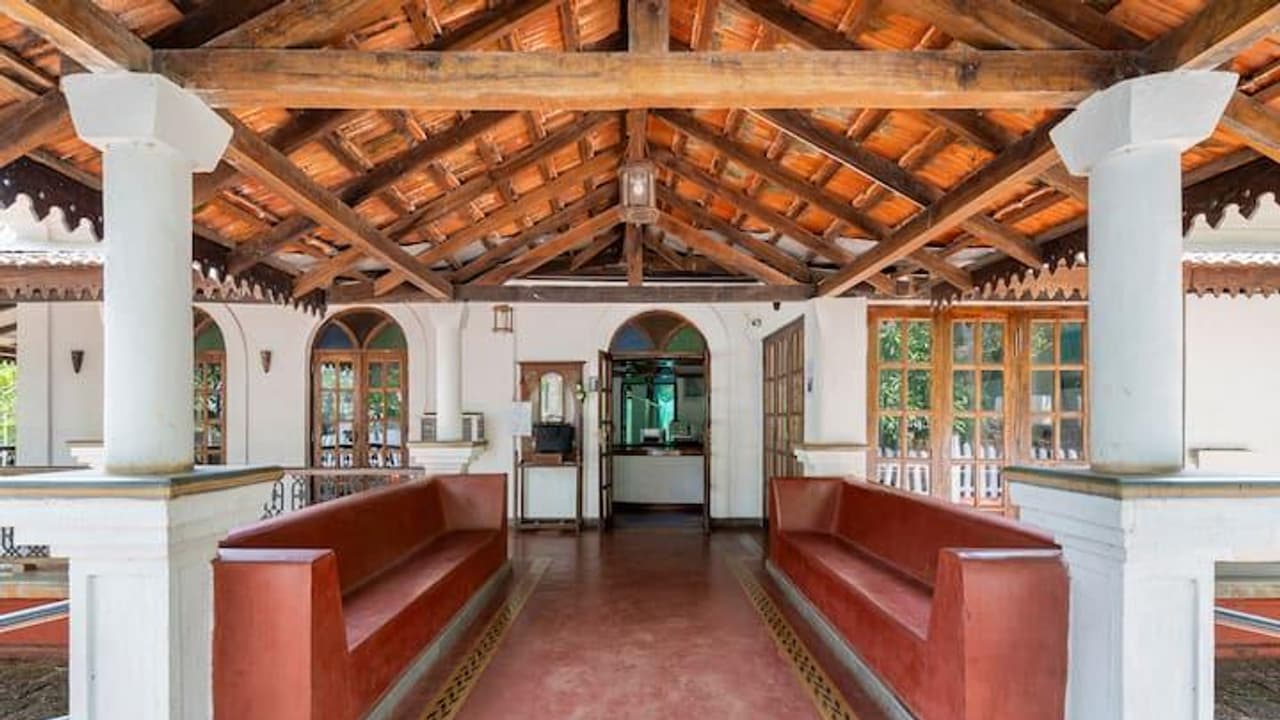
Ever wondered why traditional Goan homes have a raised porch between the front door and street? Discover the story of the balcão and how this unique space connected private homes with everyday community life.
Take a careful look at the entrance of an old Goan house, and you will find one unique thing about its construction. There is an architectural gap, an elevated and covered area with steps, columns, and benches.
It is known as the balcão, which serves not only to enhance the beauty of a traditional Goan house but also to provide the transition from private space of the home and external world. This, perhaps, is what makes the balcão special.
Not Simply an Entrance of a Traditional Goan Home
In many cases, the balcão is located right before the entrance door of the traditional Goan house. The balcão usually includes a staircase and sopos, which are benches constructed of masonry, and therefore, the entrance transforms into a sitting place for people. In architectural terms, the balcão is recognized as a unique architectural element of Goan residential architecture.
Such arrangement made the process of entering the house quite different from the traditional way. One was able to take a rest, have a chat, observe the environment before entering the personal space.
Where The Street Meets The Home
Balcão had almost the same meaning of an architectural handshake. It allowed a person to sit down outdoors but remain within the territory of the house. It made it possible to have a conversation without being invited into the depths of the house.
According to researches on traditional Indian architecture, the Goan balcão is described as a transition space between indoors and outdoors. Such design of it got more complicated over time with development of staircases, columns, railings and seating benches. It makes the construction element not only aesthetic but social as well.
Importance of the Seating
The seating benches are one of the recognizable features of the balcão. They made the front of the house accessible for use. Rather than just an empty pass through the door it became a place for resting, talking or observing the happenings around. It acts like a social media in the past, where people come together, discuss, chat and exchange information. Before internet, balcão was the social media.
Architecture that Uncovered the Transformation in Society
But there is a much more fascinating tale that unfolds once one takes a historical perspective on the balcão.
Initially, the Goan domestic architecture had inward-looking structures that were built around the courtyard structure. Gradually, especially under the influence of the Catholic architecture and architecture inspired by the Portuguese, the facade of the house acquired a more outward look.
In this respect, the balcão played an important role in this process. This architectural element could therefore not be merely considered to be purely decorative. It helped transform the relations between the house and the surrounding environment.
Why is the Balcão Unique?
Nowadays, modern architecture provides many ways to keep privacy through gates, walls, and locked doors. However, the traditional balcão offers a different approach to it.
One could build a boundary while remaining connected to the rest of the neighborhood. This is perhaps the main reason why this unique architectural feature continues to impress visitors of Goa.
The balcão was not placed at the entrance of the house. Instead, it was built as a mediator between two spaces—the private family domain and the outside world.