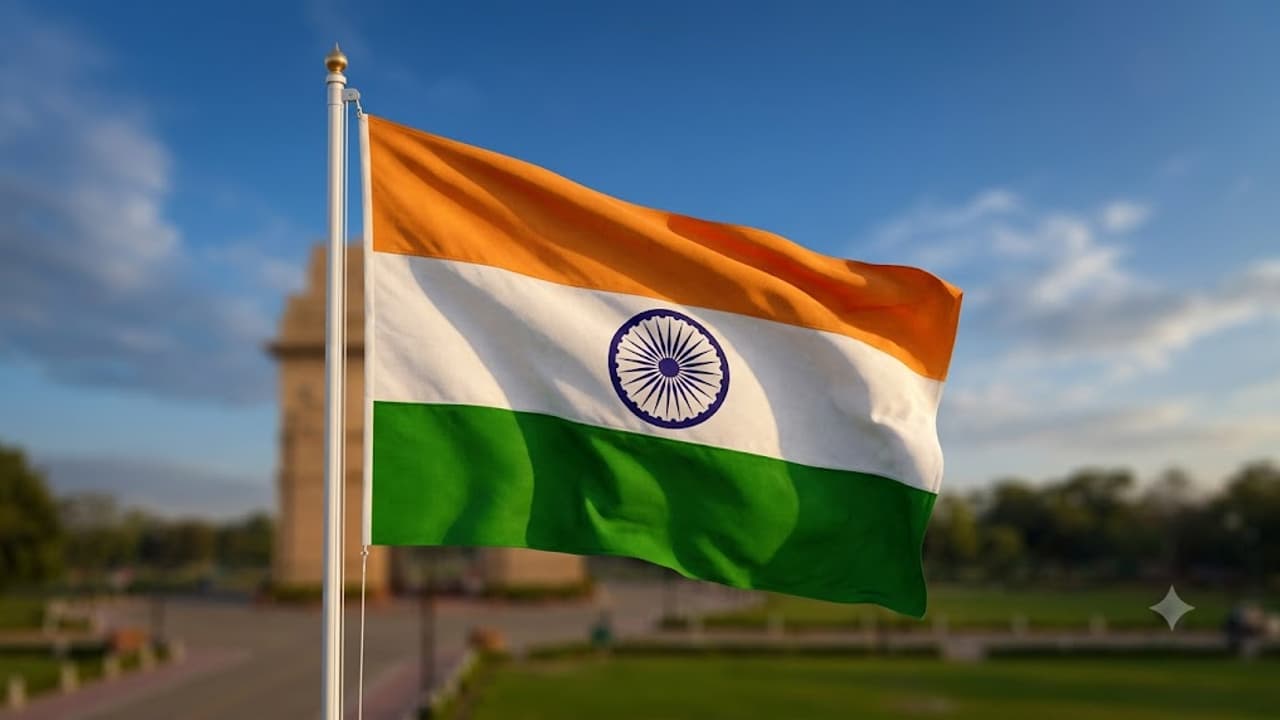
India’s national flag, the Tiranga, symbolizes freedom and unity. Its three horizontal bands—saffron, white, and green—represent courage, peace, and growth, respectively. At its center is the navy-blue Ashoka Chakra, a 24-spoke wheel symbolizing law and progress.
Independence Day 2026: The Story, Meaning and History of India’s Tiranga
As India celebrates its 80th Independence Day on August 15, the Tiranga will once again fly high across the country as a powerful symbol of freedom, unity and national pride. More than a national emblem, the Indian flag represents the sacrifices of the freedom struggle and the values that continue to define the country.
The present-day Indian national flag, with its saffron, white and green bands and the navy-blue Ashoka Chakra at the centre, has a long and fascinating history. Its evolution involved several designs before the Constituent Assembly adopted the final version just weeks before India gained independence in 1947.
What Do the Three Colours of the Indian Flag Mean?
India’s national flag is popularly known as the Tiranga, or tricolour, because of its three horizontal bands.
The saffron band at the top represents courage and sacrifice. The white band in the middle stands for peace and truth, while the green band symbolises fertility, growth and auspiciousness.
Together, these colours convey the ideals and aspirations of the nation. The Tiranga is therefore not merely a visual identity but also a reminder of the principles India seeks to uphold.
Also Read: Har Ghar Tiranga Rally: Delhi Police Takes 25 Patrol Vehicles From Vijay Chowk To India Gate
Why Does the Indian Flag Have the Ashoka Chakra?
At the centre of the white band is the navy-blue Ashoka Chakra, featuring 24 spokes. Also known as the Dharma Chakra, it represents the wheel of law and conveys the idea of continuous movement and progress.
The symbolism behind the Chakra stresses that life must keep moving forward, while stagnation represents decline. Its design was inspired by the stone wheel associated with the Lion Capital of Ashoka at Sarnath, dating back to the 3rd century BCE.
The Early Attempts to Create a National Flag
The idea of an Indian national flag existed long before independence. One of the earliest known designs is linked to Sister Nivedita, the Irish disciple of Swami Vivekananda. In 1904, she designed a red-and-yellow banner featuring a vajra, or thunderbolt, as a symbol of strength, along with the words Bonde Matoram, the Bengali form of Vande Mataram.
The banner was later displayed at a Congress exhibition in 1906, marking an important early chapter in the evolution of India’s national symbols.
Pingali Venkayya and the Swaraj Flag
The man most closely associated with the design of India’s national flag is Pingali Venkayya. In 1921, Mahatma Gandhi asked him to create a flag that could represent the spirit of India.
His design featured two colours and a charkha, or spinning wheel, at the centre. The charkha represented self-reliance and became strongly associated with India’s freedom movement. This design came to be known as the Swaraj flag and served as an important precursor to the modern Tiranga.
How the 1931 Tricolour Paved the Way
In 1931, the Congress adopted a saffron-white-green tricolour with the charkha at its centre. The design was presented as a national symbol without any communal meaning and became the immediate predecessor of India’s present national flag.
When Was the Present Indian Flag Adopted?
On July 22, 1947, the Constituent Assembly adopted India’s national flag in its current form. The saffron, white and green colours were retained, but the charkha was replaced with the navy-blue Dharma Chakra inspired by Ashoka’s emblem at Sarnath.
As India marks Independence Day 2026, the Tiranga continues to represent not only the country’s hard-won freedom but also courage, truth, peace, progress and the unity of its people.
Also Read: Independence Day 2026: Bengaluru Traffic Curbs, Parking Bans and Metro Changes on August 15