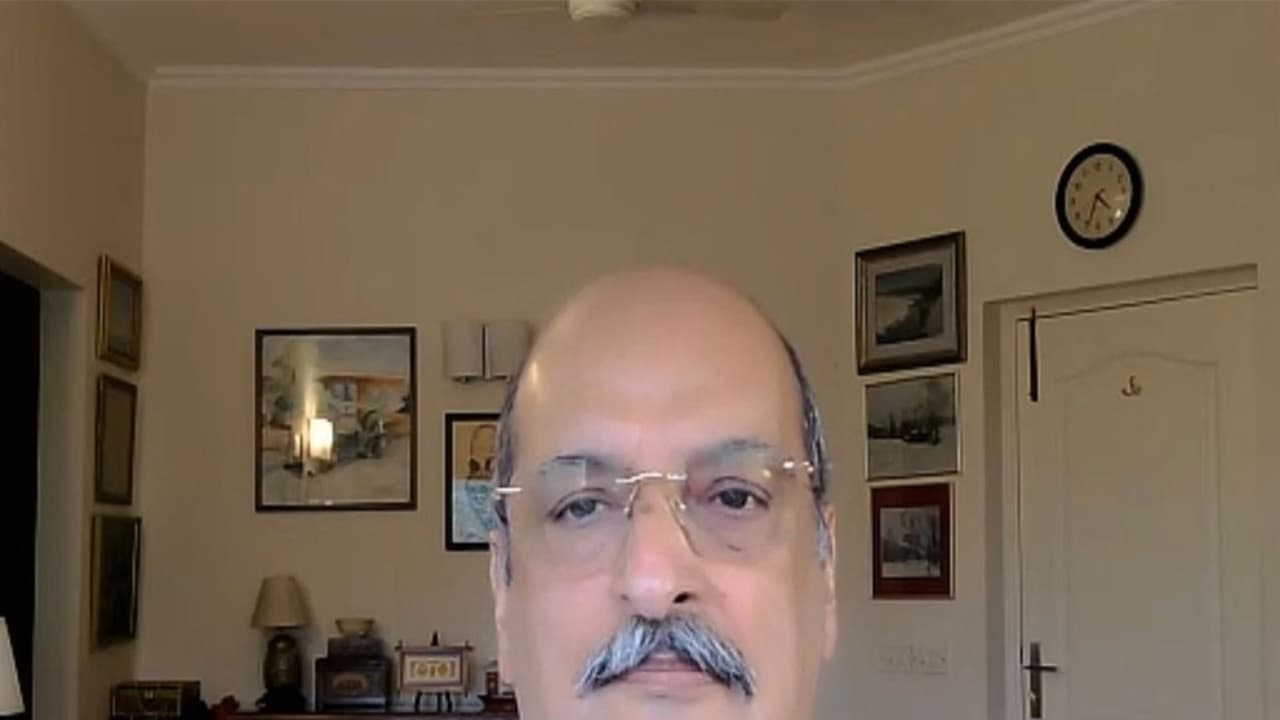
Following Putin’s remarks, former Ambassador Ajai Malhotra said India is eyeing the Arctic’s Northern Sea Route as a shorter, cheaper maritime trade corridor to Europe, urging immediate capacity building to secure early mover advantages.
India Views Arctic as Strategic Trade Corridor
Highlighting Russian President Vladimir Putin’s recent statements on India’s interest in the Northern Sea Route (NSR), former Indian Ambassador to Russia Ajai Malhotra has said that New Delhi is examining the Arctic region not merely as a domain for scientific research, but as an emerging maritime trade corridor and strategic opportunity in the global commons.
In an interview with ANI, Malhotra stated that as the Arctic ice retreats, the Northern Sea Route has opened up as a shorter, cheaper, and increasingly viable maritime connection linking India to Northern Europe along the Russian coastline. “President Putin’s statement acknowledges that India is looking at the Arctic not only as a domain of scientific research, but also as an emerging area for trade, for connectivity, and a strategic opportunity also because there are economic resources in the global commons out there,” he said. “As the Arctic ice retreats, this Northern Sea Route has opened up and it is a viable one. It’s increasingly becoming more and more viable. It’s shorter, it’s cheaper in terms of a maritime link from India along the Russian coast to Northern Europe. So, we should take it seriously with a long-term perspective. And I think the right approach is to develop the capabilities now so that India has the option to, as it were, to use the Northern Sea Route at scale when the conditions completely permit doing so,” he stated.
Building Capacity and Seizing Early Mover Advantage
Pointing to concrete measures for capacity building, he outlined plans for training Indian seafarers and constructing specialised vessels. “I have mentioned earlier also that we have agreed on training our Indian seafarers in polar navigation, but I have also suggested that we should build five Arctic-capable ice class vessels for our seafarers to use. And we can do so by the year 2030 or 31. We have the funding available for it. And we should then agree also with Russia on a framework for Arctic cooperation along the North Sea Route. The point here is that India cannot wait until the route is fully mature before investing in it. By then, any early mover advantages would already have been lost,” he noted.
Trade, Energy, and Geopolitics: The Key Drivers
Discussing the driving factors behind New Delhi’s growing interest, Ambassador Malhotra noted that trade, energy, and geopolitics are all interconnected drivers. “I would say it is trade, it is energy, and the strategic dimension, too, all three. You know, the immediate attraction is the maritime connection, India, Russia, and Europe. And as I said, it has implications for shipping time, for costs, logistics costs. And then there’s the energy dimension, because Russia has been developing for long LNG projects and infrastructure along its Arctic coast,” he explained.
He noted that the Arctic is undergoing a profound geopolitical transformation as global powers compete over resources and shipping routes. “But India’s interest should not be reduced only to access to Russian resources. You know, the Arctic itself is undergoing a very profound transformation. It is becoming a zone of competition over energy, critical minerals, shipping routes, and also military positioning by many, by the Americans, by the NATO, by the Russians. So, this is also of interest to us. So, for India, engagement with the Northern Sea Route is, I would say, part of a larger effort to secure also our position in all of this. It fits broadly with our policy of multi-alignment to have meaningful Arctic partnerships with Russia, with the US, with the Nordic countries, and with Canada. In fact, with all the European countries and Canada also,” he remarked.
Russia’s Perspective: Open for Partnership on NSR
Responding to concerns raised over escalating geopolitical tensions, Ambassador Malhotra acknowledged that Russian President has also warned of what he describes as “artificial tensions” in the Arctic amid expanding external military and strategic presence in the region.
Putin earlier stated that India stands among the partner nations exploring strategic cooperation on the Northern Sea Route, as Moscow works to establish the Arctic maritime corridor as a vital trade bridge connecting to Asia amid shifting regional dynamics. Addressing Pacific Fleet personnel aboard the missile cruiser Varyag, Putin affirmed that Russia stays open to international partnership regarding the NSR, while emphasising that all collaborative efforts must adhere strictly to international maritime regulations. “Russia has consistently voiced, and continues to reaffirm, its readiness to cooperate and leverage the advantages of the Northern Sea Route, strictly within the bounds of existing international maritime law…we see growing interest from countries wishing to engage with us on this front. These partners include, above all, our friends China, India, and other nations who are actively discussing these matters with us.”
The Russian President’s observations coincide with Moscow’s accelerated push to turn the Arctic corridor into a major commercial passage linking Europe with Asia. Running along Russia’s northern Arctic coastline, the NSR connects the Atlantic and Pacific Oceans through waters situated north of Siberia, offering a significantly faster transit alternative compared to the traditional Suez Canal route. To support this vision, Russia has directed substantial investments into the NSR framework, constructing advanced port infrastructure, navigation networks, and a dedicated fleet of nuclear-powered icebreakers aimed at establishing a dependable, year-round commercial transit route.
Aligning Economic Goals and Regional Connectivity
For New Delhi, engagement in the NSR directly aligns with its broader economic and energy security goals. Both nations view Arctic navigation as a major future trade artery, having agreed to develop maritime routes along the NSR and establish a joint coordination mechanism to oversee progress. This initiative complements India’s participation in other key regional connectivity projects, including the International North-South Transport Corridor (INSTC) and the Chennai-Vladivostok Eastern Maritime Corridor, providing additional avenues for seamless trade integration.
Prime Minister Narendra Modi has previously stated that India and Russia will pursue these connectivity initiatives with “renewed energy”, while highlighting joint programmes to train Indian mariners in specialised Arctic navigation. As a prominent importer of energy, India stands to gain enhanced access to Russian reserves and essential raw materials through these shortened, direct sea routes. From Moscow’s perspective, India represents an essential strategic partner, aiding in the development of Arctic infrastructure while opening broader commercial avenues across Asia.
While pointing to prospects for multilateral cooperation, Putin reiterated Russia’s caution regarding “artificial tensions” in the Arctic, reaffirming that Moscow remains prepared to collaborate with global partners on the NSR within the parameters of international maritime law. As receding sea ice enhances the operational viability of the corridor, steady increases in commercial traffic demonstrate that the Northern Sea Route is evolving into an active global trade artery, with Russia actively encouraging a larger, constructive role for India in its continued development. (ANI)
(Except for the headline, this story has not been edited by Asianet Newsable English staff and is published from a syndicated feed.)