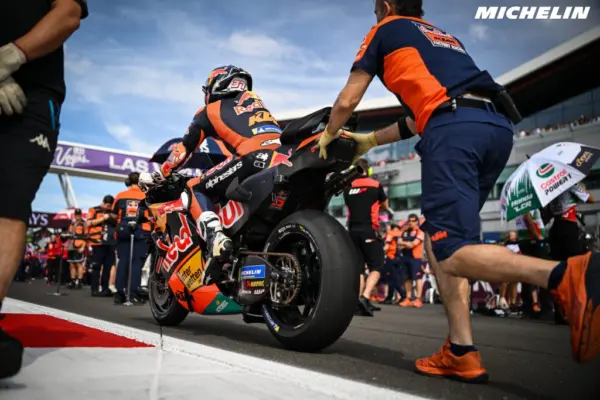
MotoGP Will Retain Two Bikes Per Rider Through 2027 After KTM Blocks Single-Machine Rule
The controversial proposal to mandate a single motorcycle per rider during MotoGP race weekends has been decisively rejected, as KTM emerged as the pivotal force opposing the change.
The decision, finalized during the Silverstone Grand Prix weekend, confirms that the sport will maintain the current format allowing two bikes per rider through the upcoming 2027 technical regulations.
Carmelo Ezpeleta, CEO of Dorna Sports, held individual discussions with representatives of the five manufacturers competing in MotoGP-Ducati, Aprilia, KTM, Honda, and Yamaha-cementing the consensus to preserve the dual-bike setup. Ezpeleta had long advocated for this approach, citing its critical role not only in sporting fairness but also in the practical management of practice, qualifying, and race sessions.
Transitioning to a single motorcycle would dramatically alter race weekend dynamics. A crash during practice could force a rider to sit out while repairs are made, while an accident in qualifying might eliminate any chance to set a competitive lap time. More alarmingly, damage sustained in warm-up could prevent participation in the race itself. The existing flag-to-flag race format-allowing riders to switch bikes swiftly in changing weather conditions-would also be severely compromised. Preparing and adjusting one bike on the fly with different tyres and setups is vastly more complicated than swapping to a second machine already configured for the conditions.
The single-bike proposition originated months ago from Aprilia, gaining Ducati’s backing, particularly with Gigi Dall’Igna’s support. The initial rationale centered on cost reduction, but this argument weakened over time as stakeholders, including Dorna and independent teams, highlighted alternative cost-control methods that would not jeopardize sporting spectacle or technical innovation.
An additional technical layer fueled opposition: the incoming 2027 regulations introduce 850cc engines, reduced aerodynamics, and restricted electronic aids, initiating a new era in MotoGP machinery. Early tests with Aprilia and Ducati prototypes revealed a performance edge over KTM, Honda, and Yamaha. Limiting each rider to one bike could hinder development efforts for manufacturers trailing in performance, as having two prototypes enables critical comparative testing and rapid adjustments during race weekends.
KTM’s stance proved decisive. Initially open to the single-bike concept within the MSMA (Motorcycle Sport Manufacturers Association), KTM reversed course between the Balaton Park and Assen rounds, becoming a staunch defender of the two-bike rule. This shift fractured the previously unified front among manufacturers, as Aprilia and Ducati remained proponents while KTM and Honda, the latter swayed by Alberto Puig’s influence within HRC, championed the status quo. Yamaha adopted a more neutral position but did not oppose the final decision.
Ezpeleta clarified the meaning of unanimity within the MSMA: only a unanimous five out of five approval counts, dismissing arguments that a four-to-one vote could suffice. With KTM and Honda immovable in defense of two machines per rider, the single-bike initiative collapsed.
The MotoGP grid’s 2027 season will thus begin with two motorcycles per rider, preserving a key element amid a profound technical revolution. This choice safeguards weekend operations, flag-to-flag race procedures, and, crucially, manufacturers’ ability to accelerate prototype development during what promises to be one of the sport’s most significant regulatory transitions.