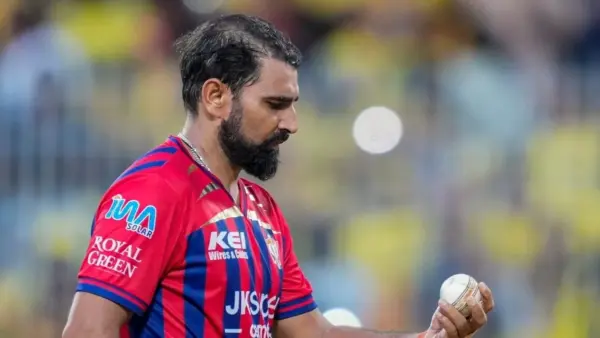
Mohammed Shami has made no secret of his desire to play in the 2027 ODI World Cup, but the veteran fast bowler’s ambitions appear to be running into a difficult reality: India may not currently have him in their plans.
Shami, who turns 36 in September, has not played for India since the 2025 Champions Trophy. Despite putting together an impressive domestic season and continuing to work on his fitness, he has repeatedly been overlooked by the national selectors.
With the 2027 World Cup set to be played in South Africa, Zimbabwe and Namibia, the question is becoming increasingly difficult to avoid: does Shami deserve another chance?
Mohammed Shami still has the 2027 World Cup in sight
Shami’s international career appeared to be entering its final phase after his prolonged absence from the Indian team.
But the fast bowler has continued to work towards a comeback, with the 2027 ODI World Cup seemingly his biggest remaining target.
His childhood coach Mohammed Badruddin recently revealed that Shami remains highly motivated and believes he still has plenty to offer Indian cricket.
“Shami’s mood is positive. He is quite motivated for the next season,” Badruddin told India Today.
“He still has cricket left. He is ready, and if the country needs him, he will be ready to serve.”
The message from Shami himself has also remained consistent: he wants to keep playing and believes he can still contribute at the highest level.
Mohammed Shami domestic numbers make the case
If selection is purely based on recent performances, Shami has given the selectors plenty to consider.
The veteran pacer took 37 wickets in just seven Ranji Trophy matches last season, underlining his ability to remain a consistent wicket-taking threat in the longer format.
He followed that up with 15 wickets in seven Vijay Hazare Trophy matches.
That is 52 wickets across 14 domestic matches in two major competitions.
Those numbers are particularly significant because Shami has not simply been turning up and trying to maintain his fitness. He has continued to produce match-winning performances.
His domestic form also came after an impressive return from the injury issues that had disrupted the latter stages of his international career.
India have struggled to settle their pace attack
The argument for Shami’s return becomes stronger when India’s recent fast-bowling problems are considered.
The national team has struggled to maintain a settled pace combination, with injuries and inconsistent performances forcing regular changes.
Harshit Rana has endured another injury setback, while Gurnoor Brar struggled during India’s ODI series in England.
Brar conceded 61, 67 and 97 runs in India’s three ODIs in England, while India’s pace combination changed significantly across recent assignments.
Jasprit Bumrah remains India’s premier fast bowler, but his workload continues to be carefully managed.
Hardik Pandya’s availability has also been an issue, leaving India searching for reliable options around Bumrah.
That makes the experience of a bowler like Shami increasingly valuable.
Mohammed Shami South Africa record is hard to ignore
The location of the 2027 World Cup could be another major argument in Shami’s favour.
South Africa, Zimbabwe and Namibia are set to host the tournament, meaning conditions could place a premium on experienced fast bowling.
Shami has an excellent record in South Africa, having taken 44 wickets in 11 international matches in the country at an average of 22.68.
His ability to extract movement from a new ball, attack the stumps and generate reverse swing later in an innings makes him particularly suited to conditions where fast bowling could play a decisive role.
His record in major ICC tournaments also strengthens the case.
Shami was India’s leading wicket-taker at the 2023 ODI World Cup, finishing with 24 wickets in just seven matches at an extraordinary average of 9.13.
He also produced a memorable campaign despite initially being left out of India’s playing XI, eventually becoming one of the most dangerous bowlers in the tournament.
Zaheer Khan believes India should take him
Former India fast bowler Zaheer Khan has also backed Shami’s potential return.
Zaheer argued that if Shami continues performing and is fit and available, India should consider taking advantage of his experience for the 2027 World Cup.
“When someone performs this well, he should definitely be in Team India’s scheme of things. He should play the World Cup and be part of the team,” Zaheer said.
He also acknowledged that the final decision rests with the captain, head coach and selectors.
“But in my opinion, if Mohammed Shami is fit and available, India should take an experienced bowler like him to South Africa,” Zaheer added.
That is perhaps the strongest argument for Shami’s inclusion: India do not necessarily need to make him the centrepiece of their attack. They could use him as an experienced tournament option alongside their younger fast bowlers.
But the selectors have not been convinced
The biggest obstacle remains the thinking of the Indian team management.
Chief selector Ajit Agarkar had earlier indicated that Shami’s immediate readiness was more suited to T20 cricket, despite his strong domestic numbers.
“I know he has played a domestic season this year. But from the information that I have got, is that at this point it’s T20 cricket that he’s sort of ready for,” Agarkar had said.
That assessment helps explain why Shami has continued to remain outside India’s plans despite producing wickets.
There is also the larger question of India’s transition towards a younger pace attack.
Shami will be 37 by the time the 2027 World Cup begins. India have already invested heavily in younger bowlers such as Gurnoor, Harshit and Prasidh Krishna, alongside Arshdeep Singh and others.
The selectors therefore have to decide whether the World Cup should be used to continue that transition or whether conditions and the importance of the tournament justify bringing back an experienced campaigner.
Duleep Trophy adds another layer to the debate
The current domestic selection system has also complicated the picture.
Shami has been selected for the Duleep Trophy, but The Indian Express has reported that the tournament has increasingly become disconnected from the national selection pathway because zonal selectors and national selectors operate with different priorities.
Former selector Saba Karim said that Shami could still force his way back into the Indian side with a strong performance or season, even if the door appears to have been closed for now.
“Although the selectors have shut the door on him now, Shami could still get back into the team based on one great performance or season,” Karim said.
That leaves Shami with a relatively straightforward task: keep producing.
Does Shami deserve a World Cup call-up?
There is a difference between saying Shami deserves to walk straight back into India’s playing XI and saying he deserves another opportunity to prove himself.
On the latter, the case is compelling.
He has 52 wickets across seven Ranji Trophy matches and seven Vijay Hazare Trophy games, an outstanding World Cup record, 44 international wickets in South Africa and the experience of bowling in pressure situations that few members of India’s current pace group possess.
His age is the obvious concern. So is the fact that he has not played international cricket since 2025.
But with India still struggling to settle their pace attack, completely ruling out a bowler of Shami’s quality this far ahead of the World Cup could prove premature.
The ideal route may be to bring him back into the ODI setup and assess him rather than decide his World Cup fate from a distance.
If he proves his fitness, maintains his domestic form and shows that he can handle the workload of international 50-over cricket, India would have a difficult case to make for ignoring him.
For now, reports suggesting that Shami is not part of India’s plans for the 2027 World Cup remain unconfirmed. What is certain is that Shami wants one more shot at the biggest stage.
And based on what he has done with the ball since returning to domestic cricket, he has given the selectors enough evidence to at least keep the door open.